

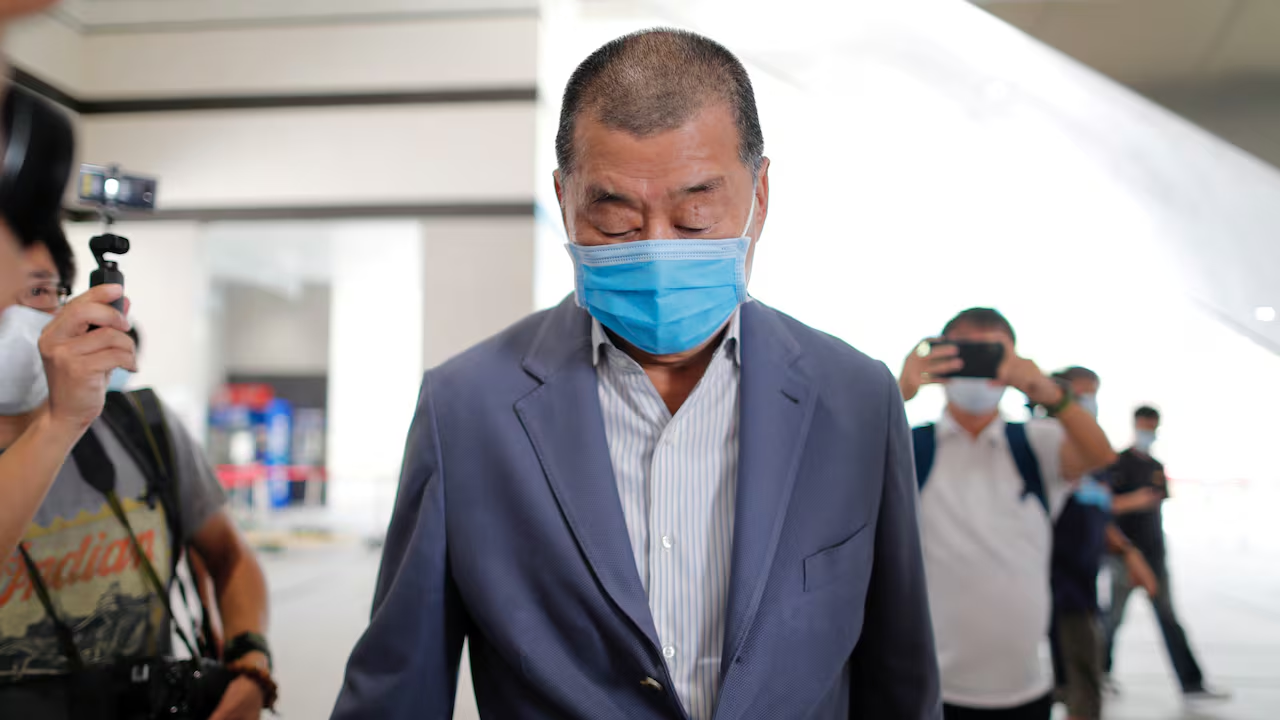
Jimmy Lai, the founder of Apple Daily, was sentenced to 20 years in prison in Hong Kong on December 15, 2025, after being found guilty of three national security crimes. A three-judge panel convicted him of two counts of conspiring with foreign forces to endanger national security under Article 29 of the Hong Kong SAR National Security Law and one count of conspiring to publish seditious materials under Section 159 of the British-era Crimes Ordinance.
The charges were extremely serious, and the court made it clear that the punishment must match the crime. Under the law, the minimum sentence for serious collusion is 10 years, and because foreign involvement worsened the case, Lai received the full 20 years. His eight co-accused, who admitted guilt, got up to 10 years, and his three companies were fined. The judges called Lai “the mastermind and the driving force behind these conspiracies” and emphasized that his lack of remorse justified the longer sentence.
Although 20 years is long, it is not unusual for serious crimes. Offenses like drug trafficking, bank robbery, or bomb-making can carry similar or longer sentences. The main principle is that punishment should fit the crime.
The court applied traditional sentencing principles from the English Court of Appeal (R vs Sargeant, 1974), also used in Hong Kong. The first principle, retribution, ensures society expresses strong disapproval of serious crimes. The second principle, deterrence, aims to prevent both the offender and others from committing similar crimes. Lai’s sentence reflects these principles clearly.
The third principle, prevention, was also crucial. Despite his age, keeping Lai in prison protects society because some people might still try to exploit him against China. The Hong Kong Court of Appeal stated in 1987 in The Queen vs Wong Pak-lam, “the offender cannot offend again.” In 1988, the court added in The Queen vs Ng Wah-kan that serious offenders deserve strict punishment to protect the public and deter others.
Lai was represented by a strong legal team, including Senior Counsel Robert Pang Yiu-hung and King’s Counsel Marc Corlett, who tried to reduce his sentence. However, the seriousness of his crimes, his lack of remorse, and the 10-year minimum made it nearly impossible.
The judges Esther Toh Lye-ping, Susanna Maria D’Almada Remedios, and Alex Lee Wan-tang, emphasized that Lai was punished for actions, not beliefs or journalism. Evidence showed he tried to subvert China’s political system and undermine the “one country, two systems” policy. He promoted US interests at the expense of his own country and wanted China to become “a lackey of the West.”
Through Apple Daily and “Stand with Hong Kong, Fight for Freedom”, Lai lobbied the US, UK, and Japan to impose sanctions, blockades, and other harmful measures against China and Hong Kong. The court described these actions as despicable and beyond acceptable limits.
Lai also wrote 161 op-eds attempting to incite hatred against authorities in mainland China and Hong Kong. While foreign critics claimed this was freedom of speech, the court ruled it was not legitimate journalism but a deliberate effort to destabilize the government.
Hong Kong guarantees press freedom under Article 27 of the Basic Law, but it is not absolute, and there are limits. Lai ignored these rules, which could have caused serious problems for other media. Chief Executive John Lee Ka-Chiu said on December 15, “The law never allows anyone, regardless of profession or background, to harm their country and compatriots under the guise of human rights, democracy, and freedom.”
Despite Lai’s actions, Hong Kong still has a vibrant media scene. His age, health, and request for segregation in prison reduced his sentence slightly, but the judges noted that grave crimes leave little room for mercy. Age alone cannot fully reduce a sentence for serious offenses. For example, a 78-year-old drug trafficker in 2000 received almost no reduction (HKSAR vs Wong Wan).
Because Lai’s crimes could have threatened China’s survival, the judges treated them as extremely serious. His wealth, power, and influence could not protect him. Even under foreign pressure, the judges upheld the law, acted fairly, and remained impartial.
Although Lai had talent, he wasted it and disappointed many. Anti-China forces may regret his sentence, but justice was served. The trial followed common-law procedures, and Lai’s conviction reflects his responsibility. In the end, the rule of law is the real winner.