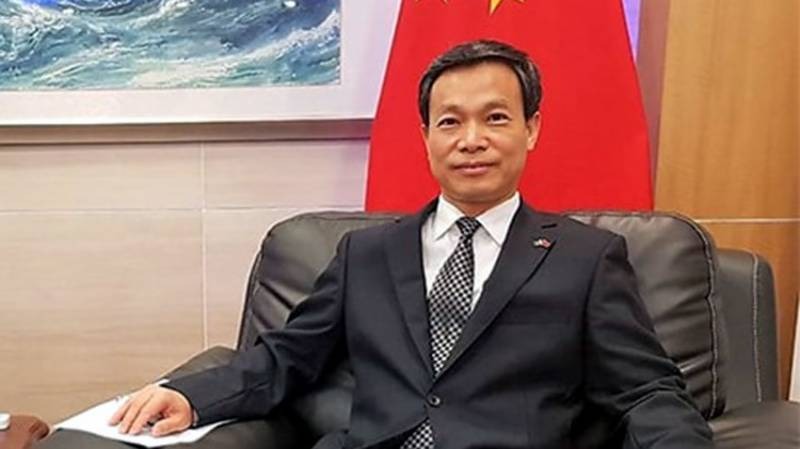


Pakistan’s Ambassador to China, Khalil Hashmi, posted on X this week that he has completed his posting in Beijing. He thanked colleagues and friends who came to his farewell reception at Pakistan House on September 9, calling it one of the most productive stretches of his diplomatic career.
Two things stood out in his message. One, a business-to-business investment push he started in June 2024. Two, four new Pakistan Study Centres set up at Chinese universities during his time there. Hashmi said these had “turned into partnerships that now have a life of their own,” and credited teams on both sides for keeping them running after he leaves.
He also linked the B2B work to vocational training, saying the goal was to create opportunities for both Chinese and Pakistani companies, and for young Pakistanis looking to enter these sectors.
The B2B Numbers, With Context
The initiative Hashmi highlighted has produced real figures, but they need some unpacking before they mean much.
Six sector-specific B2B conferences have generated roughly $22 billion in proposed investments, joint ventures and commercial commitments, Hashmi told Business Recorder last month. The first five conferences brought in over 550 commitments worth more than $20 billion. A sixth conference, focused on pharmaceuticals and healthcare, added another $1.72 billion to that total.
These are Hashmi’s own numbers, based on his account of the embassy’s work, not an independently audited total. And by his own estimate, only about 30 percent of the commitments from earlier conferences have actually turned into real agreements, joint ventures, supply deals or physical investment on the ground. The rest are still just MoUs, statements of intent rather than money that’s actually moved.
Hashmi was upfront about that gap when asked. “The signing creates momentum, but the real test is whether it becomes a contract, a factory, production and jobs,” he told Business Recorder.
The initiative covers 21 priority sectors, with conferences already held in Shenzhen and Beijing, plus additional roadshows across other Chinese provinces.
The Study Centres
The second achievement Hashmi cited, four new Pakistan Study Centres, points to a slower, longer-term kind of investment than the B2B conferences.
One example is the centre inaugurated at Shandong University in December 2025. It focuses on research and exchange in agriculture and fisheries, areas in which the province has considerable expertise. According to Pakistan’s embassy in Beijing, the centre is meant to support joint research projects, business-to-business contacts and student exchanges between the two countries.
This builds on a model Pakistan has used before. Its first Study Centre in China opened at Fudan University back in 2009, and it has since become something of a reference point for research on Sino-Pakistan relations and on CPEC specifically.
Where This Fits Into CPEC 2.0
Hashmi’s own description of his work lines up closely with how officials on both sides have been talking about the next phase of China-Pakistan economic ties.
Earlier this year, he argued publicly that CPEC needed to move “beyond roads and energy projects towards industrialization, technology transfer, innovation, agriculture modernisation and business-to-business connectivity.” He said the next phase should be centred on markets, technology, digital economies, SMEs, startups and human capital development, particularly for young Pakistanis looking to become entrepreneurs.
That’s essentially what he spent his tenure building. B2B conferences instead of infrastructure ribbon-cuttings. Research centres instead of construction sites. It fits the broader shift toward what’s now being called CPEC 2.0, which Pakistani and Chinese officials have increasingly framed around enterprise partnerships rather than large state-led megaprojects.
The same caveat that applies to the $22 billion figure applies here too. Conferences, MoUs and study centres are inputs, not outcomes. Whether any of this actually turns into exports, factories and jobs on the ground is still an open question, one Hashmi himself pointed to when he drew a clear line between momentum and results.
What Happens Without Him
Hashmi arrived in Beijing on November 11, 2023. His departure closes a tenure of just under three years, and no successor has been publicly named so far.
The embassy’s B2B calendar isn’t pausing for the handover, at least on paper. A conference on semiconductors and integrated circuits is planned next, along with one on sports goods and surgical instruments expected in Sialkot later this year.
The real test of Hashmi’s time in Beijing won’t be the farewell post itself. It will be whether the B2B pipeline produces actual investment and jobs, and whether the study centres remain active under the embassy’s next leadership.
Read More Articles:
Rawalpindi Ring Road Nears Completion
China Commemorates Mao’s 50th Death Anniversary
Chengdu Opens New Route for Pakistan Farm Exports