


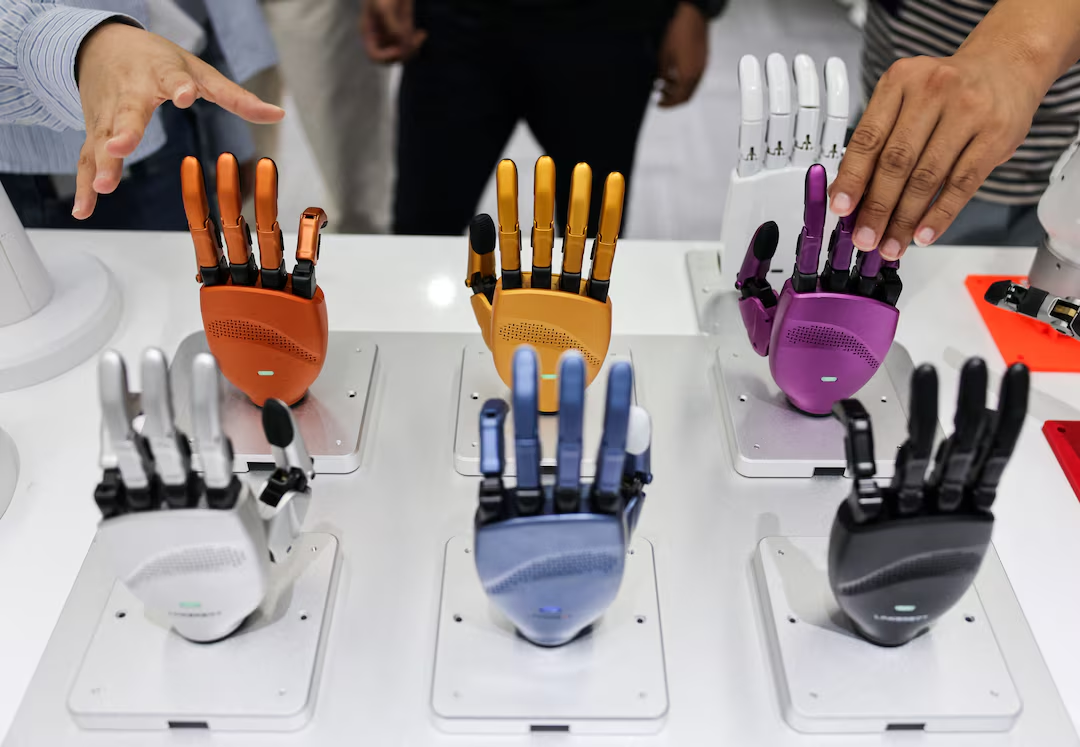
Linkerbot, a leading Chinese robotics startup, is preparing for a major expansion after targeting a $6 billion valuation in its next funding round. The company specializes in advanced robotic hands for humanoid systems.
The Beijing-based firm recently completed a Series B+ funding round valued at $3 billion. It now aims to double that valuation as investor interest in robotics continues to grow.
Strong Investor Backing and Rapid Growth
Linkerbot has attracted major investors, including Ant Group, HongShan Group, Zhongguancun Science Park Fund, Bank of China Asset Management, and Fosun Capital. These backers reflect rising confidence in China’s robotics industry.
Moreover, the company has rapidly scaled its operations. It plans to increase production capacity from 5,000 to 10,000 robotic hand units per month.
Global Leadership in Robotic Hand Technology
The company currently holds more than 80% of the global market share in high-degree-of-freedom robotic hands. This positions Linkerbot as a dominant player in precision robotics.
In addition, its technology is widely used in industrial automation, research institutions, and robotics development programs.
Focus on Human-Level Dexterity
CEO Alex Zhou said the company aims to replicate human dexterity through advanced robotic systems. Its LinkerSkillNet platform contains over 500 recorded manipulation skills.
As a result, the system enables robots to perform tasks such as threading needles, handling soft objects, and precision assembly work.
Industrial Applications and Use Cases
Linkerbot’s robotic hands are already used in manufacturing environments. They support tasks such as screw turning, object handling, and high-precision production work.
Furthermore, many clients integrate these hands into existing robotic arms instead of deploying full humanoid systems.
Technology Advantage and Production Capacity
The company manufactures key components in-house, including motors and joint modules. It also uses advanced materials designed for durability and efficiency.
In addition, its lightweight O6 model can carry heavy loads despite minimal weight, making it suitable for industrial deployment.
Future of Humanoid Robotics in China
Investor interest in humanoid robotics is rising sharply across China. Companies like Unitree and others are accelerating innovation in the sector.
As a result, robotics firms are moving toward mass production and commercial deployment in both industrial and service sectors.
Read More Articles:
China Unveils Bionic Manta Ray Robot