


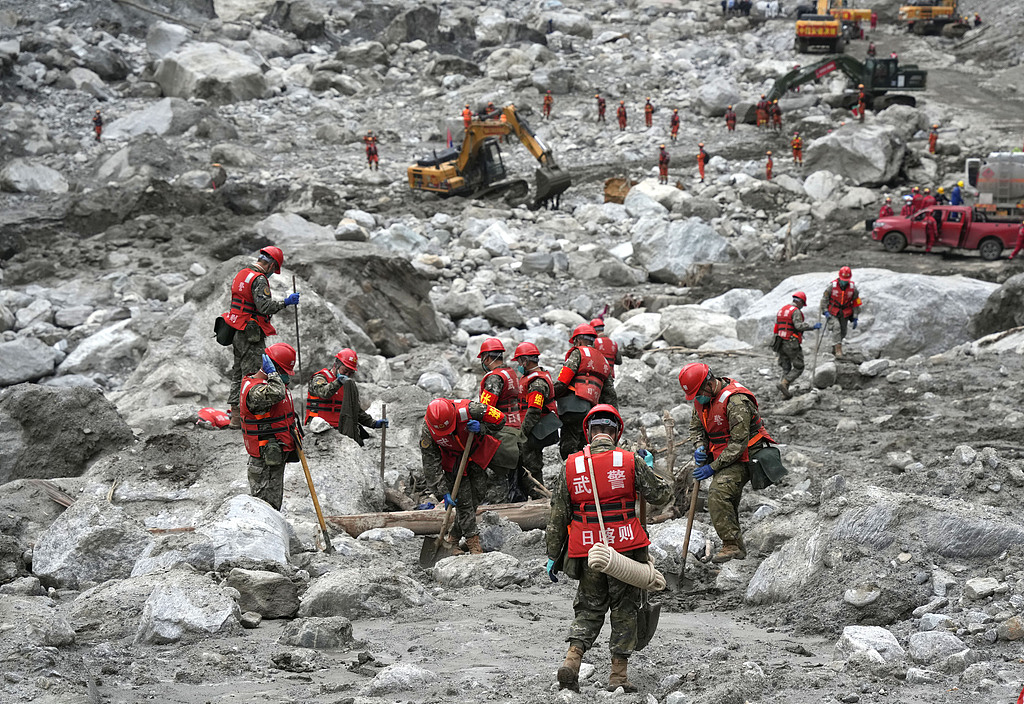
Search and rescue operations are continuing after a devastating mudslide struck Gyirong County in southwest China’s Xizang Autonomous Region on August 26.
The disaster followed a high-altitude glacier collapse in Nepal. As of 6 p.m. Saturday, officials reported 43 deaths and 519 people missing at the border port.
More than 2,500 people and 500 vehicles have joined the rescue operation. Meanwhile, drones have completed more than 1,000 supply drops, delivering 5.43 tonnes of essential supplies.
Rescue Teams Continue Intensive Searches
Ren Wei, commander of the frontline headquarters, said authorities will continue searches according to the existing rescue plan.
The operation focuses on covering the core disaster zone as thoroughly as possible. Teams are working across land, water and air to locate missing people and recover belongings.
Before the road reopened, rescuers used boats and helicopters to reach affected areas. In addition, a mountain-road detour took teams around 12 hours to reach the core zone.
After the road reopened at 10 a.m. on September 2, authorities launched deeper searches across the affected area.
Six specialized groups and seven rescue teams are now working in coordinated operations. As of Saturday evening, rescuers had saved two people and recovered 993 personal belongings.
Support for Affected Families
Authorities have also expanded support for families of people killed or missing in the disaster.
Dedicated personnel are maintaining one-on-one contact with families. They are also helping with accommodation, information updates and psychological support.
A 24-hour hotline for Chinese families has received 675 calls. Authorities have also received 791 family members in person and provided accommodation to 640 people.
Support for Missing Foreign Nationals
The disaster has also affected foreign nationals. Authorities confirmed that 261 foreign nationals from 23 countries remain missing.
China has shared relevant information with the embassies of the countries concerned through diplomatic channels.
A separate 24-hour hotline has received 509 calls from families of missing foreign nationals. Authorities are providing updates through established communication channels.
China has also strengthened disaster-prevention cooperation with Nepal. Through a dedicated information channel, China shares daily weather, hydrological and glacier-related data with Nepal.
At Nepal’s request, China has dispatched specialists in tunnel rescue and DNA identification. It has also provided emergency supplies.
Difficult Conditions Challenge Rescuers
The mountainous disaster zone presents serious challenges for rescue teams.
The area has steep mountains, deep valleys, unstable geological conditions and numerous glaciers and glacial lakes. Heavy damage to the G216 National Highway has also affected access.
Furthermore, rescuers face repeated landslides, thick mud and sharp temperature changes at high altitude.
Rockfalls and slope collapses remain potential threats. Barrier-lake hazards also increase the risks facing teams working near affected waterways.
A rescuer from China Anneng Group described the fast-moving water and unstable riverbanks as major operational challenges.
Monitoring Secondary Disaster Risks
Authorities have mobilized more than 100 experts and technical specialists to monitor possible secondary disasters.
Teams are assessing risks around the barrier lake and areas affected by the ice-rock collapse. They are also conducting geological surveys along routes toward the border.
More than 150 pieces of specialized equipment have been deployed.
The equipment includes slope radars, radar-video systems, drone mapping tools, mudflow sensors, water-level monitors and meteorological instruments.
These systems allow authorities to track changing conditions and identify potential downstream risks.
Gyirong Port Recovery Under Review
Authorities will conduct a detailed assessment of disaster risks around Gyirong. They will then evaluate how to restore essential functions in surrounding areas.
Gyirong Port has served as an important China-Nepal border gateway for decades. The customs office was established in 1962, while China and Nepal later developed highways, bridges and border facilities connecting the two sides.
The two countries designated Resuwa and Gyirong as border trade points in 1981. Access for third-country nationals opened in August 2017.
Today, Gyirong remains an important land-based trade gateway between China and Nepal.
Rescue Efforts Continue
The Xizang border mudslide rescue operation remains focused on finding missing people and preventing further casualties.
At the same time, authorities are providing support to affected families and coordinating humanitarian assistance with neighboring countries.
With difficult terrain and continuing geological risks, rescue teams face a challenging operation. However, authorities say searches will continue until the core disaster area receives comprehensive coverage.
Read More Articles:
China Aids 1,720 Nepali Border Residents