Pakistan and China are taking further steps to strengthen bilateral security cooperation, with a new focus on improving coordination between their law-enforcement institutions and enhancing the operational capacity of Pakistani security personnel.
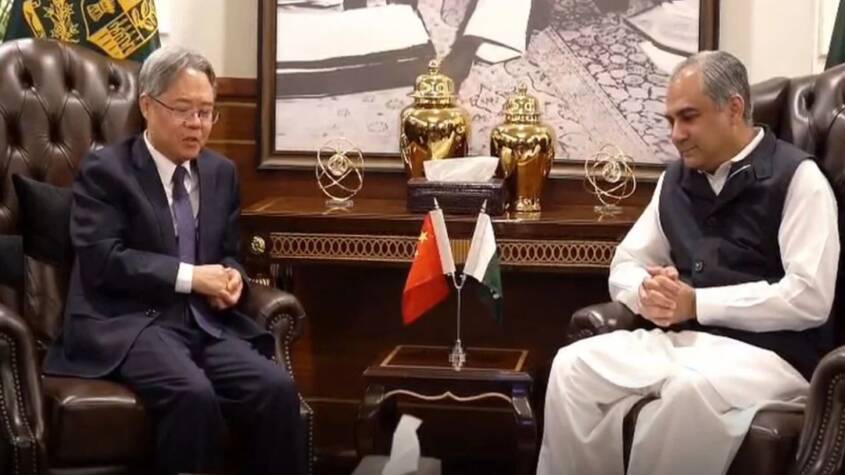
The understanding was reached during a meeting in Islamabad between Interior Minister Mohsin Naqvi, Minister of State for Interior Talal Chaudhry and Chinese Ambassador to Pakistan Jiang Zaidong. The discussions focused on the wider Pakistan-China strategic partnership, particularly security cooperation and institutional collaboration.
According to the Chinese Embassy, Ambassador Jiang met Naqvi on November 17 to exchange views on law-enforcement and security cooperation. Both sides expressed their willingness to deepen collaboration in response to regional security challenges.
Chinese Instructors to Train Pakistan’s Special Protection Unit
As part of the new measures, Chinese instructors will soon visit Pakistan to provide specialised Chinese-language training to personnel of the Special Protection Unit (SPU).
The training aims to improve communication between Pakistani security officers and Chinese officials and nationals living or working in Pakistan. Better language skills are expected to help officers coordinate more effectively during security operations and their engagement with Chinese citizens.
The initiative also reflects the importance both countries attach to protecting Chinese nationals and strengthening the security arrangements surrounding Chinese personnel and projects in Pakistan.
China Supports Islamabad Law-Enforcement Centre
Another key development is China’s commitment to provide technical and institutional support for the establishment of a new Law Enforcement Centre in Islamabad.
The centre is being developed along the lines of China’s policing model. Its establishment forms part of Pakistan’s broader efforts to modernise law enforcement through improved infrastructure, technology and specialised training.
Earlier, in September 2026, Interior Minister Mohsin Naqvi held talks with Chinese Vice Minister of Public Security Gao Qi. The two sides agreed to expand police training exchanges and cooperation in modern technology and equipment, while China pledged support for establishing the centre.
The proposed facility is also linked to policing reforms announced by Naqvi in August. These included a pilot project to bring detention, investigation and summary trial facilities under one roof, with the aim of reducing procedural delays and improving the handling of minor offences.
Naqvi also highlighted the potential role of artificial intelligence-based technology and modern equipment in addressing Pakistan’s security challenges.
China Reaffirms Support for Pakistan’s Security Efforts
During the latest meeting, Ambassador Jiang reaffirmed China’s readiness to deepen law-enforcement and security cooperation with Pakistan.
He noted that the regional security environment was becoming more challenging and called for stronger efforts to combat illegal and criminal activities. He also stressed the importance of protecting the safety and lawful rights of Chinese citizens in Pakistan.
Naqvi thanked Beijing for its continued support in strengthening Pakistan’s law-enforcement capacity. He reaffirmed that Pakistan attaches great importance to the security of Chinese nationals and will continue taking measures against terrorism and criminal activities.
Pakistan also reiterated its commitment to improving the security network and providing a safe environment for Chinese citizens living, working and investing in the country.
Senior Officials Attend Pakistan-China Security Meeting
The meeting was also attended by senior Pakistani and Chinese officials, including the Federal Interior Secretary, Special Secretary Interior, Director General of the National Cyber Crime Investigation Agency (NCCIA) and Minister Counsellor Xu Hangtian of the Chinese Embassy.
The latest engagement builds on ongoing cooperation between Islamabad and Beijing in police training, counterterrorism, modern technology and institutional capacity-building.
As Pakistan and China continue expanding their strategic partnership, stronger law-enforcement coordination and improved security capabilities remain important areas of bilateral cooperation.
Read More Articles:
Xi Outlines Four Pillars for Asia-Pacific Cooperation