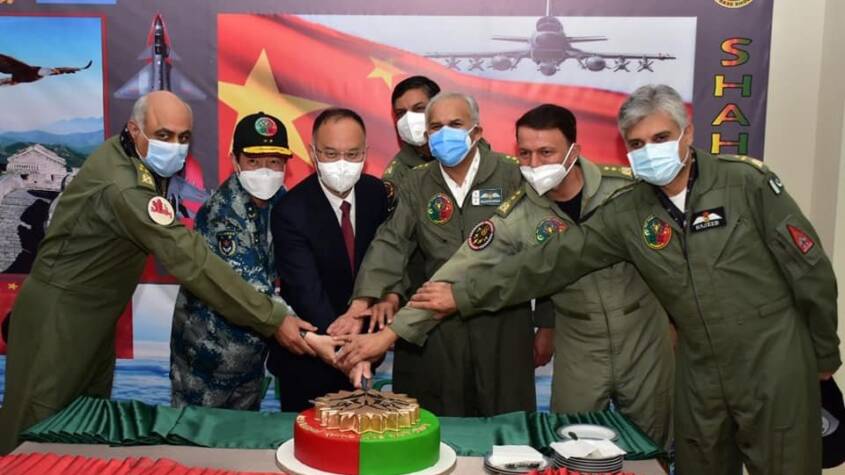

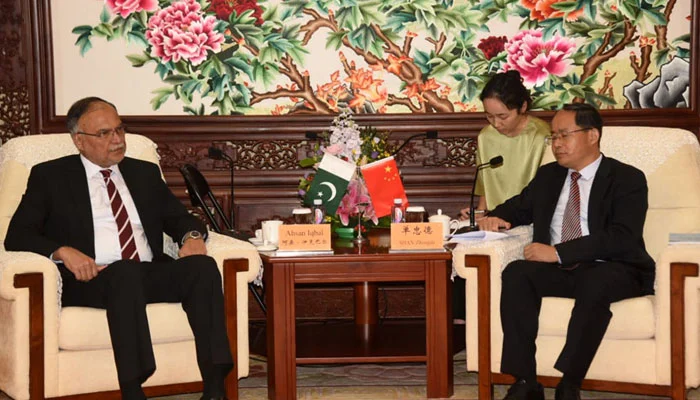
Pakistan’s ambition to advance in space and nuclear technology took a major leap as Federal Minister for Planning, Development and Special Initiatives, Ahsan Iqbal, held high-level talks in Beijing with Chinese officials, including Shan Zhongde, Chairman of the China Atomic Energy Authority (CAEA) and China National Space Administration (CNSA) to discuss Pakistan’s Lunar Mission by 2035 with China’s Support
The meeting marked a strategic effort to align cooperation in nuclear energy and space exploration with Pakistan’s long-term development agenda. Minister Iqbal revealed that Pakistan plans to send its first astronaut to the Chinese space station by 2026, and by 2035, aims to land a rover on the moon with Chinese collaboration. The initiative is part of the “Uraan Pakistan” vision to push scientific and technological boundaries.
Expanding Nuclear and Space Collaboration Under the CPEC Framework
During the meeting, Iqbal underscored the transformational role of CPEC in resolving Pakistan’s infrastructure and energy deficits. He praised China’s support in nuclear power projects like K-2, K-3, and C-5, calling them “shining examples” of peaceful nuclear collaboration.
In response to global climate change threats, Iqbal highlighted the urgency of transitioning to alternative energy sources, including atomic energy. He called for deeper partnerships with China in quantum computing, nuclear innovation, and satellite technologies for agriculture and disaster management.
Shan Zhongde expressed appreciation for Pakistan’s contributions to CPEC and reaffirmed China’s full support for joint space missions, peaceful nuclear development, and strengthening strategic cooperation.
Training, Innovation and Economic Modernisation
Iqbal also emphasised Pakistan’s high-quality human capital and technological potential. He spoke about the newly established Quantum Computing Centre and ongoing efforts to integrate science, technology, and engineering sectors with economic planning. He advocated for increased scholarships and exchange opportunities for young Pakistani scientists in Chinese institutions, especially in advanced space research.
As part of broader economic cooperation, Iqbal held discussions with Chinese business leaders and officials from the China International Development Cooperation Agency (CIDCA). He focused on expanding CPEC’s socio-economic footprint to uplift underdeveloped regions, promote B2B investments, and transition Pakistan toward industrialisation.
He revealed that 1,000 Pakistani agriculture experts are being trained in China to modernise the farming sector, with 300 already having completed the program.
CPEC Phase II: From Infrastructure to Industrial Growth
With over $25 billion already invested in infrastructure and power generation under CPEC Phase I, Minister Iqbal confirmed that CPEC Phase II will prioritise industrial cooperation, agriculture modernisation, and technology transfer.
He encouraged Chinese companies to explore manufacturing opportunities in Pakistan’s export-oriented sectors like garments, agriculture, sports goods, and surgical instruments. He also highlighted Pakistan’s competitiveness in EVs and solar energy, inviting joint ventures in these emerging industries.
Strategic Vision and Regional Diplomacy
The minister also touched upon regional and global developments, advocating for peace and cooperation through platforms like the Shanghai Cooperation Organisation (SCO). He condemned recent violence in Gaza and Jerusalem and urged global powers to uphold human rights and international law.
To mark 75 years of diplomatic relations, Pakistan and China plan to host special commemorative events next year. In the lead-up to Prime Minister Shehbaz Sharif’s visit, the Pakistan-China Business Conference on September 4 in Beijing will host over 450 companies from both nations, aiming to boost cross-sector partnerships.
Related stories:
‘Landmark development’ – Pakistan launches advanced Remote Sensing Satellite from China