

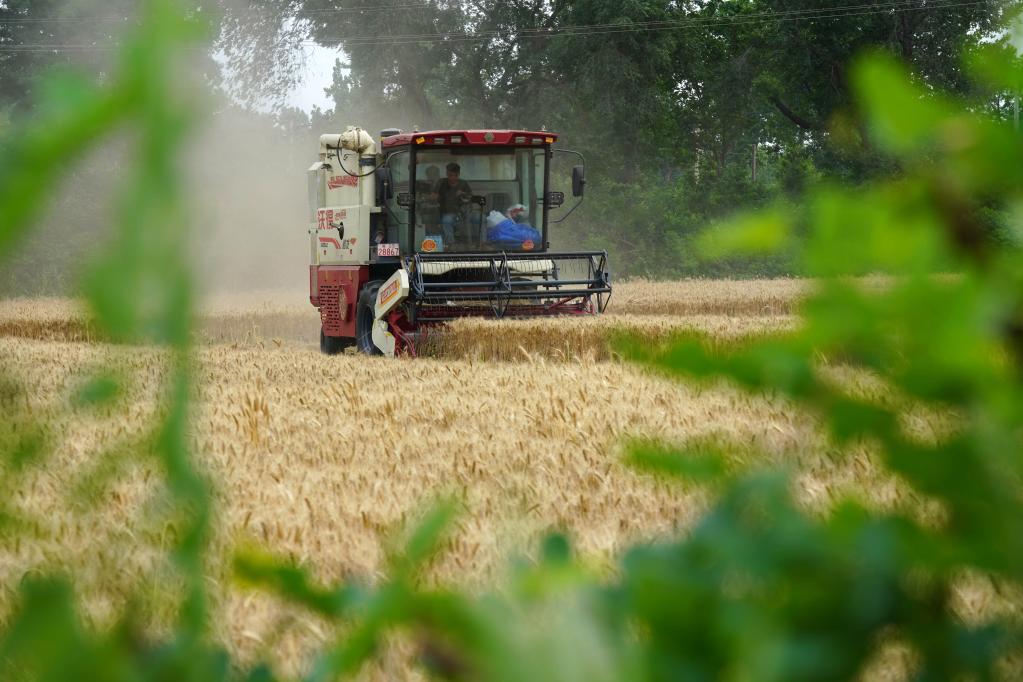
As high rainfall and the start of the nation’s major flood season pose challenges to grain output in some important agricultural regions, China is expediting its summer harvest and planting campaign while stepping up measures to defend against floods and other weather-related dangers.
Securing production amid uncertainty
Vice Premier Liu Guozhong urged all-out efforts to guarantee a successful “Three Summer” campaign—summer harvesting, summer planting, and summer field management—during an inspection tour in Hebei Province, north China, in order to establish a strong foundation for this year’s grain production.
China’s summer grain production is currently in a critical phase. Major producing regions including Henan, Shandong, Anhui, and Jiangsu are home to the majority of the nation’s summer wheat harvest, which makes up more than 20% of the yearly grain output. But heavy rainfall is likely to affect these provinces.
Maximizing summer harvest
As of June 2, China had harvested 119 million mu (7.93 million hectares) of summer wheat, or 35.09% of the country’s total harvest, according to the Ministry of Agriculture and Rural Affairs. Wheat harvesting is almost 70% finished in Anhui, nearly 50% finished in Henan, more than 20% finished in Jiangsu, and more than 10% finished in Shaanxi, among the major producing provinces.
In order to secure the summer grain harvest, Liu emphasised the importance of maximising periods of favourable weather, enhancing meteorological monitoring and early warning systems, ensuring seamless summer grain procurement, coordinating summer planting and field management, and ensuring consistent chemical fertiliser supplies and prices.
Challenges posed by weather
China’s Ministry of Water Resources reports that major river conditions have been largely constant since the nation’s flood season began on April 1. However, mountain torrents and unusually early and severe flooding in small and medium-sized rivers have been caused by localised excessive rainfall. Significant rainfall events have complicated crop production in a number of important agricultural provinces, such as Hubei, Anhui, and Henan.
Experts believe that worsening global climate change is partially to blame for the rising frequency of catastrophic weather events.
The overall variation in hydrological and climatic circumstances is probably related to climate change, according to Zhang Jianyun, a hydrology specialist at the Chinese Academy of Engineering.
Ensuring food security
Officials claim that general farmland waterlogging levels are still controllable despite weather-related difficulties. Additionally, agricultural insurance has become more crucial in assisting farmers in recovering from calamities and ensuring food security.
Read More Articles:
NDMA Warns Punjab of Heavy Rain, Floods Next Two Days
Pakistan-China CPEC 2.0 Prioritizes Industry, Agriculture, Mining