
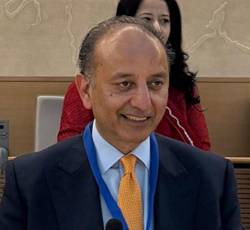
Federal Minister for Climate Change and Environmental Coordination, Dr. Musadik Malik, has intensified Pakistan’s call for a fair and effective Global Plastics Treaty, coupling his latest diplomatic outreach with earlier bold reform proposals aimed at tackling the mounting plastic pollution crisis.
During the Informal Ministerial Dialogue on “Investment Opportunities for a Circular Economy in the Context of the Global Plastic Treaty” at the Fifth Session of the Intergovernmental Negotiating Committee on Plastic Pollution (INC-5.2), Dr. Malik highlighted the stark imbalance in global plastic consumption and waste management. He noted that wealthy nations consume up to 20 times more plastic per person than many developing countries and frequently export low-value or contaminated waste under the guise of recyclables, leaving nations like Pakistan to bear the environmental and health costs without the infrastructure to manage it safely.
To address this injustice, Dr. Malik proposed a two-pronged approach:
Extended Consumer Responsibility (ECR) Framework – Linking responsibility to consumption levels, requiring high-consuming nations (over 100 kg per capita annually) to contribute to a global Plastic Fund for recycling and waste management infrastructure in affected countries.
Global Plastics Credit Market – Modelled on carbon credits, rewarding developing nations for measurable recycling and waste reduction efforts, with proceeds supporting modern recycling facilities, waste collection systems, and safer employment for informal waste workers.
On the sidelines of the same session, Dr. Malik led an interactive briefing with delegations from Bangladesh, Egypt, Tajikistan, Malaysia, and Sudan, seeking to build regional consensus on the treaty and address inequities in green financing. He stressed that countries with the highest plastic consumption also tend to benefit most from green financing, while those suffering the worst impacts are left behind.
Reaffirming Pakistan’s commitment, Dr. Malik called for equitable financing mechanisms, technology transfer, and capacity-building support to ensure that environmental aid reaches the nations most affected.
“Plastic pollution is not just an environmental issue, it’s an issue of justice, fairness, and sovereignty,” he declared. “Pakistan stands ready to lead the fight for a future where no country is treated as a dumping ground.”
Related stories:
Pakistan, Qatar to Boost Climate Action, Green Investments
Government pushes climate resilience via CPEC Green Corridor