
In a significant move to fast-track Pakistan’s ambition of becoming a $1 trillion economy by 2035, the country signed a strategic partnership agreement with China on Sunday to enhance bilateral economic cooperation under the “Uraan Pakistan” initiative.
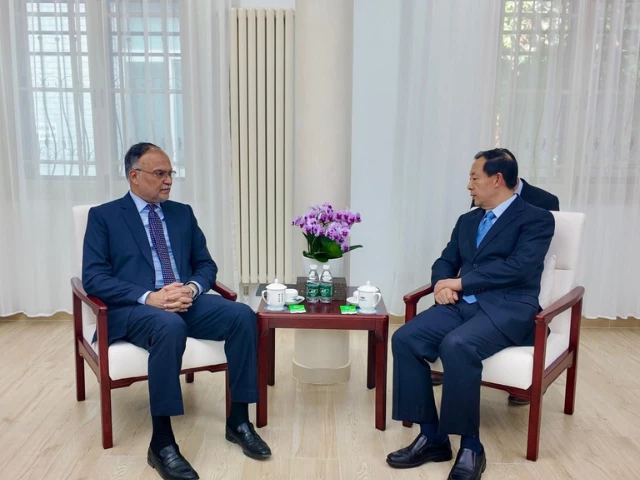
The agreement was finalised during a high-level meeting between Pakistan’s Federal Minister for Planning, Development and Special Initiatives, Ahsan Iqbal, and Lu Hao, President of China’s Development Research Centre (DRC) and Centre for International Knowledge on Development (CIKD).
Focus Areas: Trade, Digitalisation, Energy, and Infrastructure
The collaboration will focus on five key pillars of Uraan Pakistan: exports, digital transformation, energy and infrastructure development, environmental sustainability, and equity and empowerment. Minister Iqbal highlighted that the Chinese partnership is crucial for Pakistan’s transition into a globally competitive economy.
Through joint research, training programs, and expert exchanges, China will support Pakistan in areas of strategic economic development and policy planning.
Boosting Trade and Market Access with China
Iqbal emphasised Pakistan’s objective to strengthen trade ties and increase its share in China’s $2 trillion import market. He noted that access to Chinese markets will be critical for boosting Pakistani exports and enhancing the country’s global market presence.
“Pakistan wants to promote trade and exports with China,” Iqbal stated, adding that learning from China’s experience in export-led growth and sustainable development is a key component of the strategy.
Signs of Recovery: Economic Indicators Improving
The Planning Minister cited encouraging economic indicators aligning with the goals of Uraan Pakistan. These include a reduction in the policy rate from 23% to 11%, and the Pakistan Stock Exchange reaching a historic 140,000 points, figures acknowledged by international financial institutions as positive signs of recovery.
CPEC and Strategic Partnership Beyond Politics
Referring to the China-Pakistan Economic Corridor (CPEC), Iqbal noted that the bilateral relationship has evolved from political alignment to a broad-based economic and social partnership. “CPEC has transformed our relationship into a strong development alliance,” he said.
Learning from China’s Development Model
Iqbal praised China’s scientific and strategic planning, describing it as a model for sustainable economic development. He stressed the importance of continuity in policies and political stability, pointing out that past instability had hindered Pakistan’s progress.
Lu Hao expressed full support for Pakistan’s development goals and reaffirmed China’s commitment to facilitating the Uraan Pakistan agenda.
This newly formalised partnership is a key milestone in Pakistan’s long-term economic roadmap and marks a renewed commitment to regional cooperation, export-led growth, and inclusive development.
Related stories:
CPEC Phase II: Pakistan terms China’s model a guiding example