
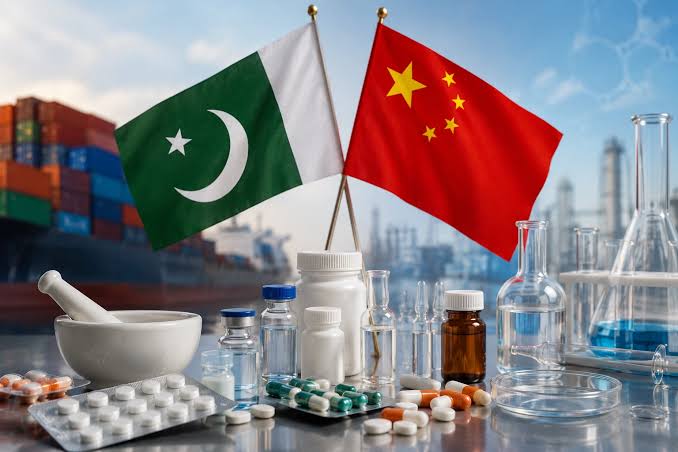
Pakistan is moving closer to local vaccine production by expanding its health partnership with China, as the government unveiled plans to establish indigenous manufacturing alongside more than $1.4 billion in Chinese healthcare investment commitments.
Federal Minister for National Health Services, Regulations and Coordination Syed Mustafa Kamal said cooperation with Chinese pharmaceutical companies will help transform Pakistan’s healthcare industry through technology transfer, investment, and advanced manufacturing.
China to Support Local Vaccine Manufacturing
Speaking at a news conference on Wednesday, the minister said the recently concluded Pakistan-China B2B Investment Conference 2026 marked a major milestone in bilateral cooperation, particularly in pharmaceutical manufacturing, biotechnology, and vaccine production.
Moreover, he said both countries identified six priority pharmaceutical sub-sectors to attract Chinese investment and expertise, reflecting their commitment to strengthening strategic healthcare cooperation.
National Vaccine Policy Finalized
Mustafa Kamal revealed that Pakistan currently imports all 13 vaccines used under its national immunization programme, making domestic production a national priority.
To address this challenge, he said the government has finalized Pakistan’s first National Vaccine Policy, which provides a roadmap for establishing local vaccine manufacturing through partnerships with international companies, especially from China.
He added that China’s expertise in pharmaceutical research, biotechnology, and vaccine production can help Pakistan build a sustainable domestic manufacturing base.
“The objective is to create local manufacturing capacity so Pakistan can gradually become self-sufficient in vaccine production through international cooperation and technology transfer,” the minister said.
Chinese Investment Exceeds $1.4 Billion
The minister highlighted the strong response from Chinese companies during the Pakistan-China B2B Investment Conference.
The two-day event attracted 140 Chinese companies and 240 business delegations, resulting in more than 340 business-to-business meetings between Pakistani and Chinese enterprises.
Furthermore, 22 companies signed commercial agreements worth $629.5 million, while additional memorandums of understanding valued at $800 million were concluded.
As a result, the conference generated total announced investment commitments exceeding $1.4 billion.
Focus on Technology Transfer
Mustafa Kamal said the Ministry of Health has already started engaging with participating companies to ensure that the agreements lead to operational projects rather than remaining on paper.
He explained that the partnerships aim to establish pharmaceutical manufacturing facilities, encourage technology transfer, and strengthen long-term industrial collaboration between Pakistan and China.
Strengthening Pakistan’s Pharmaceutical Industry
The minister noted that Pakistan currently manufactures nearly 85 percent of the medicines consumed domestically and exports pharmaceutical products to around 52 countries.
However, he acknowledged that about 95 percent of pharmaceutical raw materials are still imported.
Therefore, he said closer cooperation with China will help localize supply chains, improve industrial resilience, and increase Pakistan’s export competitiveness.
DRAP Introduces Digital Reforms
Mustafa Kamal also highlighted regulatory reforms designed to attract greater foreign investment.
He said the Drug Regulatory Authority of Pakistan has introduced an online regulatory system to speed up the registration of medicines, medical devices, and related products.
In addition, he expressed confidence that DRAP will become fully digitized within the next year, creating a faster, more transparent, and investor-friendly regulatory environment for both Pakistani and Chinese pharmaceutical companies.
Read More Articles:
LCIA, UMT Sign Academic Cooperation MoU