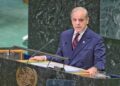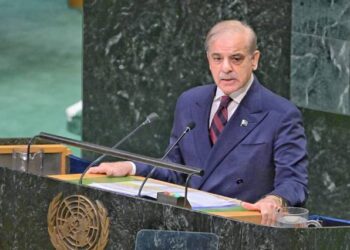

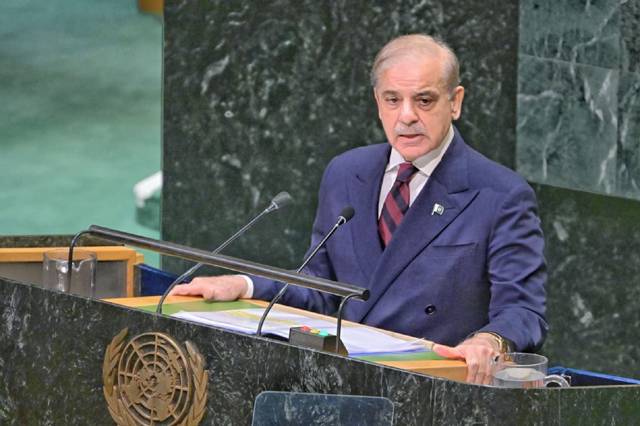
Prime Minister Shehbaz Sharif said any threat to the safety and sanctity of the Haramain Sharifain is a red line that must never be crossed. He made the remarks while addressing the 81st United Nations General Assembly in New York on Friday.
The prime minister condemned the attempted drone attack on Makkah and expressed Pakistan’s solidarity with Saudi Arabia. He also condemned recent Houthi attacks against the Kingdom.
Makkah Agreement and Regional Security
Shehbaz Sharif said the Makkah Joint Defence Agreement between Saudi Arabia, Türkiye and Pakistan is not directed against any country.
Instead, he described it as a collective commitment to defence, stability and peace in the region. He also called for the Strait of Hormuz and Bab al-Mandab to remain open because of their importance to global trade and energy flows.
Pakistan’s Regional Peace Efforts
The prime minister highlighted Pakistan’s diplomatic efforts to reduce regional tensions. He referred to the Islamabad Memorandum of Understanding and efforts to bring Washington and Tehran together in Islamabad.
He also praised Field Marshal Syed Asim Munir and Deputy Prime Minister Ishaq Dar for their role in these efforts.
Kashmir Remains a Key Issue
Turning to South Asia, Shehbaz Sharif discussed tensions between Pakistan and India. He said Pakistan exercised its right to self-defence under Article 51 of the UN Charter following what he described as external aggression.
He stressed that South Asia must not return to the brink of a wider conflict. According to the prime minister, a lasting solution requires addressing the Kashmir dispute.
Shehbaz Sharif also reaffirmed Pakistan’s support for the Kashmiri people’s right to self-determination.
Indus Waters Treaty and Water Security
The prime minister also addressed the Indus Waters Treaty. He rejected India’s unilateral decision to place the treaty in abeyance and said Pakistan considers the agreement valid and binding.
He stressed that water should not become a tool of conflict. He further warned that any attempt to stop, impede or divert Pakistan’s water share would be treated by Islamabad as an act of war.
Terrorism and Afghanistan
Shehbaz Sharif highlighted Pakistan’s losses in the fight against terrorism. He said the country had lost almost 100,000 lives and suffered economic losses exceeding $150 billion.
He called on Afghan authorities to take verifiable action against militant groups operating from Afghan territory. He also stressed the need to protect the fundamental rights of Afghan women and girls.
Pakistan’s Economic Priorities
The prime minister outlined Pakistan’s economic priorities, including agricultural and industrial modernization, mineral development, digitalization, and AI and IT skills for young people.
He also highlighted new economic pathways with China, the Gulf and Central Asia. In addition, he called for debt relief, affordable long-term financing and greater representation for developing countries in global financial institutions.
Climate Change and Global Responsibility
Shehbaz Sharif said Pakistan contributes less than one percent of global emissions but remains highly vulnerable to climate change.
He urged developed countries to fulfill their climate finance commitments. He also called for faster funding for loss and damage, adaptation and climate resilience.
Pakistan Calls for Palestinian State
The prime minister also raised the situation in Palestine. He called for an independent, sovereign and viable Palestinian state based on the pre-1967 borders, with Al-Quds Al-Sharif as its capital.
He also condemned Israeli actions in Lebanon and Syria and called for an end to the violence.
Call for UN Reform
Concluding his address, Shehbaz Sharif called for reform of the UN Security Council. He said the body should become more representative, democratic and accountable.
He urged world leaders to restore trust through concrete action. The prime minister also called for greater cooperation to preserve peace in an increasingly divided world.
Read More Articles:
Pakistan-China Cooperation and the Green Supply Chain