

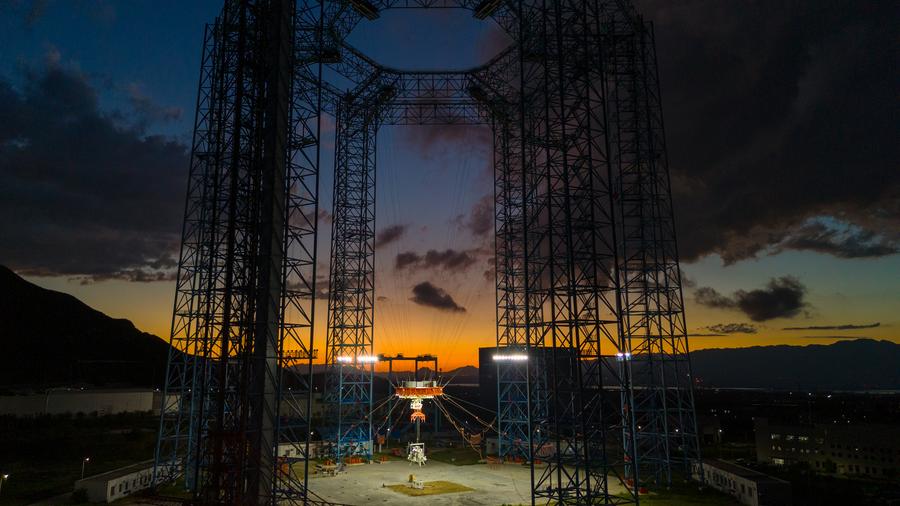
China has achieved a significant breakthrough in its manned lunar exploration program, completing a comprehensive landing and takeoff test for its crewed lunar lander, Lanyue (“Embracing the Moon”), at a specialised site in Huailai County, Hebei Province.
The test, carried out on Wednesday and announced by the China Manned Space Agency on Thursday, marks the first time China has conducted an extraterrestrial landing and takeoff simulation for a manned spacecraft. Officials say the achievement is a vital step toward the country’s goal of landing taikonauts on the moon before 2030.
Advanced Design for Crewed Moon Missions
The Lanyue lunar lander consists of a landing module and a propulsion module, designed to ferry two taikonauts between lunar orbit and the moon’s surface. Capable of carrying a lunar rover and multiple scientific payloads, it will also function as a life support, energy, and data hub for astronauts during their stay.
According to Wang Xiaolei from the China Academy of Space Technology, the manned version is significantly larger and heavier than its unmanned counterparts, requiring more complex testing to ensure absolute safety for the crew. “Every trial is aimed at guaranteeing that taikonauts land and return safely,” Wang emphasised.
Asia’s Largest Lunar Test Facility
The Huailai test base, Asia’s largest for extraterrestrial landing trials, can simulate lunar gravity and terrain. It previously hosted China’s first Mars probe, hover and obstacle-avoidance experiments.
While Lanyue is still in its prototype stage, it will only proceed to final development after completing all pre-mission evaluations. Alongside the lander, China has also conducted multiple experiments involving the carrier rocket and crewed spacecraft to ensure readiness for the upcoming moon mission.
With this successful test, Beijing moves one step closer to placing Chinese astronauts on the lunar surface, aiming for historic scientific exploration in the next five years.
Related stories: