

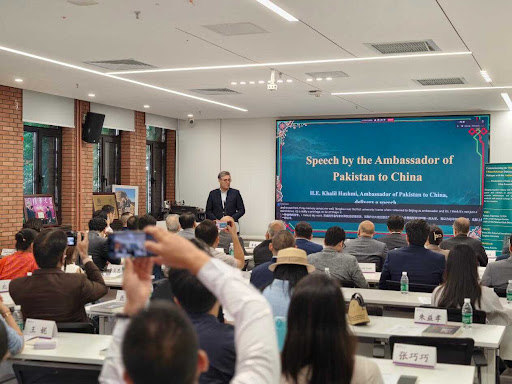
Scholars from China and Pakistan have explored centuries-old connections between the two countries through rivers, ancient routes and shared history.
The research was presented at a dialogue held on September 13 at Tsinghua University. The event examined historical links between the Indus and Yangtze rivers.
The dialogue also marked the 75th anniversary of Pakistan-China diplomatic relations.
Research Explores Ancient Civilizations
The event featured the multilingual book Indus and Yangtze: A Journey of Two Rivers from One Origin.
The book is available in English, Urdu and Chinese. It examines the civilizations shaped by the two rivers and their role in economic and cultural development.
Researchers also discussed the Gandhara civilization, Buddhism and ancient transportation networks in the Indus basin.
Moreover, they explored the journeys of Chinese Buddhist monk Faxian and exchanges along the ancient Silk Road.
Ancient Routes Connect China and Pakistan
Professor Li Xiguang presented research on Faxian’s westward journey to the ancient Kingdom of Udyana.
His team used historical documents, early maps and field investigations. The research examined mountain routes that connected ancient China with areas of present-day Pakistan.
Li stressed the importance of field research in understanding ancient exchanges. He said researchers should visit historical locations and examine physical traces left by past civilizations.
Similarly, Professor Guo Xiaoke presented research on the Yarkand River Valley. The project combines fieldwork, historical research and documentary filmmaking.
Karakoram Highway Memories Preserved
The dialogue also focused on the people who built the Karakoram Highway.
Zhang Jing of Xinjiang University of Finance and Economics presented an oral history project documenting their experiences. The project has contacted more than 100 people connected with the highway’s construction.
The researchers interviewed firsthand participants to preserve their memories for future generations.
The project views the Karakoram Highway as more than a transport route. It also documents the shared experiences and people-to-people ties between China and Pakistan.
Academic Cooperation Strengthens Historical Understanding
The event also featured doctoral research on Pakistan by Tsinghua University graduates Wen Sanmei and Liu Bei.
Meanwhile, scholars from several Chinese universities discussed field research, civilizational exchange and academic cooperation.
Pakistani Ambassador to China Khalil Hashmi attended the dialogue. He highlighted the importance of strategic trust and decades of exchanges between the two countries.
Tsinghua University School of Journalism and Communication Party Secretary and Chair of the School Board Shi Anbin also emphasized the role of communication and academic institutions.
He said such institutions can help connect countries and their people.
Rivers, Routes and Shared History
The research presented at Tsinghua offered several perspectives on China-Pakistan historical links.
The Indus and Yangtze reveal the role of rivers in shaping civilizations and economies. Ancient routes show how people, ideas and cultures moved across the region.
Meanwhile, the Karakoram Highway provides a more recent record of cooperation and shared experiences.
Together, these studies connect historical records with field research and personal memories. They also highlight the role of universities and cultural institutions in strengthening mutual understanding between China and Pakistan.
Read More Articles:
China’s Role in Pakistan-Iran Diplomacy Gains Strategic Weight
Pakistan-China Training Equips 200 Educators in Digital Skills
Pakistan-China Boundary Joint Commission Becomes Operational