
A Pakistan-China digital skills initiative has trained around 200 educators from public and private institutions across Pakistan. The training focused on modern digital marketing technologies. It forms part of a broader push to build the country’s capacity for cross-border e-commerce.
The two-week International Training Programme on the Application of Digital Marketing Technologies ran from August 31 and concluded in Lahore on September 11. Participants attended two hours of instruction daily through on-campus and online sessions, Gwadar Pro reported.
The programme took place at the newly established Center of Excellence at the Government Technical Training Institute (GTTI) Gulberg, Lahore. It operated under the Silk Road Digital Trade Academy. UNI International and China’s ITMC Technology Co. organized the training, working alongside the Zhejiang Technical Institute of Economics. Pakistan’s National Vocational and Technical Training Commission also supported the initiative.
What Educators Learned
The training covered practical digital marketing tools. These included search ranking, recommendation engines, social media marketing, app marketing and mini-programme development. Instructors placed particular emphasis on applying these tools to cross-border e-commerce strategy.
This educator-focused approach reflects a clear pattern in Pakistan-China digital cooperation this year. Organizers are training the trainers first. This way, digital commerce skills can spread through Pakistan’s existing education networks. It reduces reliance on one-off programmes for individual learners.
Part of a Broader Skills Push
This month’s training is the latest in a series of Pakistan-China digital skills initiatives. Most of them run through the same Lahore-based technical training ecosystem.
In July, the Zhejiang Technical Institute of Economics offered a free two-day online course in Search Engine Optimization and Search Engine Marketing. The course targeted Pakistani teachers, students and working professionals. GTTI Gulberg, TEVTA Punjab, ITMC Technology and UNI International Services organized it together.
In June, a Chinese delegation visited the Technical Education and Vocational Training Authority (TEVTA) Secretariat in Lahore.
The delegation discussed a separate digital-skills project for women, called Ban-Mo Academy. Planners intend to house the academy at the Government College of Technology for Women on Lytton Road. A five-party agreement backs the project, involving China’s Shandong College of Electronic Technology, Lancmall (SMC-Private) Ltd, Punjab TEVTA and China’s ITMC Technology. TEVTA Chairman Brig. (retd) Muhammad Sajid Khokhar chaired the project meeting. Classes are expected to begin in the spring 2027 session.
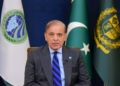
Pakistan’s Prime Minister’s Youth Programme has also engaged directly with Alibaba Group. In June, programme chairman Rana Mashhood Ahmad Khan met senior Alibaba executives in Beijing. They discussed moving earlier cooperation agreements into practical e-commerce, training and startup-support programmes for young Pakistanis. The talks built on MoUs signed during Prime Minister Shehbaz Sharif’s visit to China.
Why the Push Matters for Pakistan’s Digital Economy
Pakistan’s e-commerce growth explains why this training push has accelerated. The number of registered e-commerce merchants in the country grew by 427 percent between 2019 and 2023, according to the Pakistan China Media Initiative.
That growth has outpaced the technical capacity needed to sustain it. Pakistani merchants need to substantially improve their online storefronts and digital presentation, says Zhao Zhijiang, a former e-commerce training instructor at the National University of Sciences and Technology. Without that improvement, they cannot compete effectively in international markets. The current wave of training programmes aims to close this gap.
Chinese companies operating in Pakistan have signalled plans to deepen this cooperation further.
One Chinese firm executive, identified only as Leo, said the company will open its AI platform to Pakistani users. Freelancers and businesses will be able to build websites and generate content through the platform. The company also plans to establish forward warehouses in Pakistan, alongside training programmes for local livestream sellers.
A related 2025 development brought fresh momentum to the sector.
The China Pakistan TVET Industrial Center of Excellence introduced the China E-commerce Livestreaming Competition to Pakistan for the first time. The move reflects a broader effort to bring competition-based skills development, already common in Chinese vocational education, into Pakistan’s training system.
What Comes Next
This month’s educator training represents one piece of a larger effort. Organizers want to integrate Chinese industrial and educational resources directly into Pakistan’s training system. Plans are already under way for 2026 to establish dedicated industry-education integration bases. These will focus specifically on e-commerce and cross-border trade.
Whether these programmes build a measurably larger and more skilled digital workforce remains to be seen.
Much will depend on how many newly trained educators go on to train students at scale. The success of planned facilities like Ban-Mo Academy and the proposed integration bases will offer an early test of that momentum in the coming months.
Read More Articles:
PM Fuel Relief Scheme Expands Across Pakistan