


China has officially designated October 25 as the Commemoration Day of Taiwan’s Restoration, marking 80 years since the island’s return to Chinese sovereignty after Japan’s defeat in World War II. The decision, adopted by the Standing Committee of the 14th National People’s Congress, underscores Beijing’s firm stance on national unity and the one-China principle.
Historical Significance of the Commemoration
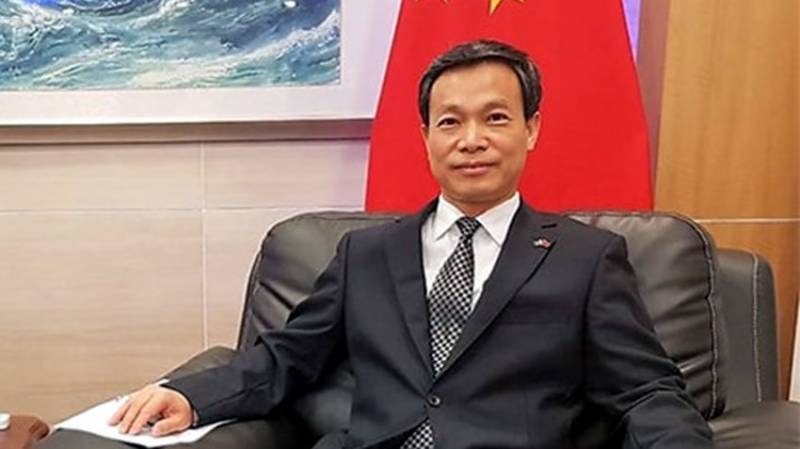
Ambassador Jiang Zaidong of the People’s Republic of China to Pakistan stated that the move “reflects the will of the people and the determination of the nation.” He emphasised that establishing the commemoration day “demonstrates the unwavering commitment of all Chinese people to uphold the one-China principle and safeguard national sovereignty and territorial integrity.”
The ambassador noted that the China Marks 80 Years of Taiwan’s Restoration commemoration pays tribute to those who fought for China’s liberation and highlights the country’s historical claim to Taiwan. “It strengthens the international consensus that there is only one China, and Taiwan is an inalienable part of it,” he said.
Historical Background and Legal Context
The decision draws on a long chain of historical and legal developments. In 1895, after the First Sino-Japanese War, Taiwan was ceded to Japan under the Treaty of Shimonoseki. However, following Japan’s surrender in 1945, China resumed sovereignty over Taiwan in accordance with the Cairo Declaration and the Potsdam Proclamation, both of which stipulated that all territories stolen by Japan, including Taiwan and the Penghu Islands, must be returned to China.
Ambassador Jiang highlighted that the restoration of Taiwan was both de jure and de facto. “From that moment forward,” he said, “China had recovered Taiwan through a series of documents with international legal effect.”
The One-China Principle and International Recognition
The ambassador reaffirmed that the one-China principle remains the cornerstone of global diplomacy. He referenced the 1971 United Nations General Assembly Resolution 2758, which recognised the People’s Republic of China as the sole legitimate representative of China to the UN, thus rejecting any notion of “two Chinas” or “one China, one Taiwan.”
“The UN resolution conclusively established that Taiwan is an inalienable part of China,” Ambassador Jiang said. “To date, 183 countries have recognised this principle and maintain diplomatic relations with China on that basis.”
He further cautioned that recent attempts by “certain external forces” to reinterpret the resolution were “false fabrications aimed at undermining the legal foundation of the one-China principle.” The China Marks 80 Years of Taiwan’s Restoration commemoration, he added, was therefore not just symbolic but also a reaffirmation of China’s sovereignty and its right to counter separatist movements.
Pakistan’s Steadfast Support for the One-China Policy
Ambassador Jiang extended appreciation to Pakistan for its consistent support of China’s territorial integrity. “As China’s ironclad brother, Pakistan has always upheld the UNGA Resolution 2758 and the one-China principle,” he said, noting the reaffirmation of this commitment in the Action Plan to Foster an Even Closer China-Pakistan Community with a Shared Future (2025–2029).
He expressed confidence that Pakistan would “continue to extend its firm, strong, and valuable support” as China commemorates the China Marks 80 anniversary of Taiwan’s Restoration milestone and pursues peaceful reunification.
Commitment to National Reunification
Ambassador Jiang concluded by reaffirming China’s determination to safeguard its sovereignty and achieve complete reunification. “Taiwan is not and will never be a country,” he asserted. “A stronger China will never allow its territory to be divided. We have the confidence and the will to advance the great cause of national reunification and realise the rejuvenation of the Chinese nation.”
Related stories: