
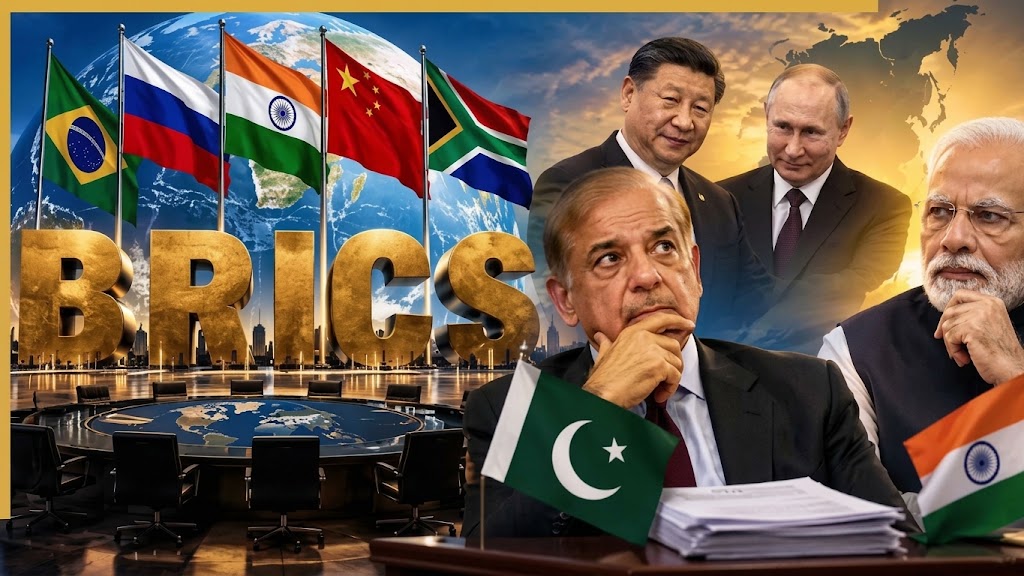
Pakistan’s interest in BRICS is not only about joining a larger economic bloc. It is also about finding a stronger place in a changing global order.
For Pakistan, the importance of BRICS is closely linked with its long-standing strategic partnership with China. As BRICS expands its economic and diplomatic role, greater engagement with the group could give Pakistan another platform to strengthen cooperation with China while developing ties with other major emerging economies.
Pakistan formally applied for BRICS membership in 2023. It has presented its application as part of its support for inclusive multilateralism and greater cooperation among developing countries. Pakistan is still outside the group, but its interest in joining remains part of its broader diplomatic and economic strategy.
China and Pakistan’s Strategic Partnership
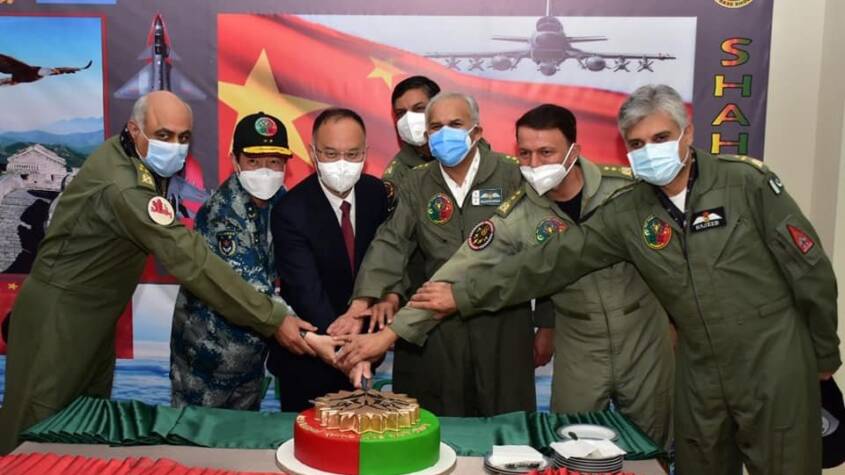
China is central to Pakistan’s approach to BRICS. The two countries marked 75 years of diplomatic relations in 2026. During Prime Minister Shehbaz Sharif’s May visit to Beijing, Pakistan reaffirmed that its All-Weather Strategic Cooperative Partnership with China remains a cornerstone of its foreign policy.
The relationship now extends well beyond traditional diplomacy. Trade, investment, infrastructure, agriculture, technology, education and industrial development have become important areas of bilateral cooperation.
CPEC is one of the most visible examples. During its first phase, Chinese cooperation supported major investments in Pakistan’s energy and infrastructure sectors, including the addition of nearly 8,000 MW of power-generation capacity.
The next phase is expected to place greater emphasis on industry, agriculture, minerals, technology, human-resource development and business-to-business cooperation. This gives China an important role in Pakistan’s engagement with the wider BRICS framework.
BRICS Offers a Wider Platform
BRICS has changed considerably since its formation by Brazil, Russia, India, China and South Africa.
The group now has 11 members, including China, India, Russia, Brazil, South Africa, Egypt, Ethiopia, Indonesia, Iran, Saudi Arabia and the United Arab Emirates. Its expansion has increased its importance across the Global South.
The 2026 BRICS summit in New Delhi highlighted economic cooperation, local-currency trade, technology and reform of international institutions.
China has also promoted greater economic and technological cooperation within the expanded bloc. At the 2026 summit, President Xi Jinping proposed initiatives covering artificial intelligence, economic cooperation and services.
For Pakistan, these developments matter because BRICS is increasingly becoming a platform for practical cooperation rather than only political dialogue.
Many of its emerging priorities overlap with Pakistan’s own development needs.
Where CPEC Fits In
Pakistan does not have to view BRICS and CPEC as separate tracks. CPEC already provides a foundation for Pakistan-China economic cooperation. Greater engagement with BRICS could complement this relationship by connecting Pakistan with additional markets, institutions and development partners.
CPEC 2.0 is particularly relevant.
In 2026, Pakistan and China agreed to strengthen the political and institutional foundation of their cooperation. The next phase is expected to focus on productivity, innovation, green development, employment, livelihoods and regional connectivity.
The emphasis is also shifting toward business-to-business cooperation. Pakistani and Chinese institutions are exploring opportunities in industry, agriculture, minerals, technology and special economic zones. This direction fits naturally with several BRICS priorities.
If Pakistan eventually joins the grouping, its existing relationship with China could help it participate more effectively in cooperation on industrial development, technology, infrastructure and regional connectivity.
Pakistan’s Diplomatic Approach
Pakistan’s BRICS application also reflects a broader approach to diplomacy.
Islamabad maintains important relationships with China, the Gulf states, Central Asian countries, Russia and Western institutions. Engagement with one partner does not necessarily require Pakistan to reduce cooperation with another.
BRICS could add another layer to this approach. Pakistan can use multilateral platforms to pursue economic and diplomatic interests while maintaining its bilateral relationships. China is particularly important in this process because the two countries already have extensive institutional and economic links.
In their May 2026 joint statement, Pakistan and China expressed support for an inclusive global economic order and an equal and orderly multipolar international system.
The two countries also agreed to strengthen cooperation on artificial intelligence and global AI governance. For Pakistan, such cooperation creates opportunities to develop a stronger voice on emerging global issues, including technology and digital development.
The India Factor
Pakistan’s BRICS application exists within a complicated regional environment.
India is a founding BRICS member and hosted the 2026 summit in New Delhi. BRICS expansion decisions require agreement among existing members, making broad diplomatic support important for any future Pakistani application.
This makes Pakistan’s approach particularly important.
Rather than treating BRICS as another arena for regional rivalry, Islamabad can continue presenting its membership bid as part of its commitment to economic cooperation, regional stability and inclusive multilateralism.
This approach would also allow Pakistan to strengthen relations with other BRICS members regardless of the outcome of its membership application.
The immediate objective, therefore, should not be membership for its own sake. Pakistan can use the diplomatic process itself to develop stronger economic and political connections across the BRICS community.
A Chance to Build New Connections
For Pakistan, one of the potential benefits of BRICS engagement is the opportunity to build new economic connections.
Agriculture, minerals, technology, pharmaceuticals, engineering, digital services and manufacturing could all benefit from wider commercial relationships with emerging economies.
Infrastructure and connectivity offer another opportunity. Pakistan’s geographical position gives it potential to connect South Asia with China, Central Asia and the Middle East. CPEC provides an important foundation for this connectivity.
Greater engagement with BRICS economies could help Pakistan explore additional trade and investment links around that foundation.
However, membership alone would not guarantee these results. Pakistan would still need competitive exports, reliable infrastructure, stronger industrial capacity and an investment environment capable of attracting long-term businesses.
China as a Strategic Advantage
Pakistan’s relationship with China gives it a strong starting point. The two countries are already working to move CPEC from an infrastructure-focused model toward a broader partnership involving industry, technology, agriculture, innovation and human-resource development.
This direction overlaps with several areas of growing BRICS cooperation. China’s strength in advanced manufacturing, digital technology, artificial intelligence and green development also creates opportunities for Pakistan to seek deeper cooperation and knowledge-sharing.
For Pakistan, the opportunity is therefore not simply to enter another international grouping. It is to use its existing strategic partnerships to participate more effectively in new forms of South-South cooperation.
Looking Beyond Membership
Pakistan’s BRICS application should be viewed as part of a longer diplomatic and economic strategy. Membership would create opportunities, but the larger objective is to strengthen Pakistan’s position in the evolving global economic system.
China will remain an important part of that strategy. The 75-year Pakistan-China relationship has already produced cooperation across infrastructure, energy, trade, technology and people-to-people links. CPEC 2.0 now aims to take that partnership into new areas.
BRICS could provide another platform for this evolution. For Pakistan, the most valuable outcome would be a combination of stronger China-Pakistan cooperation, wider engagement with emerging economies and a more active role in multilateral diplomacy.
The direction is already visible. The challenge now is to turn diplomatic interest into practical economic and strategic gains.
Read More Articles:
Why BRICS Matters for Pakistan’s Economic Future
China Pushes AI and Trade Cooperation in BRICS
Pakistan and BRICS: What Membership Could Mean for Trade and Investment