
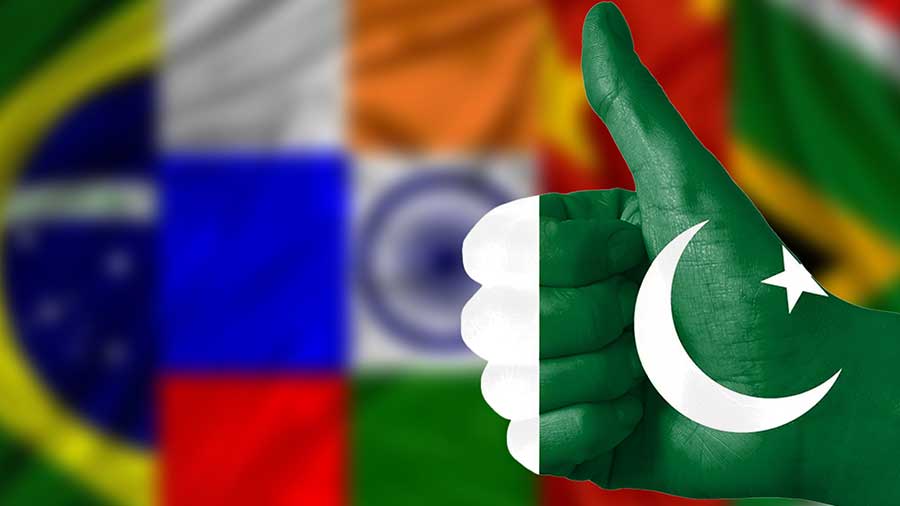
Pakistan’s effort to join BRICS has gained renewed attention following the group’s 18th summit in New Delhi on September 12–13, 2026. The expanded grouping now includes 11 full members, including China, India, Russia, Brazil, South Africa, Iran, Indonesia, Egypt, Ethiopia, Saudi Arabia and the United Arab Emirates.
For Islamabad, BRICS offers more than a diplomatic seat. Pakistan sees the grouping as a possible platform for expanding trade, attracting investment and strengthening its position among emerging economies. Membership, however, would not automatically increase exports or resolve the country’s financial problems. The real benefit would depend on Pakistan’s ability to convert diplomatic access into practical commercial cooperation.
A Larger Economic Grouping
BRICS began as an economic grouping of Brazil, Russia, India and China. South Africa joined in 2011, while Egypt, Ethiopia, Iran, Indonesia, Saudi Arabia and the UAE entered during the bloc’s recent expansion.
According to figures presented by India’s Press Information Bureau, the 11 members collectively represent around 49.5 percent of the world’s population, 40 percent of global GDP and 26 percent of global trade. These figures explain why BRICS has become increasingly important for countries seeking a greater role in global economic decision-making.
The grouping now works across three broad areas: political and security cooperation, economic and financial coordination, and cultural and people-to-people exchanges. The 2026 New Delhi Declaration also highlighted innovation, sustainability, resilience and reform of global institutions.
For Pakistan, the economic and financial pillar is likely to be the most important.
Pakistan’s Membership Application
Pakistan formally applied for BRICS membership in November 2023. Islamabad said it wanted to contribute to international cooperation and support a more inclusive global order.
Pakistan has also highlighted its relations with several existing members, particularly China and Russia. These relationships may support Islamabad’s diplomatic campaign, but they cannot guarantee admission.
BRICS decisions on expansion require consensus among existing members. Every member therefore has a role in approving a new applicant.
India remains the most difficult factor. Pakistan and India have a deeply strained political relationship, and New Delhi’s position has complicated Islamabad’s efforts to enter the grouping. As of the 2026 summit, Pakistan’s application remained unresolved.
The Trade Opportunity
BRICS membership could give Pakistan another platform for trade diplomacy.
Pakistan’s exports remain concentrated in a limited number of markets and product categories. Textiles, rice, leather, sporting goods and surgical instruments remain important export sectors, but the country has struggled to move consistently into higher-value manufacturing, processed food and technology services.
The BRICS grouping includes several large and commercially diverse markets. China offers opportunities in manufacturing, agriculture, technology and logistics. The UAE and Saudi Arabia are important commercial and investment centres. Indonesia provides access to a large Southeast Asian consumer market, while Brazil and South Africa offer further opportunities in food, minerals, industrial goods and services.
Potential sectors for Pakistani exporters include agriculture, processed food, pharmaceuticals, minerals, engineering goods, information technology, technical textiles and logistics.
The opportunity is significant, but access to a market does not guarantee success in it. Pakistani exporters would still need to meet international standards, maintain consistent supply, improve packaging and secure reliable transport links.
Local-Currency Trade
One of BRICS’ most discussed economic priorities is the expansion of trade in local currencies.
The 2026 New Delhi Declaration supported stronger cooperation on cross-border payments, local-currency settlements and financial connectivity. It also referred to work on the interoperability of central bank digital currencies and other payment-related initiatives.
For Pakistan, such arrangements could eventually reduce some of the costs associated with transactions conducted entirely through the US dollar. They could also provide additional options for businesses trading with countries that have strong commercial relationships with Islamabad.
The benefits would depend on practical arrangements. Local-currency trade requires stable exchange mechanisms, trusted banking channels, convertibility and sufficient trade flows in both directions.
Pakistan would therefore need to negotiate workable settlement systems rather than assume that BRICS membership would immediately resolve its foreign-exchange challenges.
Investment Is the Bigger Test
Trade access is only one part of Pakistan’s economic needs. The country also requires investment in production capacity.
Pakistan needs capital for energy, transport, mining, agriculture, industrial zones, digital infrastructure and export-oriented manufacturing. BRICS members include major state-owned enterprises, private companies, sovereign investment institutions and development-finance organisations.
Pakistan could use BRICS engagement to present specific investment opportunities instead of relying on broad cooperation statements. Industrial parks, mineral-processing facilities, renewable-energy projects, logistics centres and technology partnerships would provide clearer entry points for foreign investors.
An MoU signals interest. It does not automatically create a factory, production line or job.
A meaningful investment cycle begins when a commitment moves into financing, land allocation, construction, production, local supply-chain development and exports. Pakistan’s challenge is to ensure that diplomatic agreements reach that stage.
The New Development Bank
The BRICS economic ecosystem also includes the New Development Bank, established in 2015 by Brazil, Russia, India, China and South Africa.
The bank finances infrastructure and sustainable-development projects in areas such as transport, clean energy, water, urban development and digital infrastructure. Its membership has expanded beyond the original five countries, and BRICS leaders have continued to support further institutional expansion.
For Pakistan, stronger engagement with the bank could create another possible channel for development finance. This would be relevant as Islamabad faces major needs in energy, transport, climate resilience and urban infrastructure.
Access to a development bank, however, is not the same as guaranteed financing. Projects must meet financial, environmental and implementation requirements. Pakistan would need credible institutions, bankable proposals and the capacity to complete projects on time.
China’s Role
China is central to Pakistan’s BRICS calculations. Beijing is Pakistan’s major strategic partner and an important source of infrastructure, technology and investment cooperation. The China-Pakistan Economic Corridor has already created a framework for collaboration in energy, transport, industrial development and connectivity.
BRICS membership could give Pakistan another channel for engaging China on trade, investment and technology. It could also place Pakistan in wider discussions involving other emerging economies rather than limiting its economic diplomacy to bilateral negotiations.
At the same time, Pakistan should not treat BRICS as an extension of the China-Pakistan relationship. The bloc includes countries with competing interests and different economic priorities. Islamabad would need separate commercial strategies for China, the Gulf states, Southeast Asia, Africa and Latin America.
What Pakistan Must Improve
The main challenge is not simply gaining entry. It is becoming competitive enough to benefit from entry.
Pakistani exporters face recurring problems involving energy costs, logistics, taxation, regulatory uncertainty, product certification and limited access to affordable finance. These issues can discourage foreign investors even when diplomatic relations are strong.
Pakistan must also improve the implementation of investment agreements. Investors look for predictable policies, reliable infrastructure, transparent regulations and the ability to repatriate profits. Political support can attract attention, but institutions determine whether projects move forward.
This matters because Pakistan would compete with many other emerging economies for BRICS-related investment. Geography and diplomatic relationships may create interest, but they cannot replace a stable business environment.
A Platform, Not a Solution
Pakistan’s BRICS application reflects Islamabad’s broader effort to diversify its foreign economic relations. The country wants stronger links with emerging markets and greater participation in institutions that give developing countries a larger voice.
The potential benefits are real. BRICS could improve Pakistan’s access to trade networks, investment discussions, development-finance channels and diplomatic engagement. It could also support cooperation in local-currency payments, technology, agriculture, infrastructure and industrial development.
Membership, however, would not automatically increase exports, attract investment or reduce dependence on traditional financial institutions.
Pakistan’s success would depend on what it does after gaining access. If Islamabad improves its export capacity, strengthens regulatory institutions and presents credible investment projects, BRICS could become a useful economic platform.
Without those reforms, membership would remain mainly a diplomatic achievement rather than a major change in Pakistan’s economic position.
Read More Articles:
Why BRICS Matters for Pakistan’s Economic Future