

New Era of Land Warfare
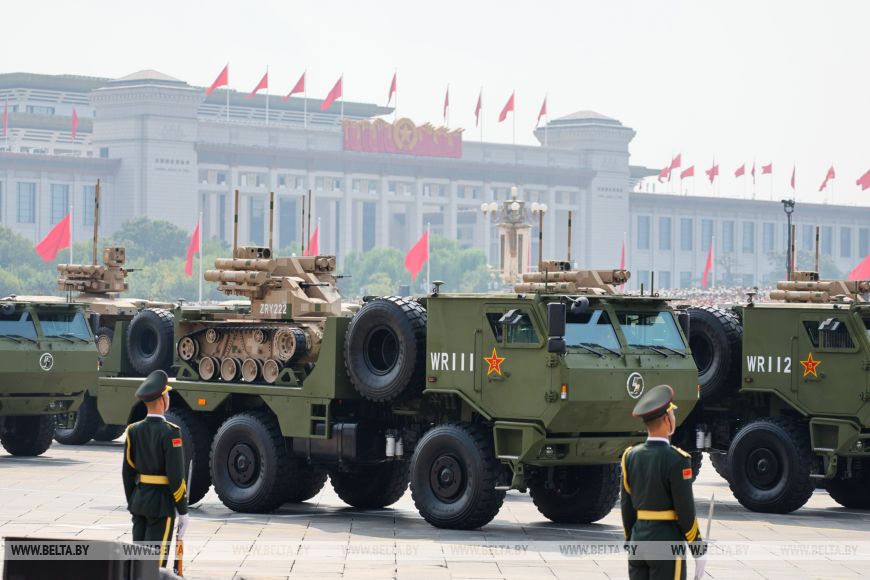
At Beijing’s V-Day parade marking the 80th anniversary of victory in the Chinese People’s War of Resistance Against Japanese Aggression and the World Anti-Fascist War, China unveiled a formation of unmanned land-based combat systems. The display marked a major step in integrating robotics into modern battlefield operations.
Diverse Roles and Designs
The systems included unmanned combat vehicles for reconnaissance, assault, mine clearance, bomb disposal, and unit support. Military experts noted that these robots can operate via remote control or autonomous navigation, offering flexible deployment and reducing human risk. Their designs varied from wheeled and tracked vehicles to quadruped robots, making them adaptable to different terrains such as mountains, urban ruins, and coastal battlefields.
Heavy Payload and Multi-Mission Capabilities
The equipment can carry a range of payloads, from machine guns and rocket launchers to drones and electronic devices. This versatility allows them to provide reconnaissance, suppress enemy fire, conduct explosive disposal, and offer direct firepower support. Experts highlighted that their advanced intelligence and network integration enable them to work alongside human units, enhancing overall combat effectiveness.
Key Battlefield Applications
Analysts emphasised their potential in high-risk environments like amphibious landings and urban warfare. With strong mobility and advanced sensors, these unmanned systems can detect hidden threats such as snipers and support troops with precision firepower. Their “steel bodies” and “iron will” allow them to lead dangerous assaults, easing the risks for soldiers.
Psychological and Strategic Impact
Experts pointed out that the presence of relentless machines on the battlefield adds psychological pressure on adversaries, potentially reshaping combat dynamics. Previous reports confirm that some unmanned platforms, including the “robot wolf,” have already been tested in PLA exercises and international drills, signalling that China’s manned-unmanned coordinated combat has reached operational maturity.
Technological Backbone
The success of such systems relies on robust information networks and anti-electronic warfare resilience. With heavy investment in these technologies, experts say China now ranks among the global leaders in unmanned land combat capability.
Related stories:
China Unveils Complete Antiballistic Missile System at V-Day