

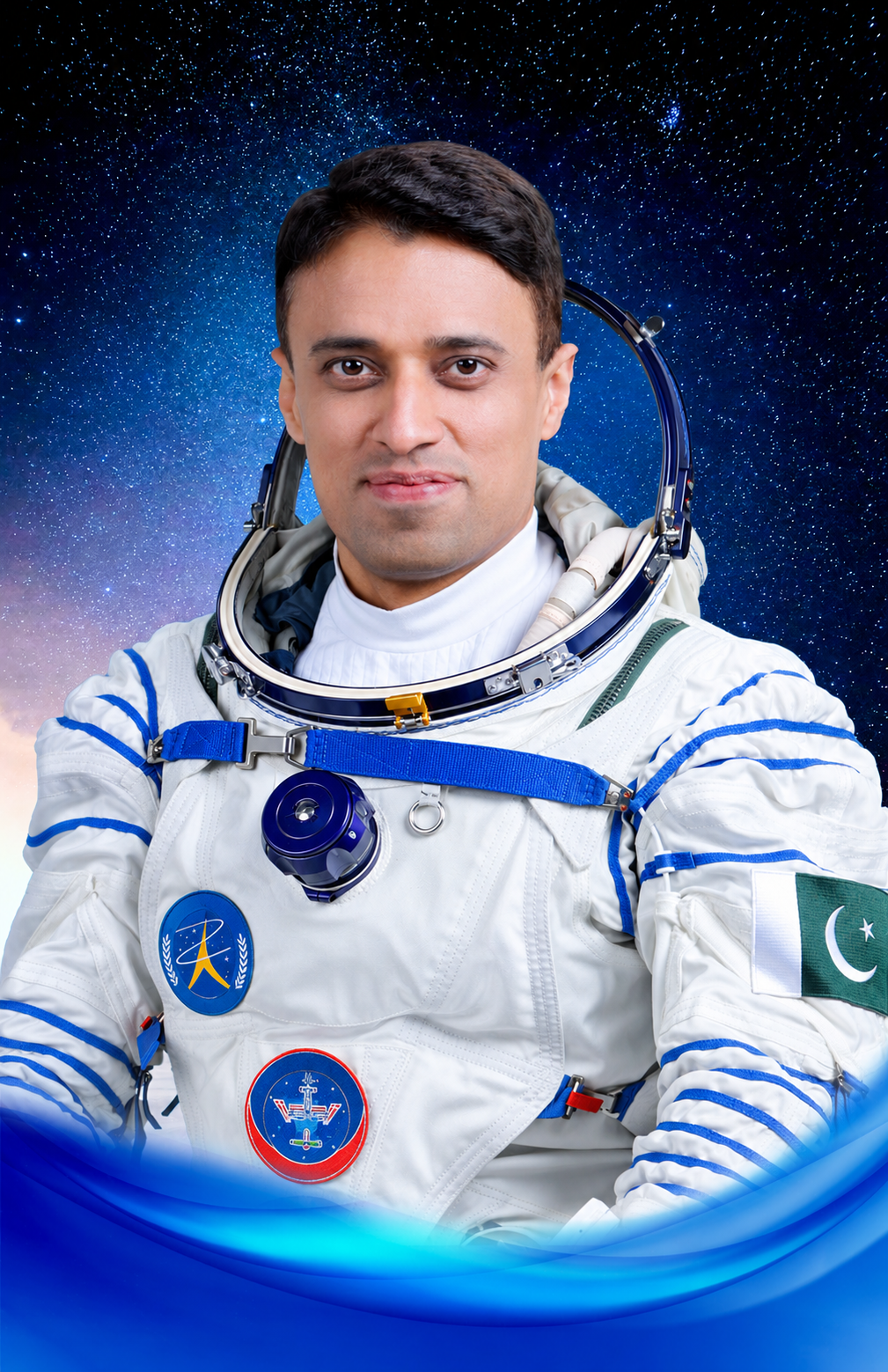
Pakistan’s astronaut Muhammad Zeeshan Ali is set to make history on November 25 as a member of China’s Shenzhou-24 crewed space mission, marking a major milestone in Pakistan-China space cooperation.
The China Manned Space Agency (CMSA) announced on November 24 that the spacecraft would lift off from the Jiuquan Satellite Launch Centre in northwest China at 8:18 a.m. Beijing time, corresponding to 5:18 a.m. Pakistan Standard Time.
The mission will carry three astronauts: Chinese commander Tang Hongbo, Chinese flight engineer Wu Yi and Pakistani payload specialist Muhammad Zeeshan Ali.
Ali’s participation will make him the first Pakistani to travel into space and the first foreign astronaut to visit China’s Tiangong space station. It will also mark the first time a foreign astronaut has joined a crewed flight under China’s human spaceflight programme.
Shenzhou-24 crew and mission details
Tang Hongbo will command the mission, while Wu Yi will serve as flight engineer. Ali will join them as a payload specialist, focusing primarily on scientific experiments conducted under the China-Pakistan space cooperation programme.
Tang has previously travelled to space aboard the Shenzhou-12 and Shenzhou-17 missions. With Shenzhou-24, he is set to become the first Chinese astronaut to visit the Tiangong space station three times.
Wu, who belongs to China’s third batch of astronauts, will undertake his first spaceflight.
According to CMSA, the crew is in good condition and preparations for the launch have been completed. The Shenzhou-24 spacecraft and its Long March-2F carrier rocket were transferred to the launch area on November 17.
Four joint scientific projects to be conducted in orbit
The mission will carry four joint China-Pakistan scientific projects covering biotechnology and materials research.
Ali will oversee experiments, install research samples and equipment, and conduct tests during his stay aboard Tiangong. One of his assignments involves an experiment using photosynthetic cyanobacteria, microorganisms that use photosynthesis to produce energy.
The research forms part of a wider effort to develop scientific knowledge through experiments conducted in the space station’s microgravity environment.
Pakistan’s participation will also provide an opportunity for local researchers and institutions to contribute to international space science projects. The selected experiments originated from research proposals submitted by Pakistani institutions and universities.
Ali to return to Earth aboard Shenzhou-23
Unlike the regular crew members, who will remain aboard Tiangong for a longer mission, Ali is scheduled for a short-term stay of approximately five to ten days.
After completing his assignments, he will return to Earth aboard the Shenzhou-23 spacecraft with Chinese astronauts Zhang Zhiyuan and Li Jiaying.
Meanwhile, Tang Hongbo, Wu Yi and Shenzhou-23 astronaut Zhu Yangzhu will continue their work aboard the space station following the crew handover.
Zhu is expected to remain in orbit for a year as part of China’s research into the effects of long-duration spaceflight on the human body.
Pakistan-China astronaut agreement paved the way
The mission follows a cooperation agreement signed on February 28, 2025, between China’s space authorities and Pakistan’s Space and Upper Atmosphere Research Commission (SUPARCO) in Islamabad.
Under the agreement, China committed to selecting and training Pakistani astronaut candidates, with one astronaut joining a short-duration mission aboard the Tiangong space station.
Two candidates, Muhammad Zeeshan Ali and Khurram Daud, were shortlisted in 2026 and undertook advanced training at China’s Astronaut Centre.
The programme included preparation for scientific experiments, space station operations and mission-related activities. Ali was ultimately selected for the Shenzhou-24 crew as a payload specialist.
The agreement represents an expansion of bilateral cooperation beyond satellite development and launches into human spaceflight, astronaut training and scientific research.
Pakistan and China highlight growing space partnership
The Pakistan Embassy in Beijing described the upcoming mission as a historic milestone in the longstanding friendship between the two countries and extended its best wishes to the astronauts.
The Shenzhou-24 mission’s emblem also features jasmine, Pakistan’s national flower, reflecting the significance of Pakistan’s participation in the flight.
Speaking at a press conference ahead of the launch, Ali thanked the Chinese government and the Astronaut Centre of China for their training and support. He said the mission represented joint efforts towards the peaceful exploration and use of outer space.
He also expressed hope that cooperation would expand from the first joint astronaut mission to further flights and future exploration of the Moon and Mars.
The upcoming flight marks a new phase in Pakistan’s human spaceflight programme. It will also give Pakistani researchers an opportunity to participate directly in scientific work aboard China’s operational space station.
Read More Articles:
Pakistan’s First Astronaut to Spend One Week in Space