
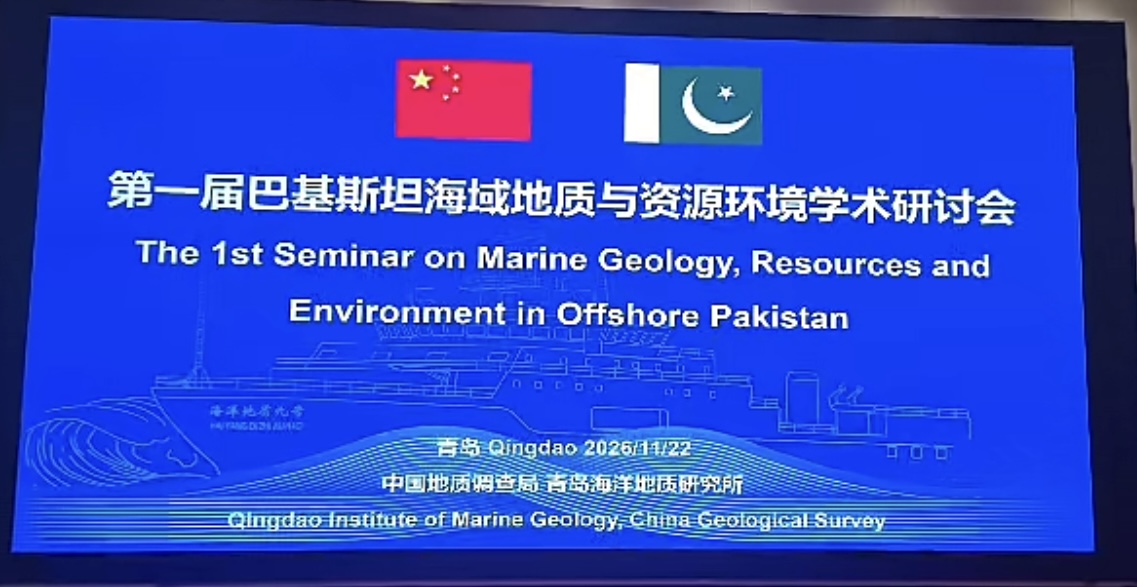
China and Pakistan have released a new framework for marine scientific cooperation, known as the Qingdao Initiative on China-Pakistan Marine Geoscience Cooperation, following a two-day seminar in the Chinese coastal city of Qingdao.
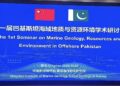
The First Seminar on Marine Geology, Resources and Environment in Offshore Pakistan took place on November 21 and 22. It brought together more than 40 Chinese experts and scholars, along with eight Pakistani visiting scholars and students.
Organized by the Qingdao Institute of Marine Geology under the China Geological Survey, the seminar focused on scientific research into offshore Pakistan’s marine resources, geological structures and environmental conditions.
The participants called for stronger research partnerships, improved marine science and technology platforms, greater support for young researchers and closer coordination on marine resource development and ecological protection.
The initiative also seeks to establish a stronger framework for China-Pakistan marine cooperation under the Belt and Road Initiative (BRI).
Seminar explores offshore oil, gas and marine resources
The seminar examined several scientific areas linked to Pakistan’s offshore regions and neighbouring waters.
A major focus was the exploration of offshore oil and gas resources, including natural gas hydrates. Researchers also discussed the geological evolution of the region, coastal resources, environmental conditions and geological hazards.
The event featured 19 academic presentations covering a range of research topics, including:
- Offshore oil and gas exploration and assessment.
- Gas hydrate accumulation models and numerical simulations.
- Regional tectonic evolution and mineralization.
- Coastal resource management and environmental risk assessment.
- Geological hazards affecting coastal areas.
- Satellite remote sensing for marine environmental monitoring.
These discussions provided a platform for Chinese and Pakistani researchers to exchange scientific knowledge and identify areas for future joint investigations.
Research into gas hydrates and offshore hydrocarbon resources was particularly relevant to Pakistan’s efforts to assess its marine resource potential. However, the seminar’s discussions and research priorities do not in themselves establish commercially recoverable reserves or confirm new discoveries.
Qingdao Initiative outlines five cooperation priorities
The newly released Qingdao Initiative identifies several areas where both countries can strengthen their scientific and institutional partnerships.
First, it calls for deeper joint research in marine geoscience, allowing researchers to share expertise and conduct collaborative studies on offshore geological structures and marine resources.
Second, the initiative emphasizes developing marine science and technology innovation platforms to support research, technological advancement and the application of scientific findings.
Third, it highlights training and professional development for young researchers. Academic exchanges, research opportunities and technical cooperation are expected to help strengthen Pakistan’s marine science capabilities.
The initiative also calls for supporting sustainable marine resource development alongside ecological protection. This reflects the importance of balancing economic opportunities with the conservation of marine ecosystems.
Finally, it seeks to establish a broader framework for bilateral marine cooperation under the Belt and Road Initiative, encouraging continued institutional engagement and long-term scientific collaboration.
Cooperation builds on previous joint marine surveys
The latest initiative builds on several years of scientific cooperation between the Qingdao Institute of Marine Geology and Pakistani institutions.
China and Pakistan signed a memorandum of understanding on marine science cooperation in 2019, providing a foundation for joint research, scientific exchanges and the assessment of marine resources.
Between 2018 and 2022, the two countries conducted three joint scientific expeditions in Pakistani waters. The surveys generated geological and scientific data that could support further research into natural resources within Pakistan’s maritime areas.
In August 2023, China Geological Survey handed over data from the joint marine geological surveys at its headquarters in Beijing. The ceremony was attended by Pakistani Ambassador to China Moin ul Haque and representatives of the Chinese geological research institutions.
The data was expected to help expand scientific research and improve understanding of Pakistan’s offshore mineral and hydrocarbon potential.
Marine cooperation included in China-Pakistan Action Plan 2025–2029
The Qingdao Initiative also aligns with the broader commitments outlined in the China-Pakistan Action Plan to Foster an Even Closer Community with a Shared Future in the New Era for 2025–2029.
The official action plan identifies maritime cooperation as an important area of bilateral engagement. It calls for stronger collaboration in marine economic development, sustainable use of marine resources, scientific research and environmental protection.
It also specifically highlights joint geological surveys, resource assessments in Pakistan and deeper cooperation in offshore oil and gas resources.
Under the plan, both countries aim to build on three previous rounds of joint surveys and conduct a comprehensive study to improve understanding of regional oil and gas geology.
The document also encourages cooperation on offshore natural gas hydrate research and marine science and technology under the existing bilateral cooperation framework.
Expanding Pakistan’s marine research capabilities
The latest development creates additional opportunities for Pakistani researchers and scientific institutions to work with Chinese counterparts on marine geology, resource assessment and environmental monitoring.
Joint research, access to scientific platforms and training programmes could help strengthen technical expertise and improve Pakistan’s capacity to study its offshore regions.
The cooperation also brings together two important priorities: assessing the economic potential of marine resources and protecting coastal and marine ecosystems.
While the Qingdao Initiative sets out areas for closer collaboration, its practical impact will depend on the research programmes, institutional partnerships and projects developed under the framework.
The seminar marks another step in the expansion of China-Pakistan scientific cooperation, with marine geoscience emerging as an important area for future research and sustainable maritime development.
Read More Articles:
Zeeshan Ali to Make History on Shenzhou-24 Mission