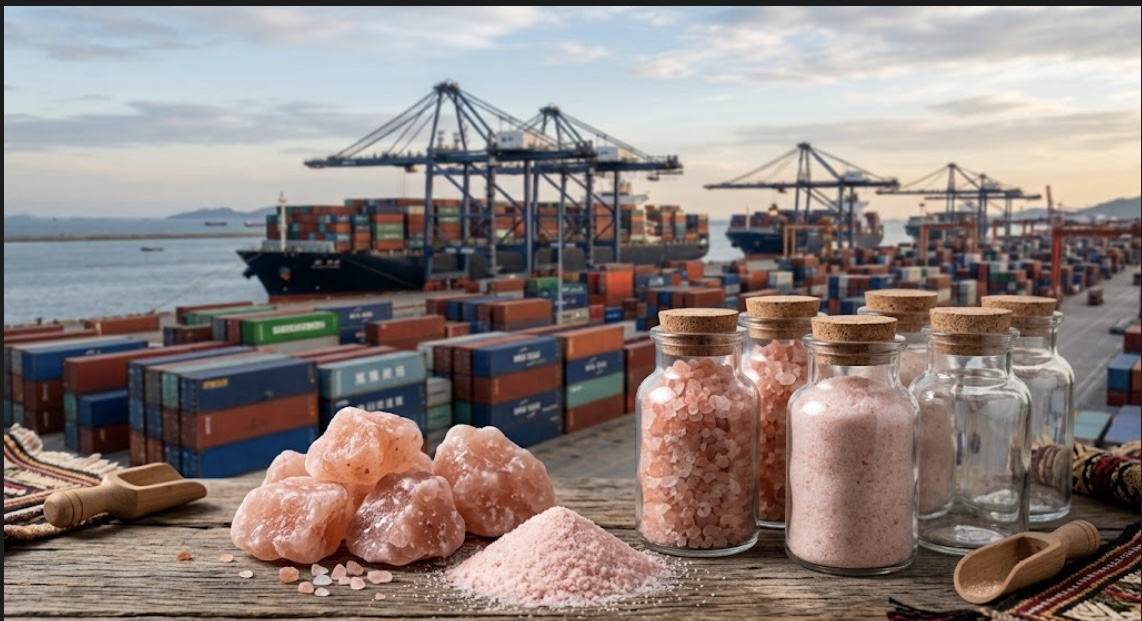
Pakistan’s Himalayan pink salt industry has an established presence in international trade. China is already one of its export destinations. However, Pakistani businesses have an opportunity to capture more value from this trade.
Himalayan pink salt could offer a promising avenue for growth. Exporters can explore better processing, retail packaging, and branding. These steps may help them move beyond bulk shipments.
However, entering a large market does not guarantee higher profits. Pakistani businesses must understand Chinese buyers’ requirements. They must also assess production costs, regulatory obligations, and market demand.
World Bank World Integrated Trade Solution (WITS) data, based on UN Comtrade, show that Pakistan exported approximately US$77.80 million worth of salt and related products in 2025. These exports fall under Harmonized System (HS) code 250100. China accounted for approximately US$7.15 million.
These figures confirm that China is an existing market for Pakistani salt. However, they do not show how much trade involved branded Himalayan pink salt. They also do not identify the share of finished consumer products or higher-value processed goods.
The real opportunity lies in capturing more value from each shipment. Pakistani exporters must identify products that Chinese buyers want. They must then determine whether processing and branding can generate sustainable returns.
What the Trade Figures Reveal
Pakistan’s worldwide salt exports reached approximately US$77.80 million in 2025. In 2024, the figure stood at US$76.72 million.
Exports to China also increased. They rose from approximately US$4.85 million in 2024 to US$7.15 million in 2025. This represents an increase of roughly 47 per cent in reported export value.
The increase is significant, but it requires careful interpretation. One year of growth does not establish a long-term trend. It also does not prove that value-added products drove the increase.
HS code 250100 covers salt and pure sodium chloride, including sea water. It does not distinguish Himalayan pink salt from other products within the same classification. Nor does it identify specific brands or retail formats.
A separate Associated Press of Pakistan report cited Chinese customs data. It placed Pakistan’s 2025 salt exports to China at approximately US$7.18 million. This figure differs slightly from the WITS estimate.
The difference may reflect variations in reporting or data aggregation. This article uses WITS figures for consistency.
The available data provide a useful starting point. However, a deeper assessment requires more detailed information. Exporters need product-level trade data, buyer information, and evidence about prices and profit margins.
Sources: World Bank WITS, 2024–2025 trade data; Associated Press of Pakistan, 29 January 2026.
Why Value Addition Matters
Value addition means improving a product’s usefulness, quality, or marketability. In the salt industry, this can take several forms.
Businesses can process, grade, and package salt for specific buyers. They can also develop specialised products for different market segments.
However, each category has different requirements.
Food-grade salt must meet applicable safety and quality standards. Industrial buyers often prioritise consistent specifications and reliable supply. Decorative products, such as salt lamps, compete on design, finishing, and customer preferences.
These markets require different business strategies.
Pakistani exporters should identify the categories with realistic commercial potential in China. They must also determine whether local processing can meet buyer requirements at a competitive cost.
Higher selling prices do not automatically mean higher profits. Processing, packaging, testing, transportation, and marketing all add expenses.
Businesses must also account for distribution costs and regulatory compliance. The goal should be to increase the value retained by Pakistani suppliers. Simply selling a more expensive product is not enough.
How Pakistan Can Move Beyond Bulk Salt Exports
1. Process Products for Specific Buyers
Processing can help Pakistani exporters meet the needs of particular customers.
For example, buyers may request specific grain sizes. They may also require consistent product specifications or customised packaging. Meeting these requirements could help exporters serve specialised markets.
The necessary investment will depend on the product. Some businesses may need sorting equipment or processing machinery. Others may require better testing facilities and quality-control systems.
Exporters should consult potential buyers before making these investments. They should confirm product specifications and assess expected demand.
Investing without confirmed demand can create unnecessary costs. Businesses may end up with expensive equipment and products that are difficult to sell.
A buyer-led approach can reduce this risk. It allows exporters to test commercial opportunities before expanding production.
2. Develop Retail-Ready Packaging
Retail packaging can make products easier to identify and market. It can also communicate product specifications, origin, and intended use.
Himalayan pink salt offers several possible formats. These include consumer cooking products, food-service packaging, and decorative items.
However, packaging decisions must reflect actual market demand. Pakistani businesses should not assume that Chinese consumers prefer the same formats as domestic buyers.
Chinese retailers may have different price expectations. They may also require specific labels, packaging sizes, and product information.
Exporters should investigate these requirements before production. They must also check the rules governing product claims and labelling.
Good packaging can improve a product’s marketability. However, it only creates commercial value when buyers are willing to pay enough to cover the additional costs.
3. Build Credible Brands
Branding can help Pakistani products stand out in competitive markets. However, it involves more than a logo or an attractive label.
Buyers need confidence in product quality. They also expect consistent specifications, traceable sourcing, and dependable supply.
Pakistani businesses could explore these factors when developing their brands. Documented sourcing and reliable quality may help build buyer confidence.
A credible account of the product’s origin could also support differentiation. However, any claims about purity or health benefits must have appropriate evidence. They must also comply with applicable regulations.
Brand development requires time and investment. Businesses should compare these costs with realistic sales forecasts and expected margins.
Some exporters may benefit from partnering with established distributors. This approach could provide market access without the immediate expense of launching an independent consumer brand.
4. Develop Relationships with Chinese Buyers
Access to buyers is essential for entering a new market. Pakistani exporters can explore several channels.
These include trade fairs, business-to-business platforms, verified importers, and targeted commercial outreach. Such channels can help businesses understand buyer requirements and identify potential customers.
The best approach depends on the product.
Industrial salt suppliers may need relationships with manufacturers and bulk distributors. Consumer-product businesses may require retail partners and e-commerce access.
They may also need arrangements for warehousing, marketing, and fulfilment.
Exporters should investigate these options before committing significant resources. They need to understand buyer expectations, commercial terms, and delivery costs.
Early engagement with buyers can also clarify product requirements. This helps businesses select suitable specifications and packaging formats.
China’s Market Is an Opportunity, Not a Guarantee
China has a large consumer and industrial market. However, its size does not guarantee demand for every imported product.
Pakistani exporters would face competition from other suppliers. They would also compete with products already available through established distribution networks.
Several factors will influence their competitiveness. These include product quality, pricing, specifications, and supply reliability. The total cost of delivery will also matter.
Retail-ready Himalayan pink salt may command a higher price per kilogram than bulk salt. However, the final retail price includes several additional costs.
Processors, packaging companies, importers, distributors, and retailers may all take a share. Consequently, Pakistani exporters may receive only a portion of the final price.
Market research must therefore distinguish retail prices from export earnings. A high shelf price does not necessarily translate into strong returns for the supplier.
Businesses should calculate their expected margins carefully. Their calculations must include raw materials, processing, labour, packaging, testing, and transportation.
They should also account for insurance, compliance, marketing, and distribution. This approach can help identify products with sustainable commercial potential.
The best opportunity is not necessarily the product with the highest retail price. It is the product that delivers competitive returns after all costs are considered.
Chinese Import Requirements Matter
Regulatory compliance is another important consideration. Pakistani exporters must understand the rules governing their specific products.
China’s General Administration of Customs (GACC) administers registration requirements for overseas manufacturers of imported food. Revised registration provisions took effect on 1 June 2026.
Exporters should therefore verify the current requirements before entering the market. The applicable rules may depend on product category, intended use, and manufacturing arrangements.
Edible salt, industrial salt, and decorative salt products should not automatically be treated alike. Their regulatory requirements may differ.
Businesses should confirm the correct customs classification. They should also check applicable product standards, labelling rules, and food-safety obligations.
Any manufacturer-registration requirements must also be verified. Qualified trade and regulatory advisers can help clarify these obligations.
These checks should take place before major investments. Otherwise, businesses may face unexpected costs or delays.
Compliance can increase expenses. Testing, documentation, packaging changes, and quality-control systems all require resources.
However, overlooking applicable rules can create more serious problems. Shipments may face delays or rejection. Businesses may also encounter difficulties accessing their intended market.
Sources: Chinese government guidance on overseas food-manufacturer registration; Shanghai Government guidance on the 2026 registration rules.
How Pakistan Can Strengthen Its Position
Pakistan needs better information about its existing salt exports. Trade authorities and industry associations could help businesses identify major product categories and destination markets.
They could also provide information about Chinese buyer requirements. This would help exporters distinguish established opportunities from assumptions about future demand.
The next step is to identify promising product categories. Businesses should focus on products where processing, packaging, or branding offers a credible advantage.
Exporters must then compare the costs of different business models. These calculations should include raw materials, processing, labour, packaging, testing, and transportation.
Insurance, compliance, marketing, and distribution must also be included. This provides a clearer picture of potential profitability.
Pilot shipments could help businesses test their assumptions. They can reveal buyer interest, acceptable prices, and delivery requirements.
Smaller trials may also expose problems before businesses expand. This reduces the risk of committing substantial resources to an unproven product.
Export-promotion institutions could support the process. They could provide verified market intelligence, buyer introductions, and guidance on standards.
Assistance with import procedures would also be useful. However, public support should focus on measurable commercial results.
These results could include repeat orders, higher export revenue, and improved profit margins. Sustainable buyer relationships should also be a priority.
The number of exhibitions attended or promotional campaigns launched is not enough. Support should help businesses secure real commercial opportunities.
The Real Test Is Profitability
Pakistan’s existing salt exports to China provide a foundation for exploring value addition. The trade figures confirm that an established market exists.
The range of potential salt products also creates opportunities worth investigating. However, aggregate export data cannot answer every important question.
They do not show how much Himalayan pink salt is sold as a branded consumer product. They also do not reveal how much value Pakistani businesses retain.
Nor can these figures establish whether finished products generate better returns than bulk exports.
Answering these questions requires product-level trade data and buyer research. Businesses must also assess regulatory requirements and calculate realistic costs.
Pakistan’s Himalayan pink salt industry could capture more value through carefully selected processed and branded products. Success will depend on verified demand, competitive production costs, and regulatory compliance.
Reliable distribution and sustainable profit margins will matter just as much. The long-term opportunity lies beyond simply exporting more salt.
Pakistan needs products and commercial relationships that allow local businesses to retain a greater share of the value generated throughout the supply chain.
Read More Articles :
McDonald’s Pakistan, StarCharge Plan EV Network
Rural E-Commerce in Pakistan: Lessons from China
Rural E-Commerce in Pakistan: Lessons from China