

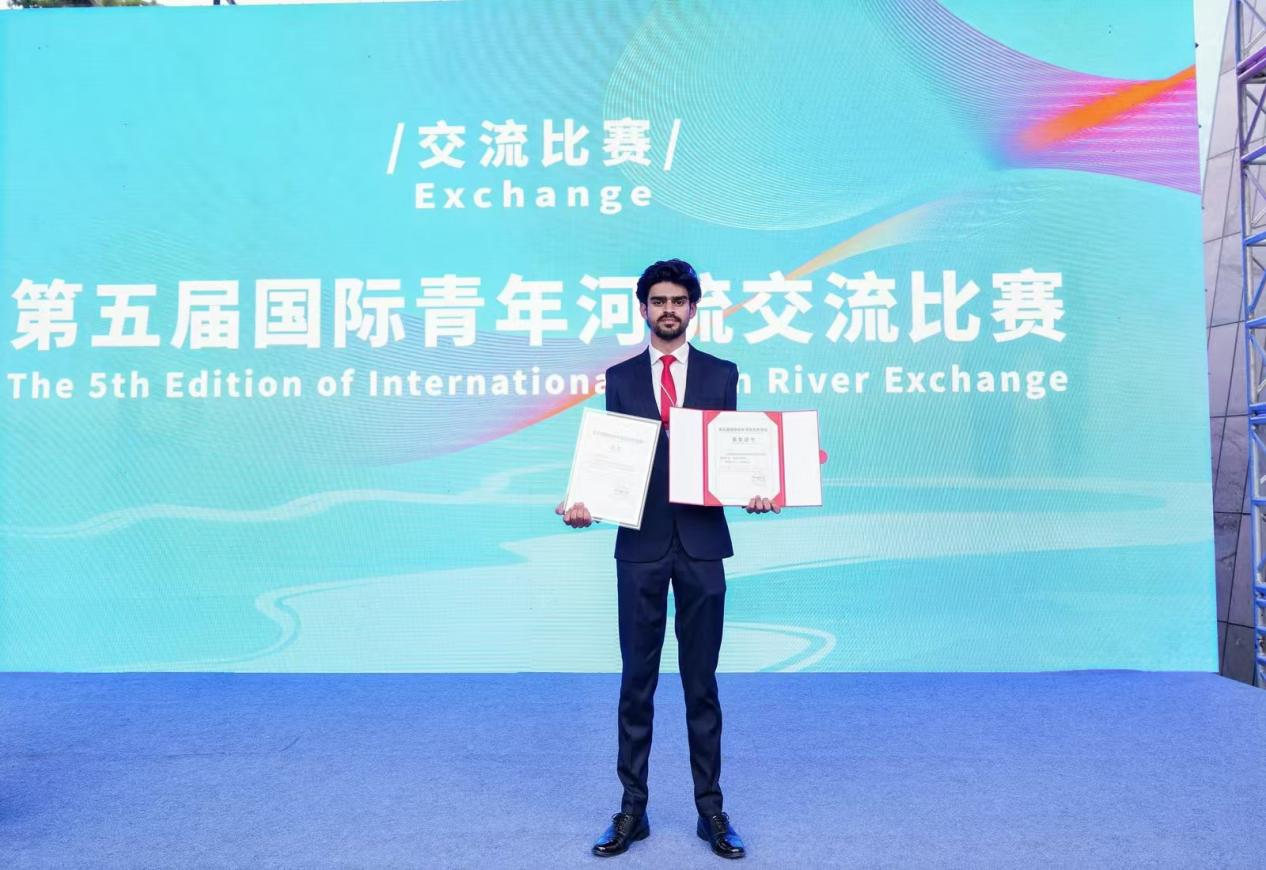
Pakistani student Azib Ali Buraq has won third prize at the 5th International Youth River Exchange in Ningbo, China. He also received the honorary title of “River Messenger.”
The event took place on September 29 in Ningbo, Zhejiang province. Azib is studying Artificial Intelligence at Nanjing University of Information Science and Technology (NUIST).
His presentation highlighted how AI could support sustainable river and irrigation management.
Youth Exchange Focuses on Rivers and Irrigation
The Global Network of Water Museums guided the event. The National Water Museum of China hosted it, while the Ningbo Museum of World Heritage Irrigation Structures organized the program.
Young students from China, South Africa, Morocco, Indonesia, Pakistan, and other countries participated. They discussed the theme of “River and Irrigation” and explored the links between water, society, and development.
AI Approach to Modern Water Management
Azib presented his topic, “The River That Shaped Us,” drawing inspiration from the Yangtze River in Nanjing.
His presentation examined the historical and economic importance of rivers and irrigation. He also introduced an AI-based approach to modern water management.
At the center of his proposal was an AI-integrated Yangtze River–Irrigation Management Model based on Digital Twin technology.
The proposed system would combine data from several sources. These include satellites, weather forecasts, environmental sensors, soil conditions, river levels, reservoirs, and water demand.
AI could then analyze this information to support prediction and simulation. It could also help authorities make decisions about irrigation, water supply, reservoirs, and ecosystem protection.
“Sense, Predict, Simulate, Coordinate, Act, Learn”
Azib summarized his proposed model through six steps:
Sense → Predict → Simulate → Coordinate → Act → Learn
Through this framework, he demonstrated how AI could help stakeholders assess different water management scenarios.
For example, the system could analyze changes in rainfall, agricultural demand, and reservoir levels. This could support more informed and coordinated planning.
Learning From Traditional Water Engineering
As part of the exchange, participants visited the Tuoshan Weir. The site is recognized as a World Heritage Irrigation Structure.
The visit gave participants an opportunity to explore traditional water management practices. For Azib, it also showed how modern technology could complement traditional engineering knowledge.
He said the experience strengthened his interest in applying AI to complex global challenges.
Building Youth Cooperation on Water Issues
The International Youth River Exchange has been held for five years. It encourages university students to explore river ecology, water civilization, and the social and economic role of water.
Moreover, the program promotes water conservation and the concept of harmony between people and water.
Azib’s achievement adds a Pakistan-China dimension to these exchanges. It also highlights the potential for young professionals to contribute technology-based ideas to global water management challenges.
Read More Articles:
Xinjiang’s Role in Driving CPEC 2.0