
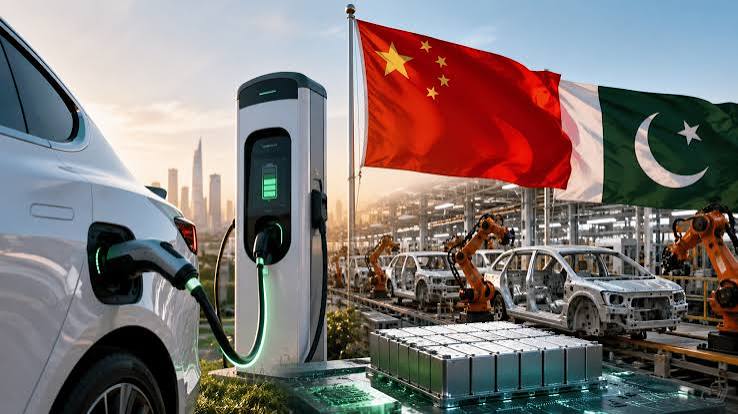
Chinese electric vehicles are moving from a niche product to a serious part of Pakistan’s automotive conversation. Brands such as BYD, GAC, Changan and Deepal are expanding their presence, giving Pakistani consumers more options than they had only a few years ago.
But the bigger story is not simply about which electric car Pakistanis will buy. It is about what Pakistan can build around the arrival of Chinese EV companies.
If Chinese manufacturers bring local assembly, technology, suppliers and investment with them, Pakistan could use the EV transition to strengthen its automotive industry. If not, the country risks becoming mainly a market for imported vehicles.
China’s EV Expansion Is Reaching Pakistan
The timing is significant. Chinese automakers are increasingly looking overseas as competition and weaker demand put pressure on their domestic market. In August 2026, Chinese passenger-vehicle exports rose 77.5% year-on-year to 894,000 units, while domestic sales fell 23.7%. Exports of electric and plug-in hybrid vehicles rose even faster, by 154.7%.
That global push is now reaching Pakistan. Chinese brands are entering a market that has traditionally been dominated by Japanese manufacturers, while Pakistani consumers are becoming more familiar with electric cars, hybrids and other new-energy vehicles.
For consumers, this means more choice and greater competition. For Pakistan’s auto industry, however, it raises a much more important question: can the country turn Chinese competition into domestic industrial capacity?
BYD Has Raised the Stakes
BYD has become one of the most visible Chinese EV brands in Pakistan. The company entered the passenger-car market through a partnership with Mega Motor Company, while plans for local assembly have been under development.
Earlier reporting indicated that BYD was targeting an initial production capacity of around 25,000 vehicles a year. The company’s wider strategy has also included the possibility of serving other right-hand-drive markets from Pakistan.
Local assembly would change the nature of BYD’s presence. Instead of simply importing completely built vehicles, production in Pakistan could create demand for local workers, suppliers, technical services and supporting industries. The government has also presented the partnership as an opportunity for technology transfer, industrial development, employment and potential export growth.
The challenge is making sure those benefits actually materialise.
More Chinese Brands Are Entering
BYD is not alone. In May, Lucky Motor Corporation announced its partnership with China’s GAC and began showcasing four electric models from GAC’s Aion and Hyptec lines. The company said it was aiming to begin local assembly as early as December 2026 and was also exploring battery swapping and possible exports to other right-hand-drive markets.
Other Chinese brands are also expanding their visibility in Pakistan, creating a much more competitive EV market than existed previously.
This competition could be useful. It can push companies to improve pricing, after-sales service, charging support and product quality. But it could also expose weaknesses in Pakistan’s existing automotive ecosystem if vehicles arrive faster than the infrastructure and local supply chains needed to support them.
Pakistan Has Set an EV Target
Pakistan already has a policy framework for this transition. The New Energy Vehicle Policy 2025–30 targets electric vehicles reaching 30% of new vehicle sales by 2030. The policy also aims to reduce fuel imports and emissions while encouraging the development of a competitive domestic NEV industry.
That target gives Chinese manufacturers an important role. China has developed one of the world’s largest EV manufacturing ecosystems, covering batteries, vehicles, electronics, charging equipment and related technologies. Chinese companies can therefore offer Pakistan more than finished cars. The opportunity is to connect that technology with Pakistani manufacturing capacity.
The Real Problem Is Infrastructure
Selling more EVs will require more than showrooms. Buyers need reliable charging, accessible maintenance and confidence that they can use their vehicles outside major urban centres.
Pakistan has already begun addressing part of this problem. The government has set out plans to expand public charging infrastructure, while charging tariffs have also been adjusted to encourage investment. Reuters reported in May that Lucky Motors and its partners were considering a major expansion of charging infrastructure alongside the wider EV rollout.
The two-wheeler market shows both the potential and the problems. Electric motorcycles have gained traction as fuel costs have risen, with Chinese manufacturers playing a major role in supplying vehicles and components. But limited after-sales service, charging infrastructure and technical capacity remain obstacles to wider adoption.
Price Will Decide How Far EVs Go
Technology alone will not determine whether electric vehicles become mainstream in Pakistan. Price will matter just as much.
Imported EVs can carry high upfront costs, making them difficult for a large section of Pakistani consumers. Local assembly could eventually reduce some costs, but that will depend on production volumes, taxation, access to components and the development of local suppliers.
This is where Chinese investment could have a wider economic impact. Pakistan does not only need Chinese cars; it needs opportunities to develop the businesses and skills that support those cars.
From Chinese EVs to Local Manufacturing
The first stage of localisation is usually assembly. The more difficult step is building a domestic supply chain around it.
Pakistan could gradually develop capabilities in areas such as vehicle electronics, wiring systems, charging equipment, battery-related components and other parts of the EV ecosystem. Training engineers, technicians and specialised workers would be just as important.
Read More Articles:
What Pakistani Literature Looks Like in China