


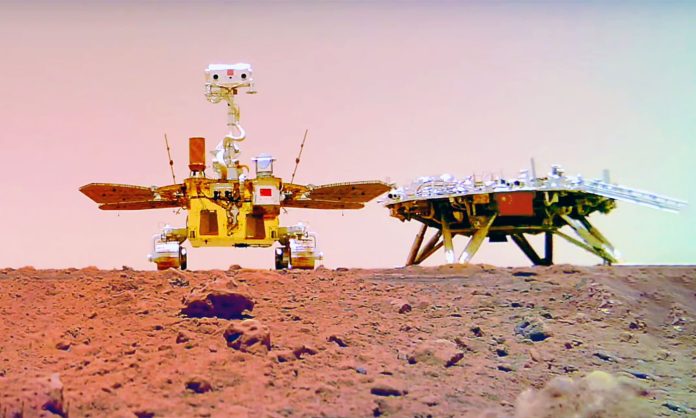
China’s first Mars rover, Zhurong, has uncovered evidence indicating that water activity on the Martian surface continued much later than scientists once believed. Researchers studying data from the rover say Mars may have experienced water-driven processes as recently as 750 million years ago.
The findings are based on subsurface radar scans conducted at Zhurong’s landing site in Utopia Planitia. Scientists identified thick, uniform sediment layers and fine internal structures that are consistent with deposits formed in water-rich environments, such as shallow lakes or coastal zones.
Experts say the discovery challenges long-held assumptions that Mars became completely dry billions of years ago. The new evidence helps refine understanding of the planet’s geological evolution and strengthens interest in Mars as a world that may once have supported habitable conditions.
Related stories: