

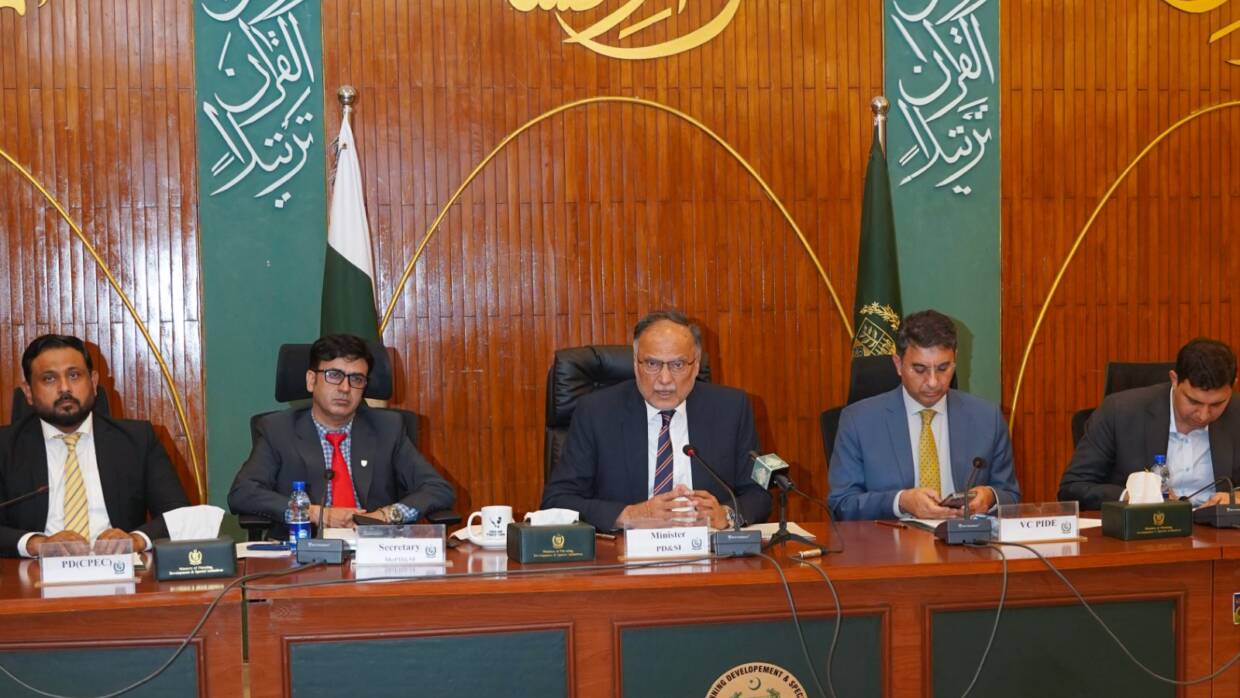
Federal Minister for Planning, Development and Special Initiatives Ahsan Iqbal has called on Pakistan’s private sector to take a leading role in realizing the economic potential of CPEC Phase-II.
He made the remarks while chairing a review meeting on the implementation of the CPEC Action Plan 2025–2029. The meeting assessed progress during the plan’s first year and discussed steps to accelerate key priorities.
CPEC Phase-II to Focus on Economic Growth
Ahsan Iqbal said Pakistan must prioritize economic growth, exports, and investment. He also stressed the need to avoid political confrontation during the country’s economic transformation.
According to the minister, CPEC Phase-I attracted around $25 billion in Chinese investment. It also added nearly 8,000 megawatts to Pakistan’s power generation capacity.
Moreover, he highlighted Thar coal development and the fibre-optic network as major achievements of the first phase.
New Focus on Industry, Agriculture and Technology
CPEC Phase-II will build on this foundation through business-to-business cooperation and industrial development.
The next phase will also target several priority areas, including:
- Industrial development
- Agricultural modernization
- Minerals and mining
- Human capital development
- Technology and digital growth
- Business-to-business investment
In addition, the minister linked these priorities with the five pillars of the URAAN Pakistan programme.
Five Corridors to Support Development
The Growth Corridor will strengthen industrial and agricultural capacity while supporting exports. Meanwhile, the Livelihood Corridor will promote social development in less-developed regions.
The Innovation Corridor will support E-Pakistan and expand IT skills among young people. Ahsan Iqbal described Pakistan’s young population as its greatest economic asset.
Furthermore, the Green Economy Corridor will focus on climate resilience, water security, food security, and modern agriculture.
Pakistan-China Agricultural Cooperation
The government plans to send 1,000 agricultural experts to China for training in modern farming technologies. Ahsan Iqbal said the programme could create a strong pool of skilled agricultural professionals.
The initiative will also promote improved seeds, farm mechanization, efficient water use, and climate-resilient crops. He described the effort as a foundation for a potential “Green Revolution 2.0.”
Private Sector Key to CPEC Phase-II
Ahsan Iqbal stressed that the government cannot deliver CPEC Phase-II alone. Instead, private businesses must lead investment and create new commercial partnerships.
The government, he said, will focus on creating an enabling environment for businesses. This includes improving competitiveness and supporting investment.
$100 Billion Export Target by 2035
The minister described export expansion as a “national emergency.” He said Pakistan must achieve the target of $100 billion in exports by 2035 to secure long-term economic stability.
He also called for stronger cooperation between the government and private sector. The goal is to establish “Made in Pakistan” as a globally recognized brand.
Political Stability Needed for Economic Growth
The minister directed relevant ministries to ensure timely implementation of the CPEC Phase-II action plan.
He also warned that political instability could undermine economic transformation. Therefore, he urged political forces to focus on reforms, better governance, and national economic development.
Ahsan Iqbal stressed that Pakistan needs to channel its recent strategic and diplomatic gains into economic progress. He called for an export-driven and self-reliant economy focused on opportunities for the country’s youth.
Read More Articles:
Pakistan Pavilion Showcases Culture in China