

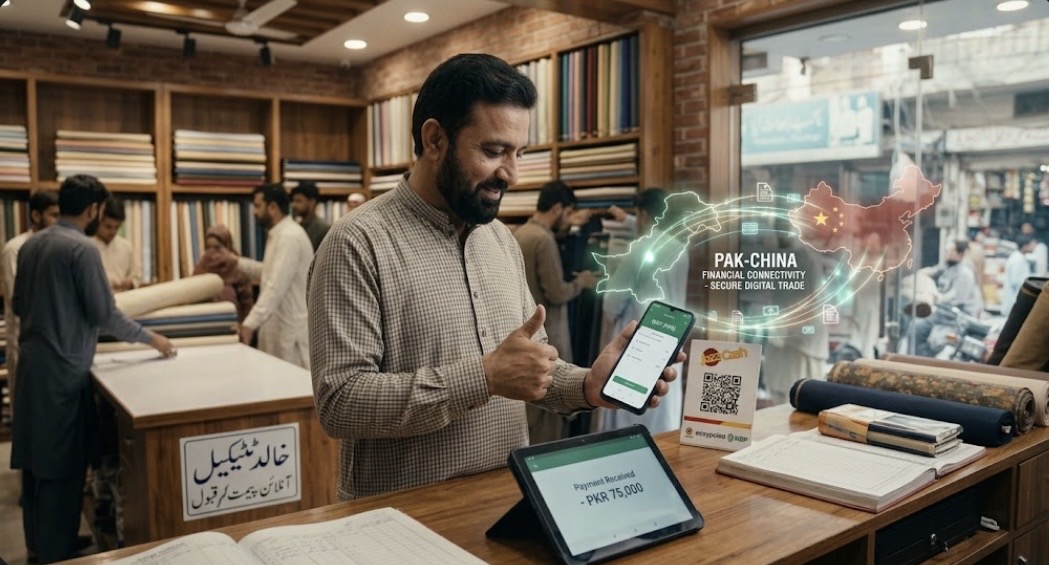
As Pakistan and China deepen their economic relationship, the ability to move money efficiently across their borders is becoming an important question for businesses, financial institutions, and travelers. Trade agreements and transport infrastructure can facilitate economic exchange, but transactions still depend on payment systems that connect buyers, sellers, banks, and regulators.
Pakistan has already developed domestic digital payment infrastructure through the State Bank of Pakistan’s Raast instant payment system. China, meanwhile, has established extensive mobile payment networks and infrastructure for cross-border transactions, including systems supporting the international use of the renminbi.
The challenge is determining how these different systems could work together.
For Pakistan and China, easier digital payments would require more than introducing Chinese payment applications in Pakistan. It would require compatible infrastructure, participating financial institutions, regulatory coordination, and commercially viable arrangements for settling transactions across borders.
Pakistan’s Digital Payment Infrastructure Is Already Evolving
Pakistan has made significant institutional progress in developing digital payments. Raast, introduced by the State Bank of Pakistan (SBP), enables instant domestic transfers between participating financial institutions. It also supports digital payments involving individuals, businesses, and government entities.
The system is designed to make domestic transactions faster and more accessible. The SBP’s official guidance, however, explicitly states that Raast is currently activated for local transfers within Pakistan, rather than international payments.
This distinction matters when considering potential cooperation with China.
A Pakistani business cannot assume that a domestic Raast transfer can automatically reach a Chinese bank account. Cross-border transactions require additional arrangements involving participating institutions, currency conversion where applicable, settlement, and regulatory compliance.
Pakistan’s payment infrastructure also includes PRISM+, its real-time interbank settlement mechanism. Together, these systems illustrate that Pakistan has a domestic foundation upon which more advanced payment services could potentially be developed.
The relevant question is not whether Pakistan needs digital payments. It is how existing infrastructure could be connected to international payment channels.
Sources: State Bank of Pakistan, Raast FAQs and Payments Ecosystem and Infrastructure.
What China Brings to the Equation
China’s payment ecosystem combines consumer-facing applications with banking infrastructure designed to support domestic and international financial transactions.
Applications such as Alipay and WeChat Pay allow users to make digital payments through participating merchants and service providers. Their domestic popularity, however, should not be confused with universal international acceptance.
For cross-border commercial transactions, China’s Cross-Border Interbank Payment System (CIPS) is particularly relevant. CIPS provides clearing and payment services for financial institutions conducting cross-border and offshore renminbi business.
It supports transactions involving trade in goods and services, direct investment, and financing. It is a financial infrastructure system, not a consumer wallet.
This distinction has practical implications for Pakistan. Connecting Pakistani businesses to Chinese payment services could involve different arrangements depending on whether the objective is to facilitate retail payments, international remittances, or commercial settlement.
For example, a Pakistani tourist paying a restaurant in China faces a different problem from a Pakistani importer transferring money to a Chinese manufacturer. The first transaction concerns merchant acceptance and consumer payment access. The second involves commercial banking arrangements, documentation, foreign exchange, and settlement.
A single payment solution would not necessarily address both.
Where Cross-Border Payments Could Become Easier
The potential benefits of better payment connectivity extend beyond convenience.
For smaller businesses, payment procedures can influence how easily they trade internationally. Multiple intermediaries, unclear fees, documentation requirements, and delays can complicate transactions, particularly for companies without dedicated finance departments.
Improved arrangements could potentially help Pakistani importers pay Chinese suppliers, Pakistani exporters receive payments from Chinese buyers, and travelers access familiar digital payment methods.
However, these benefits would depend on the actual services made available, the institutions participating in them, and the costs charged to users.
Three areas deserve particular attention.
1. Connections between existing payment systems
One possibility would be to establish appropriate links between Pakistan’s domestic payment infrastructure and international payment networks through regulated financial institutions.
Pakistan already provides a relevant example of this approach through its work on connecting Raast with Buna, the Arab Monetary Fund’s regional cross-border payment system.
The SBP identifies the Raast–Buna connectivity project as an initiative intended to facilitate digital cross-border transfers between Pakistan and participating institutions in the Arab region.
This demonstrates that Pakistan is exploring cross-border connectivity through institutional cooperation. It does not establish that Raast is connected to China’s payment networks or that a similar arrangement with China has been agreed.
Any proposed Pakistan–China connection would require its own technical, regulatory, and commercial assessment.
2. Better access to commercial settlement
For businesses trading between Pakistan and China, improving access to appropriate banking channels may be more immediately relevant than connecting consumer wallets.
Financial institutions could examine how eligible transactions might be processed more efficiently, including the use of renminbi where commercially appropriate and permitted under applicable arrangements.
This would require clarity about participating banks, account arrangements, exchange-rate mechanisms, transaction documentation, and the treatment of failed or disputed payments.
The benefits would need to be demonstrated through actual transaction costs and processing times rather than assumed from the availability of digital technology.
3. Easier payments for travelers
Consumer payments present another potential opportunity.
If participating banks, payment networks, and regulators established compatible arrangements, travelers might eventually find it easier to pay participating merchants without relying exclusively on cash or conventional international cards.
Yet such a service would require confirmed merchant acceptance, appropriate currency conversion, clear fee disclosures, and accessible customer support.
The availability of a Chinese payment application in one market does not automatically mean that every foreign-issued account can use it there.
Regulatory and Technical Barriers Cannot Be Ignored
Cross-border payment connectivity introduces challenges that domestic instant payment systems do not resolve on their own.
Foreign-exchange rules determine how currencies can be converted and how international payments are documented. Any proposed arrangement would need to comply with the applicable requirements in both countries.
Anti-money-laundering and counter-terrorist-financing controls require participating institutions to conduct appropriate checks, monitor transactions, and investigate suspicious activity.
Cybersecurity and data protection are equally important. Payment networks exchange sensitive financial information, making secure authentication, appropriate data handling, fraud prevention, and clear responsibilities essential.
There are also commercial questions. Banks and payment providers need viable operating models, while businesses need transparent fees and reliable access to their funds.
An arrangement that is technically functional but expensive to use may offer limited benefits to smaller traders.
Pakistan and China would therefore need to evaluate both infrastructure compatibility and the practical economics of any proposed service.
What Should Pakistan and China Do Next?
A realistic approach would begin with clearly defined use cases rather than a broad promise of payment integration.
First, the relevant financial authorities could assess which cross-border transactions create the greatest difficulties for businesses and consumers. Import payments, export receipts, remittances, and traveller payments should be evaluated separately.
Second, participating banks and payment providers could map existing transaction routes, identify unnecessary friction, and assess opportunities to improve interoperability.
Third, regulators would need to establish appropriate arrangements for settlement, foreign exchange, consumer protection, cybersecurity, and dispute resolution.
Finally, any pilot programme should measure transaction costs, processing times, failure rates, accessibility, and user satisfaction. These indicators would help determine whether the new arrangements offer genuine improvements over existing channels.
Financial Connectivity Is the Next Question
Pakistan and China have developed extensive economic links, but the efficiency of their financial transactions remains an important area for further investigation.
Pakistan’s domestic payment infrastructure and China’s cross-border financial systems offer potential starting points for cooperation. Neither, however, eliminates the need for specific agreements, participating institutions, and regulatory safeguards.
The practical opportunity lies in identifying where businesses and individuals experience the greatest payment difficulties and developing targeted solutions around those needs.
Closer payment connectivity could complement Pakistan–China trade, but its value would ultimately depend on whether transactions become demonstrably easier, faster, safer, and more affordable.
Read more Articles:
Pakistan-China Digital Corridor: Tech and CPEC 2.0
Pakistan-China Vloggers: How Creators Shape Relations
Pakistan Leaders Vow to Strengthen Food Security