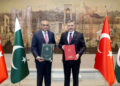


The Pakistan-Rwanda trade agreement signed in Kigali on September 24 could give Pakistani businesses a new platform for expanding into East Africa. The agreement focuses on bilateral trade, investment, local production and business-to-business cooperation, moving the relationship beyond government-to-government engagement.
The agreement was signed by Rwanda’s Minister of Trade and Industry, Antoine Kajangwe, and Pakistan’s High Commissioner to Rwanda, Naeem Khan, during the Rwanda-Pakistan Investment Forum 2026. The three-day forum brought together government officials, investors, manufacturers, entrepreneurs and business representatives from both countries.
The immediate question is not simply how much Pakistan and Rwanda can trade with each other. It is whether stronger commercial ties with Rwanda can help Pakistani companies build a wider presence across East Africa.
A New Framework for Bilateral Trade
The agreement aims to increase cooperation in trade and investment while encouraging local production and stronger links between businesses.
Rwanda’s Minister of Trade and Industry said the agreement covers cooperation around goods produced locally in both countries and greater commercial collaboration. Reporting from Rwanda also indicates that the framework is intended to support business partnerships and joint ventures, particularly in manufacturing and technology.
That emphasis matters because the two economies have different strengths.
Pakistan has established manufacturing and export capacity in areas such as textiles, pharmaceuticals, surgical instruments, food products and light engineering. Rwanda, meanwhile, has been positioning itself as a regional business and investment centre in East Africa.
The agreement therefore has the potential to move cooperation beyond conventional exports toward partnerships involving investment, production and distribution.
Why Rwanda Matters Beyond Rwanda
Rwanda’s importance for Pakistani businesses is partly connected to its position within the East African Community.
Rwanda became a full EAC member in 2007 and joined the EAC Customs Union in 2009. The EAC Customs Union provides for free or preferential movement of qualifying goods among member states while applying a common external tariff to imports from outside the bloc.
The EAC has since expanded to eight partner states, including Kenya, Tanzania, Uganda, Rwanda, Burundi, South Sudan, the Democratic Republic of Congo and Somalia.
This does not mean that a Pakistani product entering Rwanda automatically receives tariff-free access across the entire EAC. Rules of origin, customs requirements, product standards and individual market conditions still matter.
However, Rwanda’s regional integration gives companies operating there access to a broader economic ecosystem.
For Pakistani firms, that could make local partnerships, distribution networks and eventually production arrangements more important than simply shipping finished goods from Pakistan.
B2B Cooperation Could Be the Real Test
The Rwanda-Pakistan Investment Forum was designed around precisely this issue.
The Rwanda Development Board said on September 24 that representatives from both countries explored opportunities in agriculture, manufacturing, textiles and apparel, pharmaceuticals, ICT, tourism and logistics.
Earlier discussions between Pakistan’s Board of Investment and Rwanda’s High Commission had also identified B2B engagement as an important mechanism for expanding trade, investment and commercial cooperation.
This is significant because bilateral trade agreements alone do not create export growth.
Companies still need buyers, financing, reliable logistics, certification, distribution partners and predictable regulatory arrangements. B2B engagement can help address those gaps by connecting Pakistani producers directly with Rwandan companies and investors.
For example, a Pakistani textile company could explore a distribution partnership rather than relying solely on direct exports. A pharmaceutical company could investigate local manufacturing or packaging. An IT company could provide services without establishing a traditional goods-export model.
The same approach could apply to agricultural processing, logistics and light manufacturing.
Which Pakistani Sectors Could Benefit?
The sectors discussed at the Kigali forum provide an indication of where commercial opportunities may emerge.
Textiles and Apparel
Pakistan already has a large textile manufacturing base and extensive experience in exporting garments and textile products.
Rwanda’s apparel and manufacturing market could therefore offer opportunities for Pakistani companies through exports, sourcing partnerships and investment.
The longer-term opportunity would be to combine Pakistani manufacturing expertise with local distribution or production arrangements.
Pharmaceuticals
Pharmaceuticals are another potential area of cooperation.
Pakistan has an established pharmaceutical manufacturing sector, while Rwanda’s investment forum specifically included pharmaceuticals among the sectors under discussion.
Any expansion, however, would depend on regulatory approvals, product registration and compliance with Rwanda’s health and pharmaceutical requirements.
Agriculture and Agro-Processing
Agriculture could provide another practical route for cooperation.
The investment forum identified agriculture among the sectors for potential collaboration. For Pakistan, opportunities could include agricultural machinery, food processing, irrigation-related technologies and selected food products.
The strongest opportunities may come where trade is combined with technology or local production rather than relying entirely on finished-product exports.
ICT and Services
The opportunity is not limited to physical goods.
ICT was also identified at the forum, creating potential space for Pakistani software companies, digital-service providers and technology businesses.
Services can also reduce some of the logistical barriers associated with traditional merchandise trade.
Pakistan’s Wider Africa Strategy
The Rwanda agreement also fits into Pakistan’s longer effort to expand economic engagement with Africa.
Pakistan’s Ministry of Commerce established the Look Africa Policy Initiative to increase trade and investment engagement with African economies. The government’s strategy has included greater business outreach, trade promotion and efforts to develop institutional links with African regional blocs, including the EAC. (Ministry of Commerce)
In September 2026, Pakistan and African countries also reaffirmed a goal of raising bilateral trade to $15 billion by 2030, according to Radio Pakistan. Rwanda was among the African countries represented at the launch of the Pakistan-Africa Economic Council. (Radio Pakistan)
The Rwanda agreement therefore comes at a time when Islamabad is seeking greater commercial engagement with African markets.
What Could Limit the Opportunities?
The agreement creates a framework, but implementation will determine its commercial value.
East African trade remains affected by transport costs, customs procedures, standards, non-tariff barriers and limited business-to-business connections. The EAC itself acknowledged in February 2026 that intra-regional trade had remained around 15% of total trade for more than a decade and that barriers continue to restrict the region’s trade potential. (East African Community)
Pakistan also faces the practical challenge of building competitive logistics routes to East Africa.
For companies, the calculation will therefore involve more than tariff preferences. Freight costs, delivery times, currency risks, financing, local regulations and reliable distribution partners will all influence whether a Pakistani product can compete.
From Agreement to Market Presence
The Pakistan-Rwanda trade agreement gives both governments a framework for deeper economic cooperation. The next step is for businesses to turn that framework into contracts, joint ventures, distribution agreements and investment projects.
Rwanda can provide Pakistani businesses with a foothold in an increasingly integrated East African market, but that opportunity will depend on how effectively companies use local partnerships and comply with regional trade rules.
For Pakistan’s Africa strategy, the bigger test is whether Rwanda becomes more than a bilateral trading partner. If Pakistani companies establish sustainable commercial relationships in Rwanda and use them to understand wider East African markets, the agreement could become part of a broader shift from occasional trade missions toward long-term business-to-business engagement.
Read More Articles:
Pakistan-China Trade Hits $16.44bn, Envoy Confirms