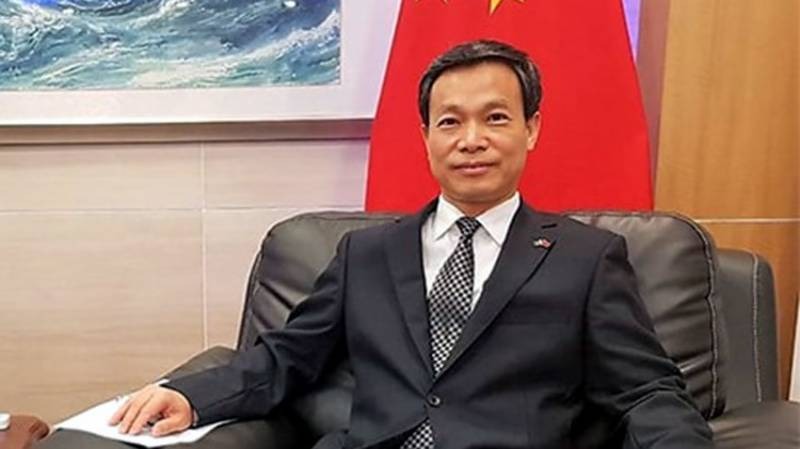


Pakistan-China bilateral trade reached $16.44 billion between January and July 2026, representing a 13.4 percent year-on-year increase, Chinese Ambassador to Pakistan Jiang Zaidong said on September 30.
The figure provides a concrete measure of the economic relationship at a time when Islamabad and Beijing are marking the 75th anniversary of diplomatic relations and preparing to move cooperation into the next phase of CPEC.
Jiang cited China Customs figures at a reception marking the 77th anniversary of the founding of the People’s Republic of China in Islamabad. He also pointed to faster growth in agricultural trade, rising Pakistani exports to China and China’s continuing position as Pakistan’s largest source of foreign investment during the first eight months of the year.
The numbers are significant not simply because total trade has expanded, but because several of the fastest-growing components are connected to sectors that Pakistan and China have identified as priorities for CPEC 2.0.
Specific Figures Behind a Familiar Bilateral Message
Prime Minister Shehbaz Sharif, addressing the same reception, reaffirmed Pakistan’s commitment to strengthening its All-Weather Strategic Cooperative Partnership with China. He said the two countries were transitioning towards the next phase of CPEC, with greater emphasis on industrialisation, special economic zones, information technology and artificial intelligence, agriculture, and mines and minerals.
Jiang’s remarks added a quantitative dimension to that diplomatic message.
According to figures he attributed to China Customs, bilateral trade reached $16.44 billion from January through July, up 13.4 percent from the same period a year earlier. China’s exports to Pakistan increased by 9.8 percent, while Chinese imports from Pakistan increased by 45.7 percent.
That distinction matters. The overall increase in bilateral trade was accompanied by substantially faster growth in China’s imports from Pakistan. In other words, the latest figures indicate that Pakistani products accounted for a growing part of the increase in two-way trade during the period covered by Jiang’s remarks.
The figures, however, cover only the first seven months of 2026. They should therefore be treated as a year-to-date indicator rather than a full-year projection.
Agricultural Trade Is Growing Faster
The agricultural figures are even more notable.
Jiang said bilateral agricultural trade reached approximately $830 million from January to August 2026, increasing by 45 percent year-on-year. China’s agricultural imports from Pakistan reached about $530 million, up 63 percent compared with the same period last year.
Jiang also cited a Pakistani agricultural trade surplus of approximately $230 million with China, describing this as a 200.6 percent year-on-year increase.
Rice was one of the clearest examples of this expansion. Pakistan exported approximately 373 million kilograms of rice to China, valued at around $127 million during the period. The volume increased by 245.7 percent year-on-year, while its value rose by 186.9 percent.
These numbers place agricultural trade among the more dynamic areas of the Pakistan-China economic relationship in 2026.
The 45 percent increase in agricultural trade is also considerably faster than the 13.4 percent increase recorded for overall bilateral trade. That does not by itself establish a structural transformation in the relationship, but it does show that agricultural products are becoming an increasingly important area of commercial exchange.
For Pakistan, the more important question is whether this growth can move beyond a small number of commodities and develop into a broader export base involving processed food, livestock products, fisheries, horticulture, dairy and other higher-value agricultural goods.
From Agricultural Exports to Agricultural Capacity
The recent trade numbers have emerged alongside a wider expansion of Pakistan-China agricultural cooperation.
The two countries’ May 2026 joint statement placed agricultural production capacity, Chinese agricultural investment in Pakistan and greater market access for Pakistani products among the areas of cooperation. It also recorded the successful completion of a programme involving 1,000 young Pakistani agricultural technicians trained in China.
Prime Minister Shehbaz Sharif said on September 30 that the first group of 1,000 Pakistani agriculture graduates had completed training in China, while another 1,000 were ready to follow.
The initiative has been developing in stages. In July 2026, the prime minister announced that another 1,000 agriculture graduates from across Pakistan, including the provinces, Gilgit-Baltistan and Azad Jammu and Kashmir, would be sent to China for advanced training, building on the earlier programme.
This is relevant to trade because export competitiveness is not determined by market access alone. It also depends on production quality, disease control, post-harvest management, irrigation, processing, traceability and technical skills.
Recent cooperation has therefore increasingly connected agricultural trade with the systems required to sustain it.
Livestock Cooperation Adds Another Layer
Livestock has become an important part of that broader cooperation.
On September 2, China donated veterinary vaccines to Pakistan targeting Lumpy Skin Disease and Brucella melitensis. The handover took place at the National Agricultural Research Centre in Islamabad, with Pakistan’s Ministry of National Food Security and Research and Chinese representatives participating.
Later in September, Pakistan and China launched a joint laboratory for livestock disease prevention and control in Luoyang, Henan Province. The facility is intended to support cooperation in animal vaccines, disease control, research, technology transfer and training.
These developments are important in the context of agricultural exports because disease-control systems directly affect the ability of livestock-producing countries to enter and remain in international markets.
Pakistan has also been pursuing its own livestock reforms. In July, Prime Minister Shehbaz announced full federal funding for development of an indigenous Foot-and-Mouth Disease vaccine and launched the Pakistan Animal Identification and Traceability System.
Taken together, these initiatives suggest that agricultural cooperation with China is developing across multiple levels: trade, training, disease prevention, research and technology.
China Remains Pakistan’s Leading Foreign Investor
Jiang also cited investment figures from the State Bank of Pakistan.
According to the figures referenced in his speech, China, including Hong Kong, accounted for 60.7 percent of Pakistan’s total foreign investment attracted between January and August 2026, maintaining China’s leading position among foreign investors during that period.
The wording is important. The 60.7 percent figure refers to foreign investment attracted during the specified January-August period and includes Hong Kong. It should therefore not be interpreted as meaning that 60.7 percent of Pakistan’s entire accumulated stock of foreign investment comes from China.
Nevertheless, the concentration is substantial. It highlights the continuing importance of Chinese capital to Pakistan’s investment environment and reinforces the economic significance of bilateral ties beyond trade in goods.
For Islamabad, the longer-term challenge is to convert investment into productive capacity, exports, employment and technology transfer. For CPEC 2.0, that means the emphasis increasingly has to move from individual projects towards industrial ecosystems in which investment produces sustained commercial activity.
CPEC 2.0 Moves Beyond Infrastructure
The economic direction outlined by both sides in 2026 points towards a broader interpretation of CPEC.
The May 26 Pakistan-China joint statement called for the high-quality development of the upgraded version of CPEC 2.0. It identified industrial parks, textiles, home appliances, mining, oil and gas, agriculture, digital economy, artificial intelligence, science and technology, and trade liberalisation among areas for deeper cooperation. (Ministry of Foreign Affairs)
The CPEC Secretariat has similarly described CPEC 2.0 as increasingly focused on business-to-business cooperation, industrial development, agriculture, science and technology, mining and minerals and Gwadar-related commercial activity. In an April consultation, officials also discussed halal meat exports, agricultural mechanisation, farmer training, aquaculture, seafood processing and value-added production.
In August, the CPEC Secretariat held further consultations with a Chinese delegation on B2B and industrial cooperation, with officials emphasising a transition from infrastructure towards industrialisation, productivity, competitiveness and stronger private-sector participation.
That shift is important because the next stage of bilateral economic cooperation will be measured increasingly by what Pakistan produces and exports, rather than simply by the scale of infrastructure investment.
An Upgraded Free Trade Agreement Could Shape the Next Phase
Jiang said China was ready to work with Pakistan to deepen cooperation in industry, agriculture and mining, while advancing the high-quality development of CPEC 2.0 and an upgraded version of the China-Pakistan Free Trade Agreement.
The proposal is consistent with commitments made during Prime Minister Shehbaz Sharif’s May visit to China. The Chinese Foreign Ministry said at the time that both sides had agreed to accelerate CPEC 2.0 and forge an upgraded bilateral free trade agreement while exploring cooperation in areas including artificial intelligence, digital economy and agriculture.
The precise scope and timetable of the proposed FTA upgrade were not specified in Jiang’s September 30 remarks.
That leaves implementation as the next important stage. For Pakistan, the commercial value of any upgraded trade framework will depend partly on whether it expands meaningful market access for Pakistani exporters and encourages investment in sectors capable of producing competitive goods for the Chinese market.
The agricultural figures suggest that some movement is already taking place, particularly in rice and other agricultural exports. The challenge will be broadening that momentum.
What the Numbers Mean for Pakistan-China Economic Relations
The latest data presents several distinct trends rather than one single story.
Overall bilateral trade has grown by 13.4 percent during the first seven months of 2026. Agricultural trade has expanded much faster, by 45 percent through August. Chinese imports from Pakistan have increased by 45.7 percent during January-July, while agricultural imports from Pakistan rose by 63 percent through August. Rice exports have recorded particularly strong percentage growth.
At the same time, China, including Hong Kong, accounted for 60.7 percent of Pakistan’s foreign investment attracted during the first eight months, according to the State Bank figures cited by Jiang.
These numbers show a relationship increasingly centred on trade, investment, industrial cooperation and sector-specific capacity building.
They also provide benchmarks against which the implementation of CPEC 2.0 and a possible upgraded FTA can be assessed.
The immediate question is no longer simply whether Pakistan-China economic cooperation is expanding. The more specific question is whether the expansion can translate into a wider range of Pakistani exports, greater domestic value addition, stronger industrial capacity and more diversified sources of investment.
What Comes Next for CPEC 2.0
The September figures arrive at an important point in the bilateral relationship.
In May, Pakistan and China formally marked 75 years of diplomatic relations and agreed to push forward cooperation under the upgraded CPEC framework. In September, Jiang provided fresh trade and investment figures showing stronger activity in several of the sectors now being prioritised.
Agriculture provides one of the clearest examples of how the relationship is evolving. Trade growth is occurring alongside graduate training, agricultural research, livestock disease control, veterinary cooperation and efforts to improve market access.
Industry, mining, technology and B2B cooperation are expected to form other major components of CPEC 2.0.
For Pakistan, the significance of the latest figures will ultimately depend on their durability. A strong year-to-date increase is an important indicator, but sustained export growth requires competitive production, reliable logistics, standards compliance, processing capacity and continued access to international markets.
For now, Jiang’s figures provide a concrete benchmark: $16.44 billion in bilateral trade in the first seven months of 2026, $830 million in agricultural trade through August, and China including Hong Kong accounting for 60.7 percent of foreign investment attracted during the first eight months.
As Pakistan and China move into the next phase of CPEC cooperation, these figures offer a measurable starting point for tracking whether the relationship’s emphasis on industry, agriculture, investment and trade liberalisation produces broader commercial results.
Read More Articles:
President Zardari Reaffirms Stronger Pakistan-China Ties