

Federal Minister for Commerce Jam Kamal Khan on Tuesday hosted ambassadors of seven Southeast Asian nations at the Ministry of Commerce. The meeting reaffirmed Pakistan’s commitment to boosting trade, investment, and people-to-people ties with the regional bloc. Importantly, Pakistan invited ASEAN investment in CPEC zones as part of its broader push to deepen economic integration.
Broad Representation from Southeast Asia
Envoys and senior diplomats from Indonesia, Malaysia, the Philippines, Thailand, Brunei Darussalam, Vietnam, and Myanmar attended the meeting. Their participation reflected strong regional representation and growing interest in Pakistan’s market.
Pakistan’s New Trade Priorities
Minister Khan welcomed the delegates and explained that Pakistan is moving beyond conventional trade. Instead, the focus is on long-term partnerships in technology, agriculture, skills, and infrastructure. He outlined reforms such as tariff rationalisation, new vehicle import policies, and progress toward a Free Trade Agreement (FTA) with the Gulf Cooperation Council.
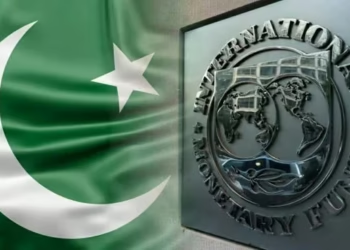
With the support of a $7 billion IMF program, Pakistan has achieved single-digit inflation and improved macroeconomic stability. As a result, the country is positioning itself as an attractive destination for foreign investors.
Pakistan Invites ASEAN Investment in CPEC Zones
Khan described Pakistan as a strategic gateway to Central Asia, with ports offering stronger connectivity under new transit trade agreements. He stressed that Pakistan invites ASEAN investment in CPEC zones, encouraging companies to set up industries, add value, and re-export to global markets. To enhance investor confidence, he also highlighted the creation of a Trade Dispute Resolution Commission.
Regional Response and New Opportunities
The ambassadors welcomed Pakistan’s outreach and expressed optimism about stronger cooperation. The Malaysian envoy encouraged Pakistani firms to explore Malaysia’s growing chip-making industry. Others pointed to existing investments in Pakistan’s construction and power sectors. They also identified religious tourism, skills exchange, and supply chain linkages as promising areas of collaboration.
Pakistan-ASEAN Relations and Future Outlook
ASEAN, founded in 1967, has grown into one of the world’s fastest-rising economic blocs. Pakistan became a Sectoral Dialogue Partner in 1993 and continues to seek an upgrade to Full Dialogue Partner status, though the bloc currently maintains a moratorium on new memberships.
Looking ahead, the meeting signalled Islamabad’s renewed effort to embed itself more firmly in the Southeast Asian economic landscape. Both sides agreed to prepare a roadmap for expanding trade, investment, and institutional cooperation in the coming months.
Related stories:
ASEAN, Pakistan reaffirm commitment to deepen partnership
Pakistan possesses potentials to enhance trade with ASEAN countries: Meher Kashif