

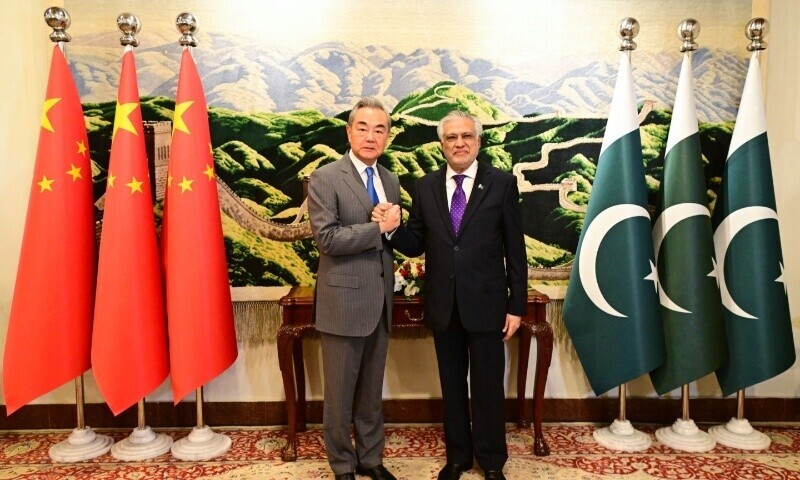
Pakistan and China have reaffirmed their commitment to advancing their All-Weather Strategic Cooperative Partnership through deeper cooperation in trade, defence, and regional security.
Foreign Office (FO) spokesperson Ambassador Shafqat Ali Khan said on Friday that Chinese Foreign Minister Wang Yi visited Islamabad on August 21, 2025, at the invitation of Pakistan’s Deputy Prime Minister and Foreign Minister Ishaq Dar to co-chair the 6th Pakistan–China Foreign Ministers’ Strategic Dialogue.
Comprehensive Dialogue on Bilateral Relations
The talks covered the full spectrum of ties, including CPEC Phase-II, economic cooperation, people-to-people exchanges, and global issues. Wang Yi also met President Asif Ali Zardari, Prime Minister Shehbaz Sharif, and Chief of Army Staff Field Marshal Syed Asim Munir.
President Zardari thanked China for supporting Pakistan’s sovereignty and its stance on Kashmir, while Prime Minister Shehbaz reaffirmed Islamabad’s resolve to expand cooperation in ICT, agriculture, industrialisation, and minerals under CPEC Phase-II.
Defence and Security Engagements
In his meeting with the Army Chief, discussions centred on regional security, counterterrorism, and defence cooperation. Both sides pledged closer coordination at regional and international forums to address evolving security challenges.
Trilateral Talks With Afghanistan
Ahead of the Islamabad meetings, a Trilateral Foreign Ministers’ Dialogue was held in Kabul on August 20, with Pakistan, China, and Afghanistan committing to enhance cooperation in counterterrorism, transit, health, education, and extending CPEC to Afghanistan. DPM/FM Dar also raised concerns with Afghan officials over insufficient counterterrorism cooperation.
Pakistan’s Broader Diplomatic Engagements
The FO highlighted Ishaq Dar’s visit to the United Kingdom (17–19 August), where he met British MPs, Commonwealth leaders, and inaugurated digital land record and one-window passport services at the Pakistan High Commission in London. He also cautioned against India’s unlawful attempts to undermine the Indus Waters Treaty.
Separately, Dar engaged with U.S. officials in a Pakistan–U.S. Counterterrorism Dialogue on August 12, reaffirming joint efforts against groups like the BLA and ISIS-K. The FO welcomed Washington’s decision to designate the BLA and its Majid Brigade as terrorist organisations.
Arms Control and Indus Waters Treaty Ruling
Pakistan and China also held the 10th Round of Bilateral Consultations on Arms Control in Beijing, focusing on non-proliferation, nuclear technology, and outer space cooperation.
The FO welcomed the Court of Arbitration’s ruling on August 8, 2025, which upheld Pakistan’s stance on the Indus Waters Treaty, rejecting India’s unilateral attempts to bypass treaty obligations.
Strong Response to Indian Rhetoric
Responding to Indian statements, the FO spokesperson rejected accusations of “nuclear blackmail,” stressing that Pakistan is a responsible nuclear state with strong civilian oversight. Ambassador Khan criticised India’s “provocative rhetoric and fabricated narratives,” warning that any aggression against Pakistan would be met with an immediate and proportional response.
Related stories:
CPEC Opens New Trade and Growth Opportunities for Afghanistan