

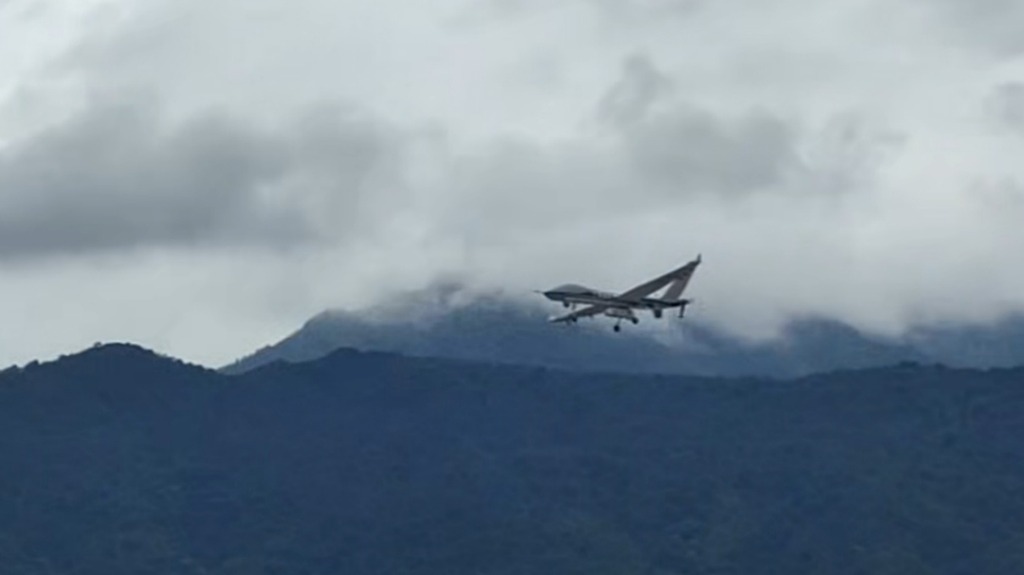
China’s domestically developed Wing Loong unmanned aerial vehicle (UAV) has successfully completed its first typhoon warning reconnaissance mission, marking a significant milestone in disaster response technology, according to its developer, the Aviation Industry Corporation of China (AVIC).
As Typhoon Wipha struck southern China this week, the large fixed-wing drone was deployed for both early warning reconnaissance and post-disaster assessment. Operating in western Guangdong, it maneuvered through severe weather, including intense rainfall and high-speed winds, to collect vital data before the storm made landfall.
Equipped with cutting-edge synthetic aperture radar, the UAV penetrated dense clouds and heavy precipitation to conduct real-time surveillance. Its data was instantly transmitted to the provincial emergency command centre, aiding in risk evaluation, flood control planning, and resource deployment.
Despite extremely low visibility, Wing Loong successfully identified flooded roads, submerged farmlands, and rising water levels in river systems. This timely information allowed emergency teams to respond swiftly, opening blocked routes, reaching affected communities, and mitigating damage.
The UAV was also outfitted with an airborne base station, providing stable communication coverage in areas where ground networks were down. During the mission, over 6,000 emergency text messages were transmitted, establishing a reliable communication link between rescue teams and disaster-hit zones.
Wing Loong’s latest operation builds on its proven track record in disaster relief, having previously been used in earthquake response and severe rainstorm scenarios. With this new capability in typhoon reconnaissance, the drone is set to play a larger role in China’s emergency management and climate resilience strategies.
Related Posts