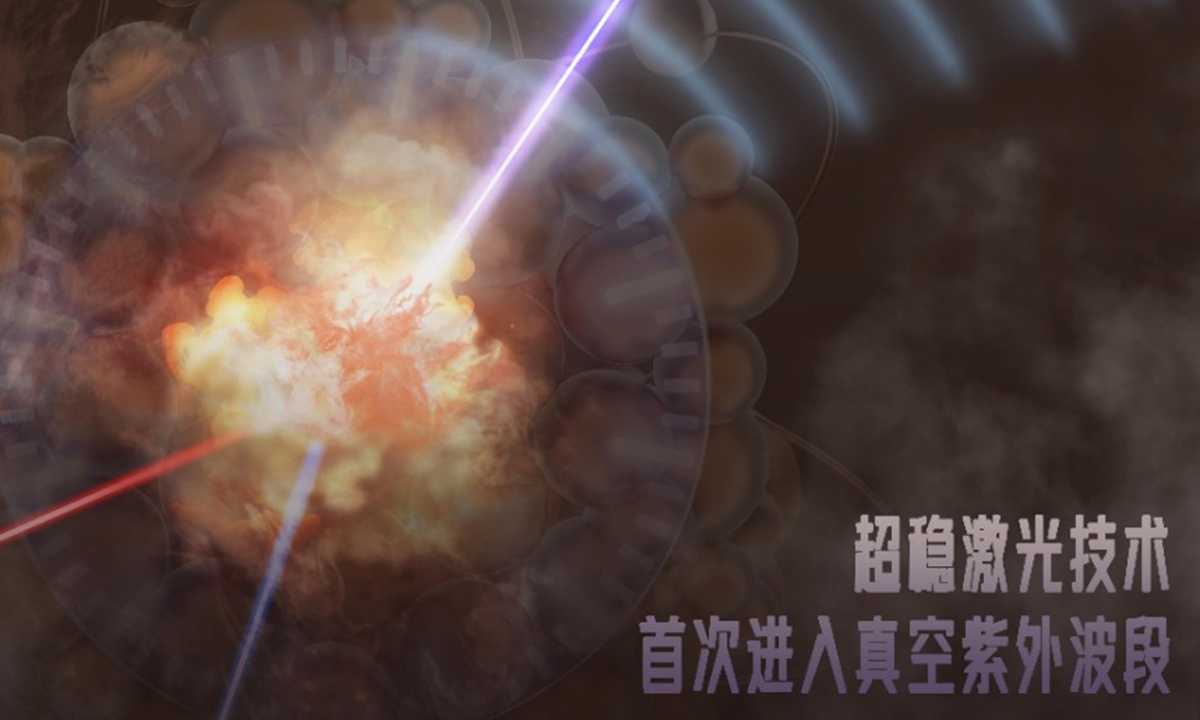
China has made a landmark advancement in continuous-wave vacuum ultraviolet (CW VUV) laser technology, overcoming a key technical challenge for the development of nuclear clocks. Scientists at Tsinghua University and the Beijing Academy of Quantum Information Sciences, led by Ding Shiqian, created a 148.4 nm CW laser with ultranarrow linewidth and output power sufficient for coherent nuclear interactions.
While conventional atomic clocks are highly accurate, they are sensitive to electromagnetic interference and largely limited to laboratory use. Nuclear clocks, on the other hand, offer higher precision and stronger resistance to interference. The new laser technology addresses the long-standing hurdle of generating a 148 nm CW source, enabling nuclear clocks to move closer to practical applications.
Beyond nuclear timekeeping, this innovation could advance quantum information research, atomic clocks, and condensed matter spectroscopy. It may also enhance technologies such as autonomous navigation, deep-space exploration, geophysical measurements, and ultra-precise testing equipment. China’s NIM-Sr1 optical clock has also contributed to International Atomic Time calibration, highlighting the country’s growing leadership in high-precision timekeeping and laser innovation
Related stories: