

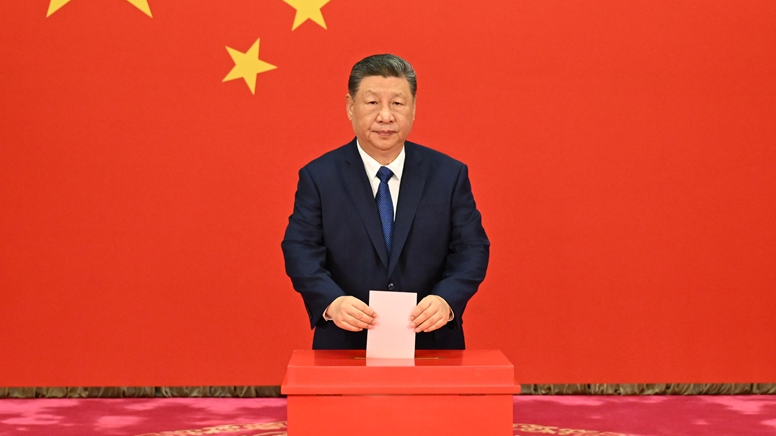
Chinese President Xi Jinping voted in Beijing on Friday, November 6, in an election to choose deputies to local people’s congresses. He cast his ballot at the Huairentang polling station in the Zhongnanhai electoral district of Xicheng District.
Xi, who also serves as general secretary of the Communist Party of China (CPC) Central Committee and chairman of the Central Military Commission, voted to elect deputies to the Xicheng district people’s congress.
During the visit, Xi called for the practice of whole-process people’s democracy, continued Party leadership and stronger supervision throughout the electoral process. He said the election should produce representatives who meet public expectations.
Xi Calls for Fair and Lawful Elections
Xi arrived at the polling station at around 3:30 p.m. He presented his voter registration card to election staff for verification before receiving a ballot.
After completing it, he placed his vote in the ballot box.
Xi described the election of people’s congress deputies as an important foundation for upholding, improving and practising China’s people’s congress system. He called for broader democratic participation and strict compliance with the law.
He also stressed the importance of maintaining fairness, integrity and effective oversight throughout the election process.
According to China’s State Council, Xi’s remarks focused on ensuring that the election remained properly supervised and that the selected deputies reflected people’s expectations.
Senior Chinese Leaders Also Cast Their Votes
Several other senior Chinese leaders also participated in the election on Friday.
Premier Li Qiang, Zhao Leji, Wang Huning, Cai Qi, Ding Xuexiang and Li Xi cast their ballots in person at polling stations in Beijing.
Meanwhile, Vice President Han Zheng entrusted a staff member to vote on his behalf. Former Chinese leader Hu Jintao also authorised a staff member to cast his ballot.
Their participation took place alongside voting across the capital, where residents selected representatives for the next term of district and township-level people’s congresses.
Beijing Election Covers More Than 16,000 Seats
The November 6 election took place at 13,054 polling stations across Beijing.
Voters were choosing 4,898 deputies to district-level people’s congresses and another 11,137 representatives to township-level people’s congresses. Together, the two levels account for 16,035 seats.
The election forms part of Beijing’s 2026 electoral cycle. A decision adopted by the Beijing Municipal People’s Congress Standing Committee in May scheduled the selection of new district and township-level representatives for November. It also set the district-level representation at 4,898 seats.
More Than 9.5 Million Voters Registered
Preparations for the election involved extensive voter registration and candidate selection across the capital.
According to information published by the Beijing municipal government on October 25, approximately 9.57 million people had registered and qualified to vote.
The city had also established 2,408 electoral districts for district-level representatives and 5,497 electoral districts for township-level representatives.
Authorities reported 8,381 preliminary candidates for the 4,898 district-level seats, while 18,333 preliminary candidates were identified for the 11,137 township-level seats.
The preliminary candidate figures were approximately 1.7 times the number of available district-level seats and 1.6 times the number of township-level seats. Electoral authorities said candidate nominations followed the procedures set out under China’s election law.
New Representatives to Take Office
The newly elected deputies will serve in the next term of Beijing’s district and township-level people’s congresses.
Under the schedule announced by the Beijing Municipal People’s Congress Standing Committee, the first sessions of the new district-level people’s congresses are due to take place before the end of December 2026. The first sessions of the new township-level congresses are scheduled before the end of November.
The election is part of China’s local people’s congress system, through which representatives are selected at district and township levels. Xi’s participation and his remarks placed emphasis on electoral supervision, legal procedures and the role of the people’s congress system in local governance.
Read More Articles:
Pakistan Highlights SCO Cooperation on Sustainable Development
Ishaq Dar and Liu Haixing Lead Pakistan-China Governance Talks