
Pakistan is seeking stronger cooperation with China in battery storage as it works to improve energy security and expand clean energy.
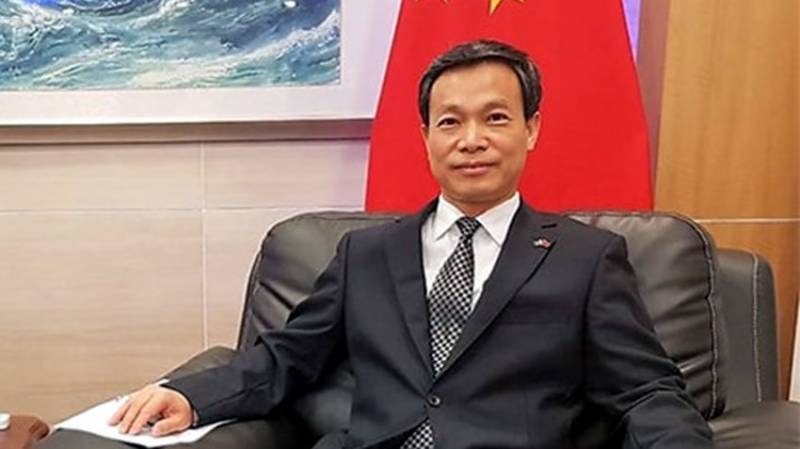
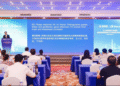
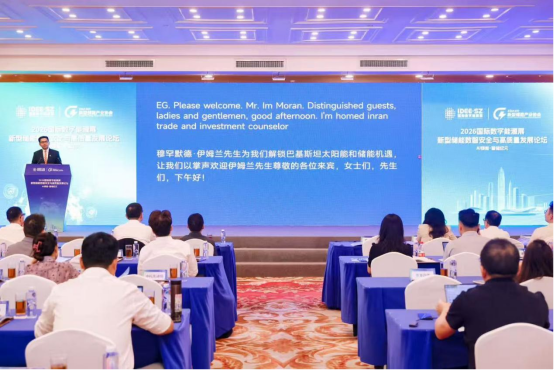
Muhammad Imran, Pakistan’s Trade and Investment Counsellor in Guangzhou, highlighted the importance of energy storage during a forum in Shenzhen.
He delivered a keynote speech titled “Unlocking Opportunities in Pakistan’s Energy Storage Market” at the 2026 New Energy Storage Digital Intelligence, Safety & High-Quality Development Forum.
Battery Storage Key to Energy Security
Imran described battery storage as a core part of Pakistan’s energy security. He also noted Pakistan’s national target to raise clean energy’s share of electricity generation to 90% by 2035.
According to Pakistan’s Ministry of Energy, clean sources account for about 55% of electricity generation. These sources include hydropower, nuclear, wind, and solar.
Meanwhile, consumer-led investment has helped install nearly 38 gigawatts of distributed solar capacity.
Growing Need for Energy Storage
Pakistan’s expanding solar capacity is increasing demand for battery storage. Federal Minister for Energy Sardar Awais Ahmad Khan Leghari has said storage can shift surplus daytime solar power to peak hours.
As a result, batteries could also help reduce reliance on imported fuels and improve the use of renewable energy.
Pakistan Plans Local Battery Manufacturing
To support the sector, Pakistan has proposed the National Lithium-Ion Battery Manufacturing Policy 2026–2031.
The proposed policy includes phased localization targets, tariff reforms, and performance-based incentives. Moreover, these measures aim to attract private investment and develop local battery manufacturing.
Pakistan-China Battery Partnerships Grow
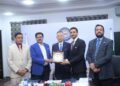
Pakistan-China cooperation in the sector is already expanding. In June, Pakistan’s Saigol Group and China’s Hebei Juhang Energy Technology Group signed an MoU.
The agreement covers advanced lithium-ion batteries, energy storage systems, and electric vehicle charging infrastructure.
Haroon Akhtar Khan, Special Assistant to the Prime Minister on Industries and Production, described the agreement as a sign of confidence in Pakistan’s industrial potential and bilateral cooperation.
China Showcases Advanced Energy Technology
China has developed strong capabilities in batteries, electric vehicles, renewable energy, and advanced manufacturing.
The Shenzhen exhibition showcased several energy storage technologies. These included lithium-ion batteries, liquid-cooled ultra-fast charging systems, and photovoltaic inverters.
Companies such as Huawei, BYD, and BTR also featured among major industry participants.
Digital Energy Opens New Opportunities
The 2026 International Digital Energy Exhibition ran from September 15 to 17 at the Shenzhen Convention and Exhibition Center.
The event covered more than 50,000 square meters and attracted participants from over 50 countries and regions. Nearly 400 overseas enterprises showcased close to 100 digital energy innovations.
For Pakistan, the event provided an opportunity to explore technologies that can support its clean energy transition.
Looking Ahead
Imran said he expected stronger industrial coordination between Pakistan and China in energy storage. He also highlighted opportunities for technological innovation and global deployment.
Furthermore, closer cooperation could support Pakistan’s renewable energy expansion, battery manufacturing, and electric mobility goals as the energy sector becomes increasingly digital.
Read More Articles:
Gwadar Unveils Three Development Projects