


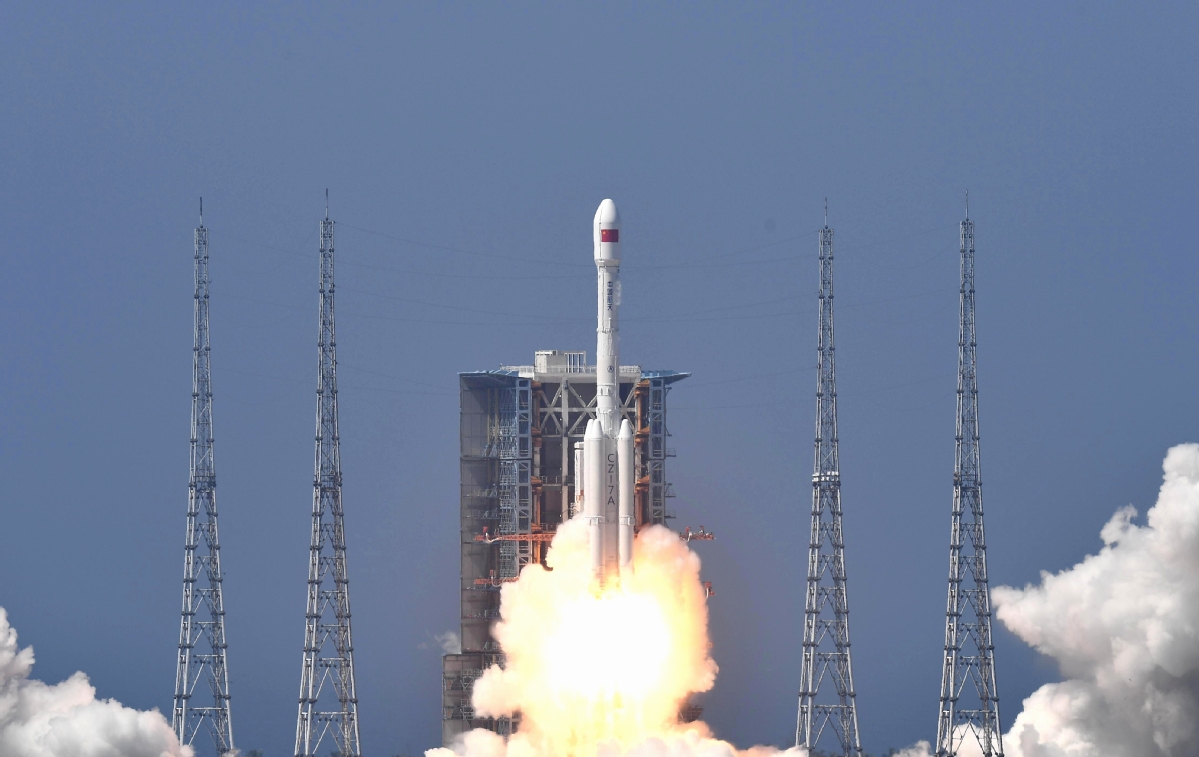
China successfully placed a new experimental satellite Long March 7A into orbit early Tuesday morning. The mission was carried out by the state-owned China Aerospace Science and Technology Corp (CASC).
The Launch Breakdown
The rocket blasted off at 10:10 am from a service tower at the coastal Wenchang Space Launch Center in Hainan province. Named the Communication Technology Demonstrator 26A, the satellite safely reached its preset orbit after a brief flight. The Shanghai Academy of Spaceflight Technology built this spacecraft. It will relay data, transmit radio and TV signals, and test next-generation communication systems.
Meet the Long March 7A
Engineering for this specific rocket model comes from the China Academy of Launch Vehicle Technology in Beijing. It features a core-stage diameter of 3.35 meters and tips the scales with a liftoff weight of 573 metric tons. Thanks to this massive power, the vehicle can carry up to 7 tons of cargo into geosynchronous transfer orbit. This successful liftoff marks China’s 46th space mission of 2026. It also clocks in as the 653rd flight for the country’s reliable Long March rocket fleet.
Expanding Orbital Capabilities
This mission underscores China’s aggressive cadence in space exploration. It also highlights their commitment to upgrading global communications infrastructure. By deploying advanced demonstrator satellites like the 26A, the nation is actively validating high-capacity data and relay technologies. These systems are required for tomorrow’s interconnected world. Furthermore, the flawless execution of the medium-lift Long March 7A reinforces Beijing’s launch capabilities. They can now routinely send heavy, sophisticated payloads into deep orbits, strengthening their competitive edge in the global space race.
Read More Articles:
Shenzhou-21 crew returns after 210 days