

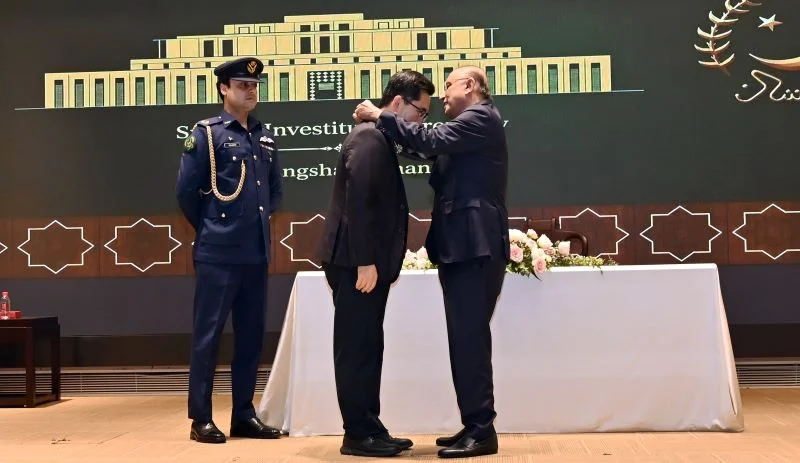
President Asif Ali Zardari has conferred the Sitara-i-Pakistan on renowned Chinese cardiologist Pan Xiangbin. The award recognizes his outstanding contributions to cardiac healthcare and services for patients in Pakistan.
The investiture ceremony took place in Changsha. During the event, the President praised Prof. Pan’s role in strengthening medical cooperation between Pakistan and China.
Contributions to Cardiac Healthcare
Prof. Pan serves as Vice President of Fuwai Hospital under the Chinese Academy of Medical Sciences. He is also Director of the National Interventional Quality Control Center for Structural Heart Disease.
His work in interventional cardiology has gained global recognition. He has pioneered advanced diagnostic and treatment methods. These include ultrasound-guided procedures that reduce the need for open-heart surgery.
Such techniques also lower radiation exposure and avoid general anaesthesia. As a result, patients benefit from safer and less invasive treatments.
Medical Missions in Pakistan
In January 2025, Prof. Pan visited Pakistan with his medical team. During the visit, they performed life-saving procedures on children with congenital heart disease.
Alongside treatment, he conducted specialized training sessions for Pakistani doctors. These sessions focused on modern interventional techniques.
Such efforts have helped improve local healthcare capacity. They also support the transfer of medical knowledge and expertise.
Strengthening Pakistan-China Medical Ties
Officials highlighted that Prof. Pan’s contributions go beyond clinical work. His initiatives have strengthened cooperation in the healthcare sector between both countries.
The ceremony was attended by several senior officials. These included Saleem Mandviwalla and Sharjeel Inam Memon.
Also present were Jiang Zaidong and Khalil Hashmi. Other officials, including Ali Hassan Barohi and Syed Qasim Naveed Qamar, attended the ceremony.
A Symbol of Lasting Partnership
The award reflects the strong and growing relationship between Pakistan and China. It also highlights the importance of collaboration in critical sectors like healthcare.
Through such partnerships, both countries continue to advance medical innovation and patient care.
READ MORE ARTICLES: