

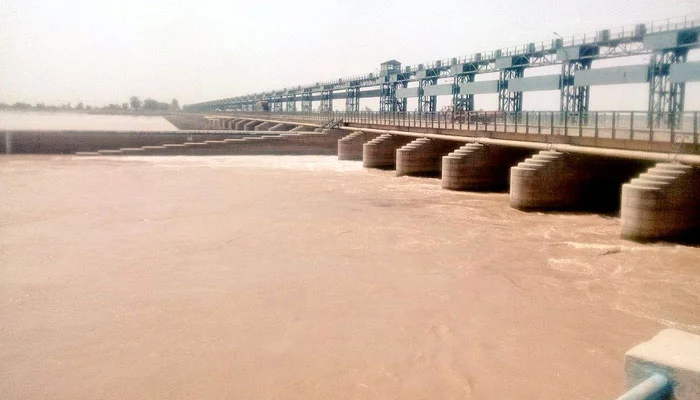
Chenab Flood Flow Reduced, NDMA Issues Warning as authorities successfully lowered water levels in the river to prevent immediate downstream flooding. However, officials caution that the combined flood wave still poses a major threat as it heads towards Panjnad and Sindh.
Controlled Reduction in Chenab Flow
The National Emergency Operations Centre (NEOC) confirmed that authorities cut the Chenab River’s flow from 885,000 cusecs to 550,000 cusecs by breaching two embankments. This move allowed the water to pass safely through Head Trimmu on September 1.
Currently, the flow is moving toward Panjnad, which has a capacity of 650,000 cusecs. Forecasts show Panjnad will receive 570,000–600,000 cusecs on September 3. On September 5, an extra 80,000–100,000 cusecs from the Sutlej will merge into the river.
Projected Flood Path Ahead
The combined flow at Panjnad may rise to 650,000–700,000 cusecs. From there, it will move towards Guddu Barrage on September 6 with 450,000–500,000 cusecs.
At Kot Mithan, the wave will join the Indus River. To manage the surge, authorities will regulate the flow at Taunsa, keeping it close to 200,000 cusecs. After that, the flood wave will travel downstream through Guddu, Sukkur, and Kotri barrages before reaching the sea between September 12 and 13.
NDMA’s Response and Precautionary Measures
An NDMA spokesperson stated that rescue and relief operations continue under the prime minister’s directives. Civil and military institutions are working together. “The National Emergencies Operation Centre is fully operational round the clock,” the spokesman said.
Residents near riverbanks and in flood-prone zones must move to safer areas immediately. “People must fully cooperate with the administration during evacuations and follow instructions before returning home,” NDMA warned.
Public Safety Advisory from NDMA
To minimise risks, NDMA advised avoiding unnecessary travel in flood-hit areas. Citizens should also prepare emergency kits with food, water, medicines, and essential documents. Additionally, the NDMA urged people to use its Disaster Alert app for updates and official guidance.
Related stories:
Flood Alert: NDMA Warns of High-Level Flooding in Budhni Nullah