

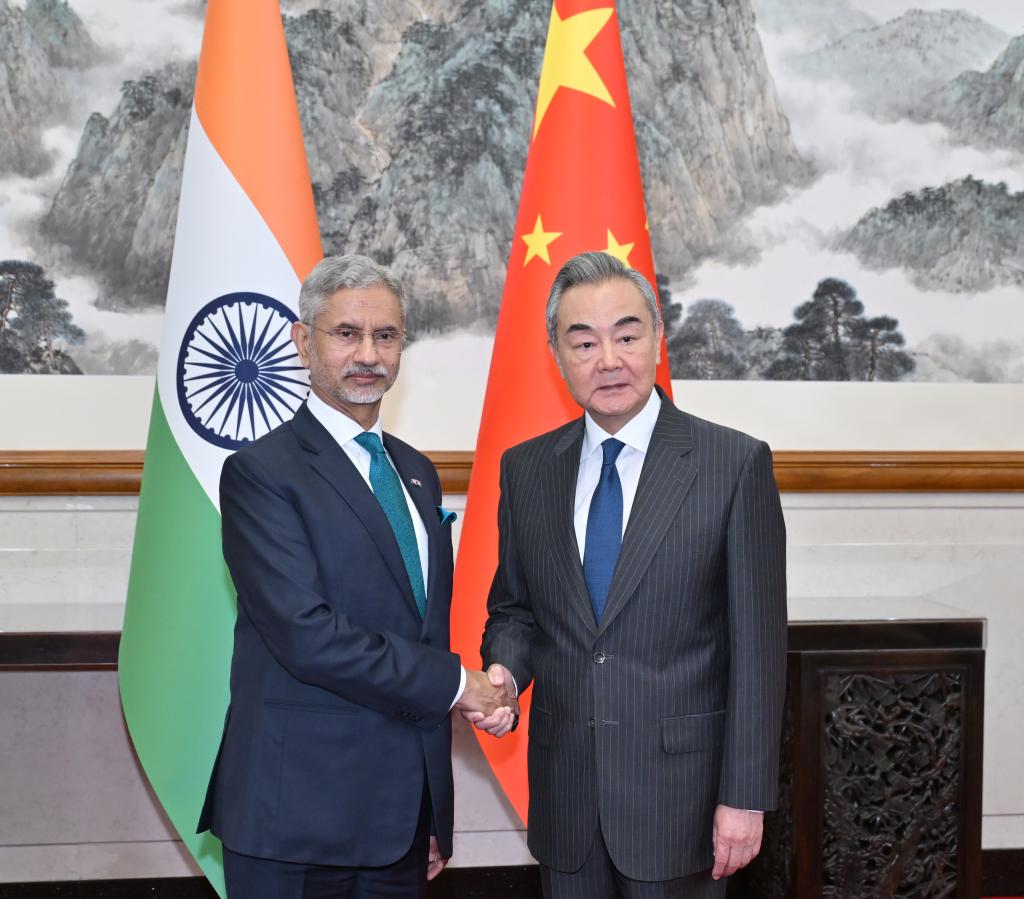
Chinese Foreign Minister Wang Yi emphasized that China and India should stick to the path of good-neighborly relations and foster mutual respect and trust. He underscored the importance of peaceful coexistence, shared development, and win-win cooperation as guiding principles for bilateral ties.
During talks with Indian External Affairs Minister Subrahmanyam Jaishankar in Beijing, Wang highlighted that both countries, as major Eastern civilizations and emerging economies, should strive to coexist harmoniously and pursue mutual prosperity.
Wang recalled that President Xi Jinping and Prime Minister Narendra Modi reached significant consensus during their meeting in Kazan last year, providing a strategic direction for improving China-India relations.
He urged both sides to maintain long-term vision, strengthen their commitment to friendship, and work towards realizing the concept of a “Dragon-Elephant Tango,” symbolizing collaborative progress.
Marking the 75th anniversary of China-India diplomatic relations, Wang said the hard-earned progress in ties should be valued and preserved through sustained cooperation and mutual goodwill.
He stressed that the bilateral relationship is not aimed against any third party and should remain uninfluenced by external forces. He called for building trust instead of suspicion, prioritizing cooperation over rivalry, and seeking mutual gain over zero-sum competition.
Wang reiterated China’s willingness to work with India to implement leaders’ consensus, enhance political trust, manage differences prudently, and boost coordination through multilateral forums like the SCO for the stable and healthy growth of ties.
He noted that Xi Jinping’s vision of a shared future for humanity aligns with Modi’s idea that “the world is one family,” showing common ground between the two nations’ philosophies.
Wang added that both countries support multilateralism and seek a fairer and more rational international order. China, he said, is ready to partner with India to uphold the multilateral trading system, stabilize global supply chains, and foster an open and cooperative international environment.
He affirmed China’s commitment to working with India in promoting a balanced multipolar world and inclusive globalization, protecting Global South interests, and advancing regional peace and development.
Indian Foreign Minister Jaishankar acknowledged that the Kazan meeting offered vital direction for the bilateral relationship and noted the normalization of exchanges and cooperation in various sectors.
He thanked China for facilitating the resumption of Indian pilgrimages to Xizang and described India and China as development partners rather than competitors. He stressed the need to take a long-term view of the relationship and use the 75th anniversary as a moment to deepen collaboration and promote peace, particularly in border areas.
Jaishankar emphasized focusing on positive dynamics in the relationship to prevent differences from escalating into disputes or conflicts.
Recognizing both nations’ global and regional significance due to their size and influence, Jaishankar affirmed India’s commitment to strategic autonomy and an independent foreign policy. He expressed readiness to cooperate with China in multilateral settings to advance a multipolar world order.
He also conveyed India’s full support for China’s role as the rotating chair of the SCO and its efforts to host a successful summit.
Related Posts