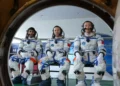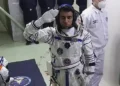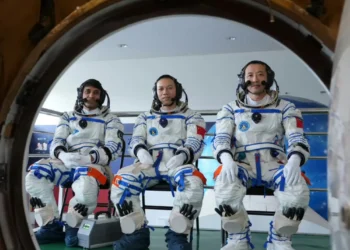


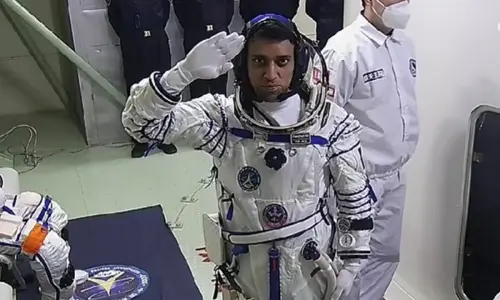
Muhammad Zeeshan Ali became the first Pakistani astronaut to enter Earth’s orbit on Wednesday after China’s Shenzhou-24 spacecraft successfully launched and reached its preset orbit from the Jiuquan Satellite Launch Centre.
The spacecraft lifted off at 8:18 a.m. Beijing time (5:18 a.m. Pakistan Standard Time) aboard a Long March-2F carrier rocket. Shortly after launch, the spacecraft separated from the rocket and entered its designated orbit.
An official at the launch centre confirmed the mission’s success, saying the spacecraft was functioning well.
The spacecraft subsequently docked with China’s Tiangong space station approximately three hours and 38 minutes after liftoff, making Ali the first foreign astronaut to visit the Chinese orbital facility.
The mission also marks the first joint flight involving Chinese and foreign astronauts in China’s crewed space programme.
Three-member crew begins space mission
Ali is serving as a payload specialist alongside Chinese astronauts Tang Hongbo and Wu Yi.
Tang Hongbo is commanding the mission, while Wu Yi is serving as the flight engineer. The three-member crew will participate in scientific research and other activities aboard Tiangong.
Following the successful launch, the China Manned Space Agency (CMSA) confirmed that the astronauts were in good condition and the spacecraft was operating normally.
The mission will also support an orbital crew rotation with the astronauts aboard the earlier Shenzhou-23 mission, alongside routine station operations, maintenance and scientific research.
Around 90 experiments planned aboard Tiangong
The Shenzhou-24 crew is expected to conduct approximately 90 scientific experiments and technology tests during the mission.
Ali will participate in research involving biological and scientific experiments in the microgravity environment.
According to Pakistan’s Space and Upper Atmosphere Research Commission (SUPARCO), his assignments include cultivating microalgae as a potential source of food and oxygen for future space missions and examining the effects of spaceflight on quinoa seeds.
He is also expected to conduct an experiment involving photosynthetic cyanobacteria, which could contribute to research into biological systems for future long-duration space exploration.
These activities will provide Pakistani researchers with an opportunity to participate in scientific work conducted aboard an operational space station.
Zeeshan Ali to spend around one week in space
Ali is expected to remain aboard Tiangong for approximately five to ten days before returning to Earth.
He will travel back aboard the Shenzhou-23 spacecraft alongside Chinese astronauts from the previous mission. The return flight will conclude his first space journey.
The mission also involves an unusual crew rotation. Shenzhou-23 commander Zhu Yangzhu is expected to remain aboard the station for a year to support research into the effects of long-duration spaceflight on the human body.
The research is part of China’s broader preparations for future human space exploration, including its planned crewed lunar mission.
Ahsan Iqbal witnesses historic launch in China
Federal Minister for Planning, Development and Special Initiatives Ahsan Iqbal witnessed the launch at the Jiuquan Satellite Launch Centre, representing Pakistan at the historic event.
Following the successful liftoff, Iqbal said the Pakistani flag had risen into orbit with Ali, carrying the hopes and aspirations of 260 million Pakistanis for technological advancement and space exploration.
He described the mission as Pakistan’s entry into a new phase of human spaceflight and highlighted the importance of continued cooperation with China.
The minister also attended the astronauts’ send-off ceremony before the spacecraft launched.
Ali says he carries the hopes of Pakistanis
Before the launch, Ali addressed the Pakistani nation and described the responsibility of representing the country in space.
“I want to assure you that I am not flying for myself. I carry the name of Pakistan on my shoulders, the hopes of 250 million Pakistanis,” he said.
He also expressed hope that the mission would become the starting point for further cooperation between Pakistan and China, including multiple joint flights and future exploration of the Moon and Mars.
Ali’s participation follows seven months of intensive astronaut training in China, which included scientific experiments, space station operations, emergency procedures and Chinese-language instruction.
He and fellow candidate Khurram Daud were selected in April 2026 for the astronaut training programme, with Ali eventually chosen for the Shenzhou-24 crew.
Pakistan-China space cooperation reaches new milestone
The historic flight follows a space cooperation agreement signed between China’s Manned Space Agency and Pakistan’s SUPARCO on February 28, 2025.
Under the agreement, China selected and trained two Pakistani astronaut candidates, with one joining a short-duration mission aboard the Tiangong space station.
The partnership has expanded the scope of Pakistan-China space cooperation beyond satellite development and launch services to include astronaut training, human spaceflight and joint scientific research.
China’s inclusion of a Pakistani astronaut in its crewed space programme also creates opportunities for Pakistani researchers to participate in international space experiments.
With Ali now aboard Tiangong, the mission represents a significant development in Pakistan’s human spaceflight ambitions and the countries’ growing scientific and technological partnership.
Read More Articles:
Beyond the Stars: A New Frontier for China-Pakistan Cooperation