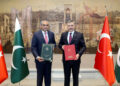

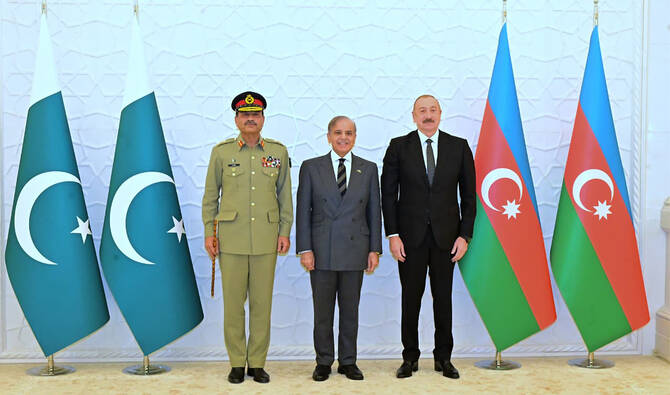
Pakistan and Azerbaijan have reaffirmed their commitment to deepen strategic cooperation, as Prime Minister Shehbaz Sharif met Azerbaijani President Ilham Aliyev in Baku on Friday. The meeting, held at the Presidential Palace, was also attended by Pakistan’s Chief of Army Staff, Field Marshal Syed Asim Munir.
Prime Minister Shehbaz Sharif thanked President Aliyev for inviting him to participate in Azerbaijan’s Victory Day celebrations, commemorating the country’s decisive triumph in the 44-day Karabakh Liberation War. He congratulated the Azerbaijani leadership and described their victory as a symbol of hope for oppressed nations striving for self-determination, particularly the people of Kashmir and Palestine.
During the extensive discussions, both leaders reviewed bilateral relations and agreed to expand cooperation across key sectors including defence, energy, trade, investment, politics, and regional connectivity. The Prime Minister praised Azerbaijan’s progress under President Aliyev’s leadership and acknowledged the landmark peace agreement signed earlier this year with Armenia.
President Aliyev expressed deep appreciation for Pakistan’s steadfast diplomatic and moral support during Azerbaijan’s struggle to liberate Karabakh. He also commended Pakistan’s constructive contribution to regional stability in South Asia.
Prime Minister Sharif extended an invitation for President Aliyev to visit Pakistan, which the Azerbaijani leader accepted. This visit marks Sharif’s fourth trip to Azerbaijan this year, following earlier engagements in Khankendi and Baku during major regional forums.
Pakistan and Azerbaijan have significantly strengthened ties in recent years through high-level visits and strategic agreements. In 2024, Azerbaijan announced a $2 billion investment in Pakistan during President Aliyev’s visit to Islamabad. Defence cooperation also advanced with Pakistan’s contract to supply JF-17 Block III fighter jets to Azerbaijan in late 2023.
The two nations continue to collaborate closely in leading international platforms such as the OIC, ECO, and the United Nations, further consolidating their longstanding brotherly partnership. Related stories: