

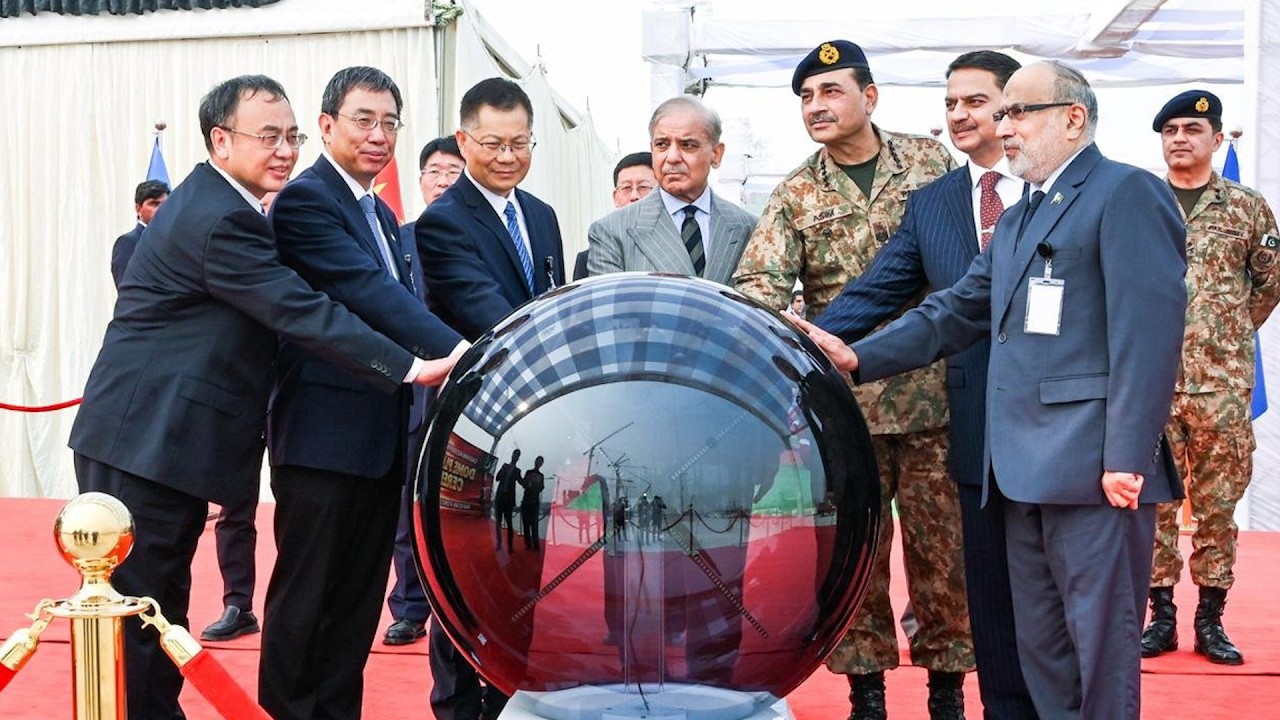
The Pakistan Atomic Energy Commission (PAEC) has achieved a major construction milestone at the Chashma Nuclear Power Plant in Mianwali with the successful placement of the reactor dome at the Chashma-5 (C-5) Nuclear Power Plant.
Prime Minister Shehbaz Sharif attended the ceremony on November 10 as the chief guest, alongside Field Marshal Syed Asim Munir, senior Pakistani officials, Chinese representatives and other project stakeholders. The Prime Minister’s Office confirmed the development, describing it as an important achievement for Pakistan’s nuclear energy programme.
The milestone was completed ahead of schedule through the joint efforts of Pakistani and Chinese engineers, technicians and workers involved in the project.
What the Chashma-5 Dome Placement Means
Dome placement marks an important stage in the construction of a nuclear power plant. It involves installing the large roof structure over the reactor building, which houses the nuclear reactor and its associated equipment.
The milestone indicates substantial progress in the reactor building’s structural construction and allows the project to move towards further construction and equipment installation activities.
According to reporting by Dawn, the dome placement marks the completion of major civil works in the reactor building and the transition towards internal construction and installation.
Chashma-5 to Add 1,200MW to Pakistan’s Power Capacity
The Chashma-5 project will have a planned generation capacity of 1,200 megawatts (MW), making it the largest nuclear power unit in Pakistan by capacity.
The plant is expected to begin generating electricity in September 2030. Once operational, it will supply electricity to the national grid and increase the contribution of nuclear energy to Pakistan’s overall power generation capacity.
The project is located at the Chashma Nuclear Power Plant site along the Indus River in Mianwali District, Punjab.
The Pakistan Nuclear Regulatory Authority (PNRA) issued the construction licence for C-5 in December 2024 after reviewing the project’s safety assessments and regulatory submissions.
PNRA identifies the reactor as an advanced third-generation pressurised water reactor based on China’s Hualong design, also known as HPR1000. The design incorporates active and passive safety features, including a double-shell containment structure.
Nuclear Energy’s Growing Role in Pakistan
Speaking at the ceremony, Prime Minister Shehbaz Sharif described Chashma-5 as a major step towards expanding clean and emissions-free electricity generation in Pakistan.
He highlighted nuclear energy’s contribution to the country’s electricity supply, saying it accounted for approximately 16.6 per cent of total electricity generation despite representing only 8.6 per cent of installed power capacity. Its contribution rises to around 26 per cent during winter, according to the figures shared at the ceremony.
PAEC Chairman Dr Raja Ali Raza Anwar also highlighted nuclear power’s importance for national energy security. He said Pakistan’s nuclear power plants were safely and efficiently generating 3,530MW of electricity and helping avoid approximately 15 million tonnes of carbon dioxide emissions annually.
PAEC’s official information identifies six operating nuclear power plants across the Chashma and Karachi sites, with a combined capacity of 3,530MW. The authority also lists one additional 1,200MW unit under construction at Chashma.
China-Pakistan Cooperation in Nuclear Energy
China has played a central role in the development of Pakistan’s civil nuclear energy programme, providing technology and cooperation for several nuclear power projects.
The Chashma nuclear complex already hosts four operating units, while the Karachi nuclear power station has two operational units. Chashma-5 will further expand this cooperation and add a major new source of electricity to Pakistan’s energy system.
The Prime Minister commended Chinese partners and acknowledged the contributions of Pakistani and Chinese workers. He said the milestone reaffirmed the longstanding Pakistan-China All-Weather friendship and their commitment to expanding cooperation in economic, security and development sectors.
He also stressed the importance of using Pakistan’s natural resources and human capital to build a stronger economy, improve energy security and promote environmental responsibility.
Chashma-5 to Support Long-Term Energy Security
Pakistan continues to face the challenge of meeting growing electricity demand while ensuring a reliable and affordable energy supply. Nuclear power can contribute to this objective by providing continuous electricity with relatively low operational carbon emissions.
Once completed, Chashma-5 is expected to strengthen the national grid, diversify Pakistan’s energy mix and reduce dependence on electricity generation sources that rely on imported fuels.
The successful dome placement represents an important step towards completing the project. Further construction, installation, testing and regulatory requirements will need to be completed before the plant can begin commercial electricity generation, currently expected in September 2030.
Read More Articles:
Jiwani Fishermen Get Modern Shelter Under BSDI