

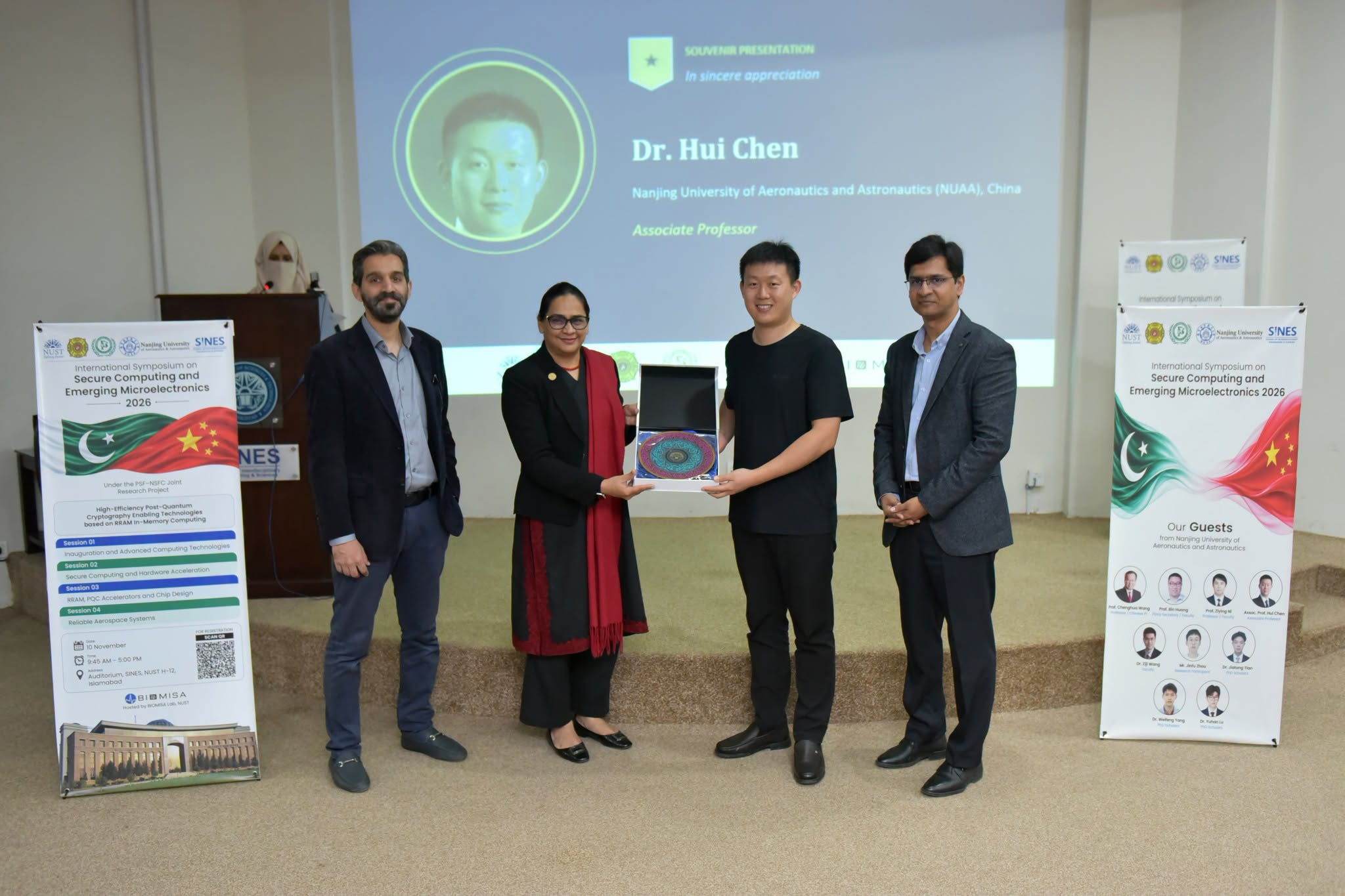
Pakistan and China are exploring new opportunities for scientific cooperation in advanced semiconductor technologies following an international research symposium hosted by the National University of Sciences and Technology (NUST) in Islamabad.
NUST’s BIOMISA Laboratory at the School of Interdisciplinary Engineering and Sciences (SINES) organised the International Symposium on Secure Computing and Emerging Microelectronics 2026. The event brought together Pakistani researchers and a nine-member delegation from China’s Nanjing University of Aeronautics and Astronautics (NUAA).
Jointly funded by the Pakistan Science Foundation (PSF) and China’s National Natural Science Foundation (NSFC), the symposium focused on developing faster and more energy-efficient computer chips using Resistive Random Access Memory (RRAM) technology.
Pakistan and China Focus on RRAM Technology
A major focus of the symposium was RRAM, an emerging non-volatile memory technology that can retain stored information without a continuous power supply.
Unlike conventional computing architectures, where processors and memory units operate separately, RRAM offers the potential to combine data storage and processing within the same hardware.
This approach is known as computing-in-memory. It reduces the need to move large amounts of data between separate processing and memory units, potentially improving computing speed and lowering energy consumption.
The technology has applications in artificial intelligence, high-performance computing and other data-intensive tasks that require efficient processing capabilities.
Researchers are also exploring its potential in cryptographic operations, where efficient hardware can help accelerate complex mathematical calculations.
RRAM Research Could Support Future Cybersecurity
The symposium’s focus on secure computing also reflects growing interest in developing hardware capable of supporting post-quantum cryptography.
Advances in quantum computing could eventually threaten some encryption systems currently used to protect digital communications and sensitive information. Researchers are therefore developing new cryptographic algorithms designed to withstand attacks from future quantum computers.
RRAM-based computing-in-memory architectures could help execute some of the mathematical operations required by these algorithms more efficiently.
A January 2026 research paper involving scientists from the Chinese Academy of Sciences explored an RRAM-based architecture for accelerating binary matrix-vector multiplication, an important operation in post-quantum cryptography systems such as Classic McEliece.
The study demonstrated the potential of RRAM hardware to improve the energy efficiency of these calculations. However, RRAM itself is not an encryption method or a replacement for quantum-resistant algorithms. Instead, it could provide more efficient hardware for implementing them.
Chinese Research Institutions Advance Semiconductor Innovation
China has been expanding its research into RRAM and computing-in-memory architectures through universities and scientific institutions.
Researchers affiliated with Tsinghua University have investigated RRAM-based computing-in-memory chips for artificial intelligence applications, focusing on improving processing efficiency and reducing energy consumption.
In a separate study published in the Journal of Semiconductors, a Tsinghua University research team presented a fabricated 28-nanometre RRAM-based computing-in-memory chip. The study reported improvements in programming speed, power consumption and computing efficiency.
Meanwhile, researchers from the Chinese Academy of Sciences have explored RRAM architectures for cryptographic calculations, including operations relevant to post-quantum security systems.
These developments demonstrate the growing range of applications being explored for the technology and provide opportunities for international academic cooperation.
NUST Introduces Its Chip Design Centre
During the symposium, participants also visited the NUST Chip Design Centre (NCDC), where they were introduced to Pakistan’s semiconductor design and development capabilities.
Established with support from the Ministry of Science and Technology and NUST, the centre aims to develop skilled semiconductor professionals and strengthen Pakistan’s participation in the global chip industry.
Its research and training activities cover digital integrated circuit design, analog and mixed-signal technologies, chip verification and related engineering disciplines.
The centre provides access to electronic design automation tools, FPGA development platforms, computing facilities and equipment for chip testing and characterisation.
According to its official profile, NCDC has trained engineers and supported chip design and development activities, contributing to Pakistan’s growing semiconductor research ecosystem.
Pakistan-China Academic Cooperation in Emerging Technologies
The symposium provided researchers from both countries with an opportunity to exchange technical knowledge and explore areas for future collaboration.
Technical presentations brought together expertise in security algorithms, digital systems, chip manufacturing and hardware reliability testing. The discussions highlighted the potential for combining research capabilities to address challenges in advanced microelectronics and secure computing.
Joint funding from the Pakistan Science Foundation and China’s National Natural Science Foundation also reflects institutional support for scientific collaboration between the two countries.
For Pakistan, partnerships with Chinese universities and research institutions could help expand access to specialised knowledge, technical expertise and advanced semiconductor research.
As demand for high-performance computing, artificial intelligence and secure digital infrastructure continues to grow, cooperation in semiconductor technologies could contribute to Pakistan’s efforts to develop local research capabilities and skilled engineering talent.
The NUST symposium marks another opportunity to deepen Pakistan-China academic engagement and explore emerging technologies that could shape the future of computing.
Read More Articles:
Pakistan Approves Another 416,000 Tonnes of Sugar Exports
Ahsan Iqbal in Beijing for Pakistan’s First Astronaut Mission
China’s Shenzhou-24 Mission to Carry First Pakistani Astronaut to Space Station