
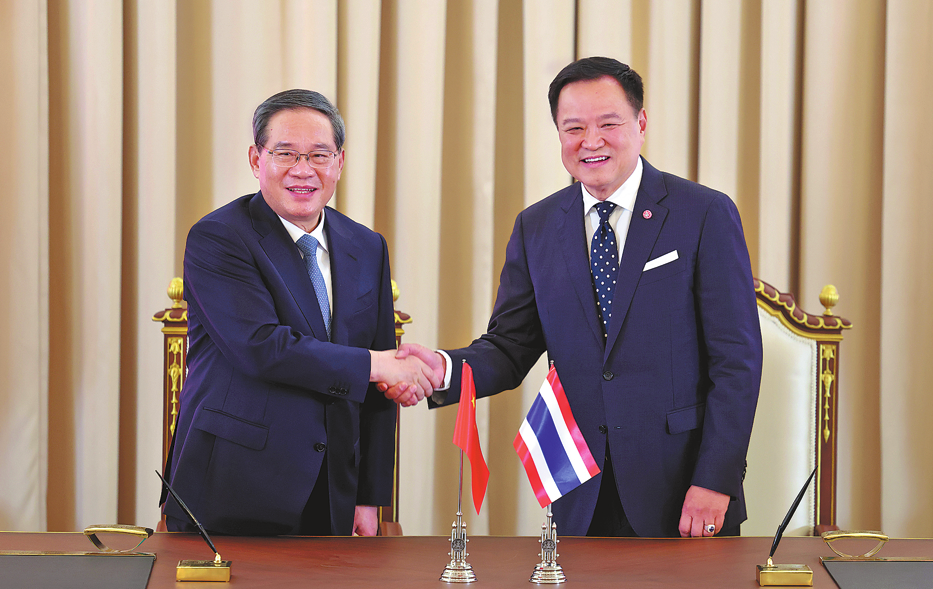
China and Thailand have agreed to strengthen their comprehensive strategic cooperative partnership, with a renewed focus on economic cooperation, industrial development, regional connectivity and security.
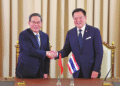
Chinese Premier Li Qiang held talks with Thai Prime Minister Anutin Charnvirakul on Friday, November 13, during his official visit to Thailand. The two leaders discussed ways to deepen political trust, expand bilateral trade and advance cooperation across several priority sectors.
Following the talks, they witnessed the signing and exchange of eight cooperation documents covering the automotive industry, vocational education, agriculture, customs, security and other areas.
The visit, scheduled from November 13 to 15, marks the first official visit to Thailand by a Chinese premier in seven years and Li’s first since assuming office. It also follows Anutin’s official visit to China in July 2026.
Li Qiang calls for stronger political trust and economic cooperation
During the meeting, Li said China was ready to work with Thailand to consolidate political mutual trust, respect each other’s core interests and address major concerns.
He noted that Chinese President Xi Jinping had met Anutin during the Thai prime minister’s visit to China in July, when both leaders outlined the direction for developing bilateral relations.
Li said the exchange of visits by the two countries’ prime ministers within four months demonstrated the strength of their bilateral relationship.
He also expressed China’s support for the Thai government’s efforts to advance national development and called for greater use of existing cooperation mechanisms.
These include the 2+2 strategic dialogue between the foreign and defence ministers of both countries and the joint committee on economic and trade cooperation.
Li said both sides should strengthen coordination between their development strategies and pursue practical cooperation that delivers tangible benefits to their populations.
China-Thailand railway and Belt and Road cooperation
Infrastructure connectivity featured prominently in the discussions, with Li calling for progress on high-quality Belt and Road cooperation and major projects, particularly the China-Thailand railway.
The railway is an important part of plans to improve transport connectivity between Thailand and neighbouring countries, with the longer-term objective of strengthening regional links with the wider Southeast Asian rail network.
China and Thailand also discussed accelerating consultations on a new five-year plan for economic and trade cooperation.
Li called for stronger coordination in areas including financial services, renewable energy, semiconductors and artificial intelligence. He also proposed advancing mutual protection of geographical indication products, which can help protect the identity and commercial value of goods associated with particular regions.
China expressed its willingness to import more quality products from Thailand and encouraged Chinese companies to invest in the country.
Li also called on Thailand to maintain a fair, stable and predictable business environment for Chinese enterprises operating in the Southeast Asian market.
Eight agreements cover agriculture, automotive industry and education
The two leaders witnessed the signing and exchange of eight cooperation documents at Government House in Bangkok.
According to the Thai government’s announcement, the agreements cover several areas:
- Agriculture: New plant-health protocols for Thai fresh durian and salak exports to China, alongside food safety cooperation.
- Automotive industry: Cooperation to strengthen the electric vehicle industry, smart vehicle technology, batteries and manufacturing supply chains.
- Vocational education: Training programmes, practical learning opportunities and exchanges involving students, teachers and technical experts.
- Security: Expanded cooperation to address cross-border crime and improve public safety.
- Customs and trade: Cooperation on agricultural standards, inspection procedures and the accuracy of weights and measurements.
- Other areas: Metrology cooperation and arrangements concerning consular services.
The agricultural protocols are expected to improve market access for Thai produce. In particular, the salak agreement could open additional opportunities for Thai exporters in the Chinese market.
The automotive cooperation is intended to help Thai manufacturers strengthen their participation in international supply chains, while vocational education partnerships will support practical skills development.
Thailand seeks stronger cooperation in technology and trade
For his part, Anutin said Thailand attached great importance to its relationship with China and remained committed to expanding cooperation under their comprehensive strategic cooperative partnership.
He called for more high-level exchanges and stronger use of existing bilateral mechanisms to increase trade and investment.
The Thai prime minister identified agriculture, finance, connectivity, electric vehicles, artificial intelligence, e-commerce, science and technology as important areas for future cooperation.
Anutin also said Thailand was prepared to maintain a favourable business environment for Chinese companies investing in the country.
He highlighted the importance of strengthening law enforcement and security cooperation to combat online gambling, telecommunications fraud and other forms of cybercrime.
The Thai government also pledged to work with China to improve the safety of Chinese tourists and expand cultural and people-to-people exchanges.
Both sides discuss regional and international cooperation
Beyond bilateral economic relations, Li called for closer coordination between China and Thailand through regional and international organisations.
He highlighted cooperation under China-ASEAN, the Lancang-Mekong Cooperation framework, the United Nations, the World Trade Organization and the Asia-Pacific Economic Cooperation (APEC).
The two countries also discussed disaster prevention, water resource management, education, tourism and media cooperation.
Anutin expressed Thailand’s support for China’s successful hosting of the APEC Economic Leaders’ Meeting and said Thailand was ready to work with China to ensure the success of the Lancang-Mekong Cooperation Leaders’ Meeting.
Both leaders emphasised the importance of cooperation in promoting regional stability, development and prosperity.
China-Thailand partnership expands across multiple sectors
The latest talks build on the commitments made during Anutin’s July 2026 visit to China, when both governments reaffirmed their goal of developing a community with a shared prosperous future.
The November meeting has added practical cooperation documents to that broader framework, particularly in agriculture, manufacturing, education and security.
The eight agreements provide a basis for further cooperation, although their long-term economic impact will depend on implementation, investment and continued coordination between the two governments and private-sector partners.
With infrastructure connectivity, advanced technology and industrial development among the shared priorities, China and Thailand are seeking to broaden their economic partnership and strengthen their role in regional cooperation.
Read More Articles:
Pakistan-China Space Mission Advances Human Spaceflight