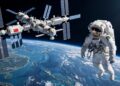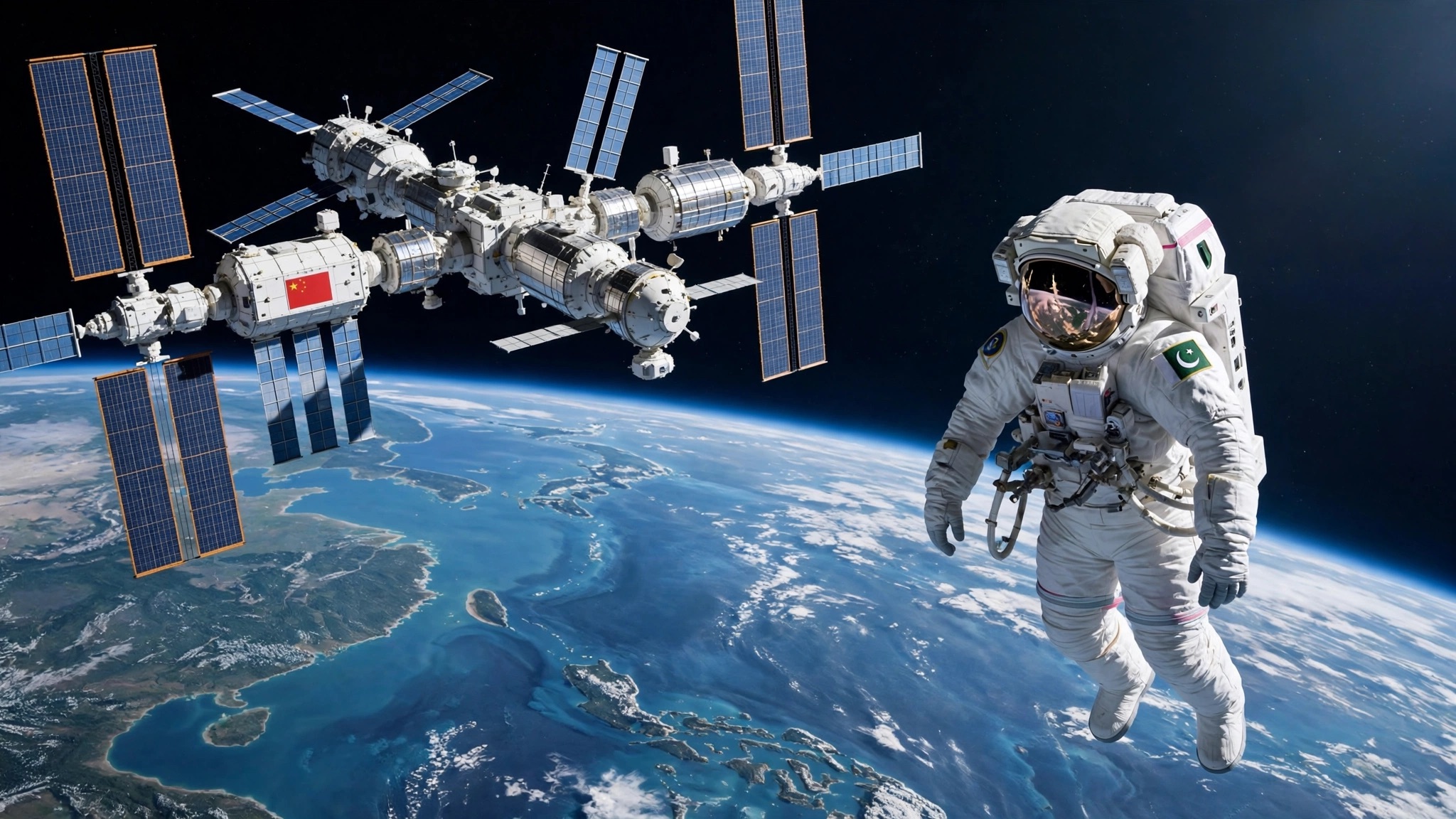
Pakistan is set to achieve a historic milestone in space exploration, with a Pakistani astronaut selected to participate in China’s Shenzhou-24 crewed spaceflight mission as a payload specialist.
The China Manned Space Agency (CMSA) announced on Saturday that one Pakistani astronaut will join the mission, marking the first time a foreign astronaut will visit China’s space station and the first joint spaceflight involving Chinese and foreign astronauts in the country’s manned space programme.
According to the announcement, the Pakistani astronaut will travel to the Chinese space station aboard the Shenzhou-24 mission, complete a short-term stay in orbit and return to Earth aboard the Shenzhou-23 spacecraft.
The agency has not yet identified which Pakistani candidate will undertake the flight or announced the mission’s launch date. However, it confirmed that the selected astronaut will serve as a payload specialist, while the other candidate will remain on standby as the mission’s backup. <Cite refs={[“turn515570search5″,”turn354955news18″,”turn354955news19”]}/>
Muhammad Zeeshan Ali and Khurram Daud Selected as Pakistani Candidates
The development follows a cooperation agreement signed between Pakistan and China in Islamabad on February 28, 2025, to select and train Pakistani astronauts for missions aboard the Chinese space station.
The agreement was signed by the China Manned Space Engineering Office and Pakistan’s Space and Upper Atmosphere Research Commission (SUPARCO), establishing a framework for Pakistan’s participation in China’s human spaceflight programme.
Under the arrangement, China would provide astronaut training and prepare Pakistani candidates for short-duration missions aboard the Tiangong space station.
Following three stages of selection and assessment, two Pakistani candidates, Muhammad Zeeshan Ali and Khurram Daud, were selected in April 2026 as reserve astronauts.
Both candidates subsequently travelled to China and joined the Astronaut Center of China in Beijing, where they began specialised training alongside Chinese astronauts.
The selection process included preliminary screening, a second round of evaluation and final selection. The two candidates were chosen after successfully completing these stages. <Cite refs={[“turn354955search15″,”turn515570search1″,”turn515570search3”]}/>
Pakistani Astronauts Complete Training in China
The two Pakistani candidates underwent a comprehensive training programme designed to prepare them for the technical and physical demands of human spaceflight.
According to the China Manned Space Agency, their preparation included basic astronaut training and specialised aerospace technical instruction.
The programme focused on developing practical operational capabilities required to perform duties aboard the space station. It also included intensive Chinese-language instruction to help the candidates understand mission commands, technical terminology and communication procedures.
In May 2026, CMSA confirmed that both Pakistani astronauts had entered the Astronaut Center of China and were training alongside their Chinese counterparts.
The agency said the training was progressing smoothly and that one Pakistani candidate would eventually serve as a payload specialist on a short-term spaceflight mission.
After completing the required training and passing the final evaluations, one astronaut will undertake the Shenzhou-24 mission, while the second will serve as the backup. <Cite refs={[“turn515570search0″,”turn515570search3″,”turn515570search5”]}/>
Pakistani Astronaut to Become First Foreign Visitor to Tiangong
The Shenzhou-24 mission will mark an important development in China’s human spaceflight programme by bringing the first foreign astronaut to its Tiangong space station.
China’s space station, also known as Tiangong or the Heavenly Palace, serves as an orbital platform for scientific research, technological experiments and international cooperation.
The station supports long-duration human habitation and provides facilities for research in areas including life sciences, space technology and materials science.
Until now, China’s crewed spaceflight missions have primarily involved Chinese astronauts. The participation of a Pakistani astronaut will introduce the first foreign national into a joint crewed mission under China’s manned space programme.
The mission also represents a new stage in China’s efforts to expand international participation in its space station programme.
The Pakistani astronaut will join Chinese crew members for a short period in orbit before returning to Earth aboard Shenzhou-23. The CMSA announcement did not disclose the exact duration of the stay or provide a detailed flight schedule. <Cite refs={[“turn354955search3″,”turn354955news19″,”turn515570search5”]}/>
Scientific Research to Be Part of Pakistan’s Space Mission
Pakistan’s participation in the Chinese space station programme is also intended to support scientific research and technological development.
Under the bilateral cooperation framework, the Pakistani astronaut is expected to undertake scientific experiments developed by Pakistani researchers while performing routine crew responsibilities during the mission.
SUPARCO has identified several potential research fields for the country’s astronaut programme, including biological and medical sciences, aerospace, applied physics, fluid mechanics, space radiation, ecology, materials science, microgravity studies and astronomy.
Earlier reports also highlighted the preparation of Pakistani biotechnology experiments focusing on food security and climate change.
Such research could help Pakistani scientists study how biological systems respond to microgravity and explore scientific questions that are difficult to investigate under normal conditions on Earth.
However, the latest CMSA announcement did not specify the final experiments or research activities assigned to the Shenzhou-24 payload specialist. <Cite refs={[“turn515570search10″,”turn515570search12″,”turn354955news23”]}/>
Pakistan-China Space Cooperation Expands Beyond Astronaut Training
The upcoming crewed mission reflects the expansion of Pakistan-China cooperation in space science and technology.
The two countries have maintained cooperation in satellite development, launches, remote sensing and space technology applications. China has supported the launch of several Pakistani satellites, while both sides continue to explore opportunities for scientific research and technological collaboration.
The astronaut agreement signed in February 2025 extended this partnership into human spaceflight, opening an opportunity for Pakistan to participate directly in China’s space station programme.
During their joint statement in May 2026, Pakistan and China welcomed the training of two Pakistani astronauts and expressed support for a Pakistani national becoming the first foreign astronaut to enter the Chinese space station.
Both governments also reaffirmed their commitment to deepening peaceful and mutually beneficial cooperation in space exploration. <Cite refs={[“turn354955search13″,”turn354955search12″,”turn354955search14”]}/>
A New Chapter in Pakistan’s Space Exploration
The Shenzhou-24 mission represents a significant step in Pakistan’s efforts to develop its human spaceflight capabilities and strengthen its position in international scientific cooperation.
Although the mission will rely on China’s spacecraft, launch infrastructure, training facilities and space station, it will provide Pakistani astronaut candidates with direct experience in crewed spaceflight and orbital research.
The experience could also contribute to Pakistan’s future scientific and technological development by expanding expertise in astronaut training, space research and advanced mission operations.
For China, the mission will demonstrate the international cooperation potential of its manned space programme and establish a new precedent for foreign participation aboard Tiangong.
As preparations continue, the selection of the Pakistani astronaut and the announcement of the mission schedule will be the next important developments.
The upcoming flight is expected to open a new chapter in Pakistan-China space cooperation while creating opportunities for further collaboration in scientific research, technology and peaceful exploration of space.
Read More Articles:
Pakistan Highlights SCO Cooperation on Sustainable Development
Ishaq Dar and Liu Haixing Lead Pakistan-China Governance Talks