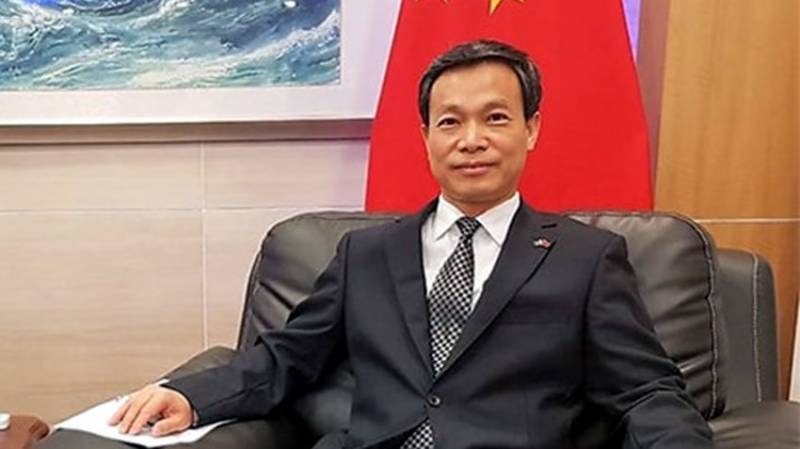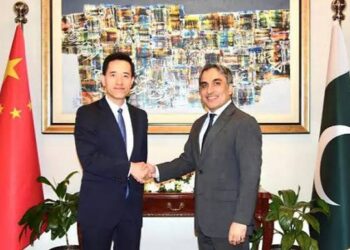

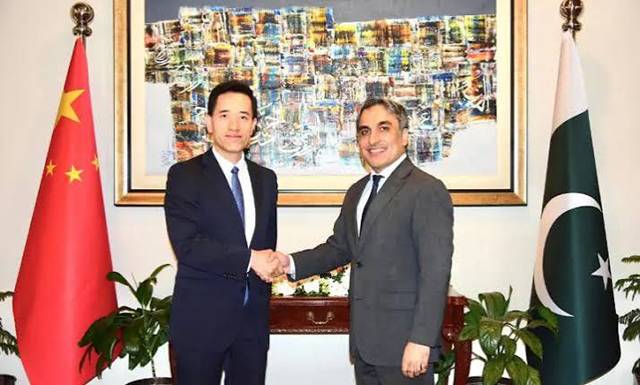
Pakistan and China have formally operationalised the Boundary Joint Commission, giving the two countries an operational forum to coordinate border management, joint surveys and trade facilitation along their shared frontier in the north. The inaugural meeting was held on September 16 at Pakistan’s Ministry of Foreign Affairs in Islamabad, co-led by Li Ya, Deputy Director General of the Department of Boundary and Ocean Affairs at China’s Ministry of Foreign Affairs, and Bilal Mahmood Chaudhary, Director General (China) at Pakistan’s Ministry of Foreign Affairs.
Pakistan’s Foreign Office described the development as a significant milestone in the bilateral relationship, framing it as a structured platform for coordination on shared-border matters going forward.
What the Commission Was Set Up to Do
According to Pakistan’s Foreign Ministry, the mechanism is intended to enhance cooperation across border management, joint border surveys, trade flows, and people-to-people connectivity. Dawn’s reporting on the meeting described the commission’s framework as addressing practical, recurring issues along the frontier, including inspections, boundary markers, cross-border facilities, and the handling of incidents.
Neither government has released a detailed schedule for the commission’s future work, and the inaugural meeting appears to have focused primarily on activating the mechanism itself.
A Mechanism With Roots Going Back to 2013
The commission is not a new invention. It traces back to the 2013 Agreement on the Boundary Management System, signed during a visit to Islamabad by then-Chinese Premier Li Keqiang. Article 45 of that agreement specifically provided for the establishment of a joint commission to oversee implementation of ongoing border management arrangements, according to Dawn’s reporting on the mechanism’s history. What changed on September 16 was that this long-dormant provision was finally activated through an inaugural meeting, more than a decade after the underlying agreement was signed.
This 2013 mechanism is distinct from an earlier body, the Joint Boundary Demarcation Commission, established under the Sino-Pakistan Boundary Agreement of March 2, 1963. That earlier commission had a narrower, essentially one-time mandate: conducting surveys, establishing boundary markers, preparing detailed maps and fixing the alignment of the boundary itself.
The 2013 agreement, by contrast, created a continuing administrative system for managing a boundary that had already been demarcated, covering matters such as marker maintenance, cross-border infrastructure and the handling of border incidents. The commission activated this month operates under the 2013 framework, not the 1963 one.
The Khunjerab Pass Backdrop
The commission’s activation comes as Pakistan and China continue expanding the role of the Khunjerab Pass, the high-altitude crossing that connects Gilgit-Baltistan with China’s Xinjiang region, as a land link for bilateral trade. In their May 2026 joint statement, the two countries agreed to make greater use of the pass to strengthen land connectivity and advance cooperation under the upgraded China-Pakistan Economic Corridor framework.
That push has already shown measurable results. Pakistan Customs collected a record Rs 15 billion in revenue from imports arriving through the Khunjerab Pass during fiscal year 2025-26, while Pakistani exports to China and Central Asian markets through the crossing reached Rs 2.8 billion over the same period.
An active Boundary Joint Commission gives both governments a more structured channel to address the practical border-management issues, from seasonal accessibility to customs coordination, that affect how efficiently goods and people move through the crossing, though whether the commission translates into concrete improvements will depend on the outcomes of its future meetings rather than the fact of its activation alone.
A Mechanism, Not a New Boundary
It is worth being precise about what the commission does and does not represent. It is an administrative body for managing an already-demarcated frontier under a decade-old agreement, not a renegotiation of any boundary line and not evidence of a newly created border relationship.
India has publicly rejected the commission. Foreign ministry spokesperson Randhir Jaiswal said New Delhi does not recognise any boundary between Pakistan and China in the area concerned, arguing the commission has no legal basis.
India maintains that the territory addressed by the underlying 1963 Sino-Pakistan Boundary Agreement, including the Shaksgam Valley, forms part of Jammu and Kashmir and Ladakh, and has said it has never recognised that 1963 agreement, which it considers illegal and invalid.
Pakistan and China have not altered their respective positions in response; both governments continue to treat the frontier addressed by the commission as settled. This is a longstanding, unresolved three-way dispute rather than a new development introduced by this commission, and readers should treat both India’s legal objection and Pakistan-China’s position on the boundary’s validity as contested claims rather than settled fact.
The commission’s activation came four days after Chinese President Xi Jinping met Indian Prime Minister Narendra Modi on the sidelines of the BRICS summit in New Delhi, where the two leaders discussed the India-China boundary question as part of a broader effort to stabilise ties.
Where This Fits in the Broader Relationship
The commission’s activation continues a pattern visible elsewhere in Pakistan-China relations this year: converting long-standing but dormant cooperation frameworks into active, functioning mechanisms. Similar structured platforms already exist for trade, industrial cooperation and agricultural research under CPEC’s second phase.
For residents and traders along the Khunjerab corridor, the practical significance will depend on what the commission’s future meetings actually produce, whether in expanded operating hours at the crossing, streamlined customs procedures, or coordinated infrastructure planning on both sides of the pass.
Activation alone is a procedural step; a decade-old provision has finally been put into practice, but its value will be measured by whether it produces tangible improvements in how the border is managed, not by the fact of the meeting itself.
Read More Articles:
Pakistan Exports to China Jump 45% to $478m