
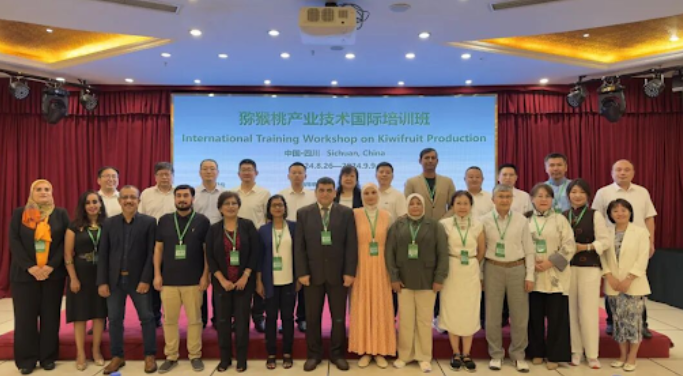
A 15-day international workshop on kiwifruit production concluded in Chengdu on August 31. The program brought together 14 agricultural experts from Pakistan, Egypt, Nepal, and Palestine.
The training focused on breeding, cultivation, orchard management, post-harvest handling, and marketing. It combined classroom lectures with field visits, practical sessions, and academic exchanges.
The workshop took place in Chengdu and Deyang in Sichuan Province, as well as Guilin in Guangxi. The Sichuan Provincial Academy of Natural Resource Sciences and Guangxi Institute of Botany jointly organized the program.
Pakistan Highlights Kiwifruit Production Potential
Pakistani experts shared their experience with kiwifruit trials in several upland areas. These include Hazara, Mansehra, Abbottabad, Battagram, Swat, and Murree.
According to Dr. Mushtaq Hussain Soomro, trials by the Pakistan Agricultural Research Council and the National Tea and High Value Crops Research Institute began in 2014.
The trials recorded around 90% plant survival. These results indicate strong potential for expanding kiwifruit production in suitable parts of Pakistan.
Phytosanitary Rules Limit Expansion
However, Pakistan faces challenges in importing live kiwifruit germplasm. Plant quarantine rules require several measures before such material can enter the country.
These include an import permit, pest risk analysis, a phytosanitary certificate, and post-entry quarantine. Therefore, expanding production requires careful attention to plant health regulations.
China Could Support Pakistan’s Kiwifruit Sector
Pakistani experts identified several areas where China could provide practical assistance. Importantly, much of this support would not require the movement of live germplasm.
Potential areas include:
- Trellis, pruning, and pollination techniques
- Tissue-culture expertise
- Disease detection and laboratory capacity
- Sanitary and Phytosanitary (SPS) compliance
- Cold-chain and packhouse infrastructure
- Good Agricultural Practices (GAP)
- Export-oriented farming and post-harvest management
In addition, experts proposed training through the CPEC Joint Working Group on Agriculture.
Training Supports Agricultural Cooperation
The workshop also included experts from international research institutions. Participants exchanged knowledge with specialists from China, the New Zealand Institute for Plant & Food Research, and the Wuhan Botanical Garden of the Chinese Academy of Sciences.
Such exchanges can help Pakistani agricultural experts adopt modern cultivation and post-harvest practices.
Third Edition of International Workshop
The Chengdu workshop marked the third edition of the international training program. Pakistani experts also participated in the 2025 edition.
Overall, the initiative highlights new opportunities for agricultural cooperation between Pakistan and China. With targeted technical support, Pakistan could further develop kiwifruit production in its suitable upland regions.
Read More Articles:
Pakistan’s Maritime Sector Enters New Phase