
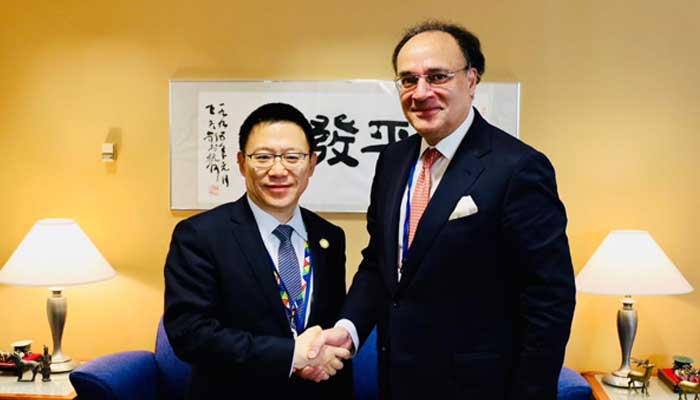
Finance Minister Muhammad Aurangzeb has sought China’s support for Pakistan’s membership in the New Development Bank (NDB), a multilateral financial institution founded by BRICS nations to fund sustainable development and infrastructure projects.
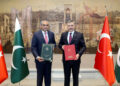
The request was made during a meeting with Chinese Deputy Finance Minister Liao Min in Washington, D.C., held on the sidelines of the IMF and World Bank Annual Meetings.
China-Pakistan Economic Cooperation Discussed
Aurangzeb welcomed the growing participation of Chinese companies in Pakistan’s agriculture, industry, minerals, and ICT sectors, reaffirming Islamabad’s commitment to strengthening bilateral economic cooperation under the evolving global framework.
He also briefed Liao Min on Pakistan’s recent staff-level agreement with the IMF, terming it an “external validation” of the government’s ongoing economic reform agenda. The minister expressed gratitude to the IMF Executive Director’s Office for its continued support during recent board deliberations.
Pakistan Eyes Panda Bond and NDB Membership
The finance minister discussed developments related to the upcoming Panda Bond issuance in the Chinese market, highlighting it as part of Pakistan’s strategy to diversify funding sources. He also extended an invitation to the Chinese Deputy Finance Minister to visit Pakistan at a mutually convenient time.
The NDB, established by Brazil, Russia, India, China, and South Africa (BRICS), provides financial assistance for development projects in emerging economies. In February, Pakistan’s Economic Coordination Committee (ECC) approved the purchase of 5,882 capital shares worth $582 million, with $116 million as paid-in capital, marking a major step toward securing membership.
Aurangzeb Meets U.S. Congressman to Strengthen Ties
Separately, Aurangzeb met U.S. Congressman French Hill, Chairman of the House Financial Services Committee, to explore avenues for enhancing Pakistan-U.S. economic cooperation. Discussions focused on the digitisation of financial services, new economy development, mineral sector collaboration, and innovation-driven IT partnerships.
Both sides reaffirmed their commitment to expanding bilateral engagement and promoting sustainable economic growth through stronger financial and technological cooperation.
Meetings with Japan, Bangladesh, and Saudi Arabia
During his six-day visit to Washington, Aurangzeb also met Saudi Finance Minister Mohammed Al-Jadaan, Japan Bank for International Cooperation (JBIC) Governor Nobumitsu Hayashi, and Bangladesh’s Special Envoy Lutfey Y. Siddiqi.
He welcomed JBIC’s participation in the Reko Diq financing group and assured continued government support for investor confidence. With Bangladesh, he emphasised regional economic integration, while with Saudi Arabia, discussions centred on the privatisation of PIA and airport operations.
Aurangzeb also addressed scholars and economists at the Atlantic Council, highlighting Pakistan’s reform agenda, fiscal discipline, and private sector-led growth strategy.
Related stories: