
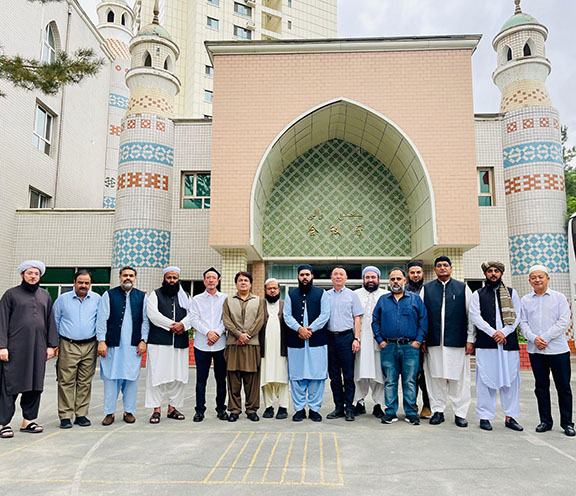
A 12-member Pakistani delegation led by Advisor to the Chief Minister of Khyber Pakhtunkhwa on Information, Barrister Dr. Muhammad Ali Saif, arrived in Beijing after completing official visits to Urumqi and Kashgar. The delegation included respected religious scholars, political leaders, and academics and was warmly welcomed by China’s Ministry of Foreign Affairs.
Focus on Islamic Engagement and Bilateral Understanding
During their stay in the Chinese capital, the delegation visited the country’s first official mosque and held an extensive meeting with the leadership of the Islamic Association of China, including both the Chairman and Vice Chairman. The Chinese side provided a detailed briefing on Islamic practices and institutions in the country.
According to Chinese officials, China is home to approximately 35,000 mosques, 55,000 imams, and more than a dozen operational Islamic centres. Beijing alone hosts 72 mosques, reflecting the diverse religious fabric of the capital. The Islamic Association of China also runs eight subdivisions across the nation and holds national-level religious competitions regularly.
The briefing further emphasised the availability of Qur’an and Hadith translations in the Chinese language. It was also shared that 10,000 Chinese Muslims performed Hajj this year, and many students are enrolled in religious studies at Al-Azhar University in Egypt.
Religious Diplomacy and Academic Exchange
Barrister Saif described the delegation’s engagements in Urumqi, Kashgar, and Beijing as “highly productive” and reaffirmed Pakistan’s commitment to deepening interfaith dialogue and educational cooperation with China.
The Pakistani delegates extended invitations to Chinese Islamic leaders to visit Pakistan, offering free religious education, accommodation, and necessary facilities for Chinese students in Pakistani seminaries. This gesture aimed to foster stronger bilateral religious and academic ties.
Prominent Delegates and Institutional Cooperation
Delegation members included well-known figures such as Mufti Zubair Ashraf Usmani (Darul Uloom Karachi), Maulana Abdul Qudoos Muhammadi (Wifaq-ul-Madaris), Mufti Anwar Shah (Jamia Ahsanul Uloom, Karachi), and Maulana Muhammad Ahmad (Darul Uloom Haqqania), among others.
The efforts of Israr Madani and the International Research Council for Religious Affairs (IRCRA) were acknowledged for helping facilitate the visit.
Officials Applaud Bilateral Efforts
Khyber Pakhtunkhwa’s Minister for Religious Affairs, Sahibzada Adnan Qadri, and Minister for Social Welfare, Syed Qasim Ali Shah, lauded the delegation’s visit as a vital initiative to promote religious harmony and cultural exchange. Syed Usama Ajmal, Chairman of the Pakistan Peace Council, and Syed Shah Faisal also expressed gratitude to the Chinese authorities and the Islamic Association.
Dr. Zia-ul-Haq presented the Chinese delegation with the “Paigham-e-Pakistan” document, reinforcing Pakistan’s national narrative of peace, tolerance, and unity.
Cultural Exchange and Symbolic Conclusion
In addition to formal meetings, the Chinese hosts arranged cultural visits for the delegation, including tours of the Great Wall of China, the Forbidden City, and other iconic landmarks. The visit concluded with a ceremonial exchange of souvenirs, symbolising the commitment of both nations to deepen religious, educational, and cultural cooperation.
Related Posts
Gwadar delegation visits Zhengzhou for agricultural cooperation