


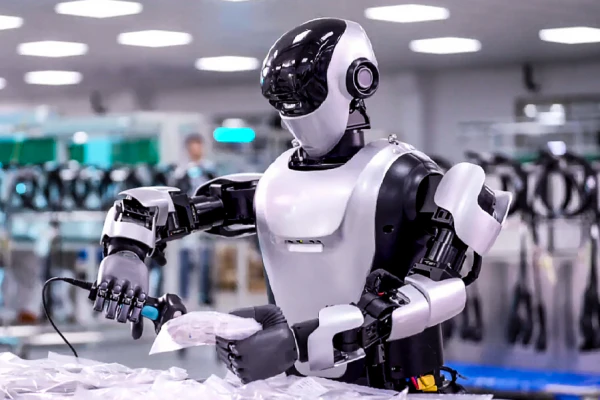
Sichuan province has launched an advanced AI robot training ground to fast-track the development of embodied artificial intelligence in China, amid growing tech boom and the Chinese government’s push to establish regional innovation hubs.
Officially inaugurated on July 18 in Mianyang, the project is part of Sichuan’s broader strategy to build a world-class robotics cluster in Western China. According to an official from the provincial science and technology department, the facility will serve as a comprehensive platform for R&D, real-world testing, and commercialisation of AI-driven robots.
Propelled by advancements in artificial intelligence and large language models, China’s robotics sector is rapidly transitioning from lab-based experimentation to large-scale production and application. Industry forecasts by the Chinese Institute of Electronics estimate the country’s humanoid robot market will reach 870 billion yuan (approximately $121.74 billion) by 2030.
The new facility aims to address key global challenges in embodied AI, such as the lack of real-world training environments, limited access to high-quality data, and inadequate testing under extreme conditions.
“This facility functions essentially as a ‘school’ for robots,” the official noted.
By creating immersive, simulated environments for robots to interact, learn, and collect data, the training ground is expected to accelerate advancements in robotic intelligence, algorithm refinement, and real-world deployment, particularly in sectors like manufacturing, healthcare, emergency response, tourism, and urban governance.
The initiative will operate through a central innovation centre focused on core technologies, system integration, and pilot manufacturing, supported by two scenario-based training zones. These zones will simulate diverse operational environments to gather data and test real-world capabilities.
The provincial government has earmarked a special fund for the project’s infrastructure and operational development. By the end of 2025, the goal is to attract at least seven robotics enterprises to the site. By 2027, the province aims to host over 30 companies, commercialise 30+ new technologies, and launch more than 10 new AI-powered robotic products, positioning the training ground as a national leader in robotics innovation.
Related Posts