


Pakistani Scientist in China Advances UVC Detection Technology Towards Industrialisation
A Pakistani scientist working in China is helping advance ultraviolet detection technology towards industrial production, highlighting how international research networks can connect scientific innovation with manufacturing. The work also offers a useful perspective on the technology and human-capital ambitions associated with CPEC 2.0, although the project itself is not a CPEC initiative.
Dr Ali Imran, Director of Research and Development at China’s National Nanotech Innovation Center in Guangzhou, has contributed to the development of solar-blind photodetector technology using an 180-nanometre, six-inch wafer semiconductor-processing platform. The project has progressed through device design, materials integration, semiconductor processing, wafer-scale fabrication, testing, packaging and intellectual-property development, according to Pakistan’s Associated Press of Pakistan (APP) on 27 September 2026.
The significance lies in the effort to bridge the gap between a promising scientific concept and a technology that can be manufactured. However, the reported progress towards industrialisation should not be confused with evidence of mass production or established commercial sales.
What Is Solar-Blind UVC Detection Technology?
Ultraviolet-C, or UVC, radiation occupies a short-wavelength part of the ultraviolet spectrum. Solar-blind detectors are designed to identify radiation within a spectral range where natural sunlight produces relatively little interference. This selectivity can help sensors detect ultraviolet signals against a complex background.
A separate APP report published on 28 September described research involving bulk lithium niobate crystals and a carefully designed arrangement of interdigitated electrodes. These alternating, finger-like structures help collect photo-generated charge carriers when UVC radiation interacts with the material. The research team is exploring whether this approach can offer a more cost-effective route to developing solar-blind UVC sensing devices.
Potential applications include flame detection, environmental monitoring and industrial safety. Such systems can be useful where precise ultraviolet measurements help monitor conditions or identify specific signals.
These applications remain potential uses rather than proof that the reported device is already deployed commercially. Further testing, manufacturing development and performance validation will determine how effectively the technology can be scaled.
Why the 180nm, Six-Inch Wafer Platform Matters
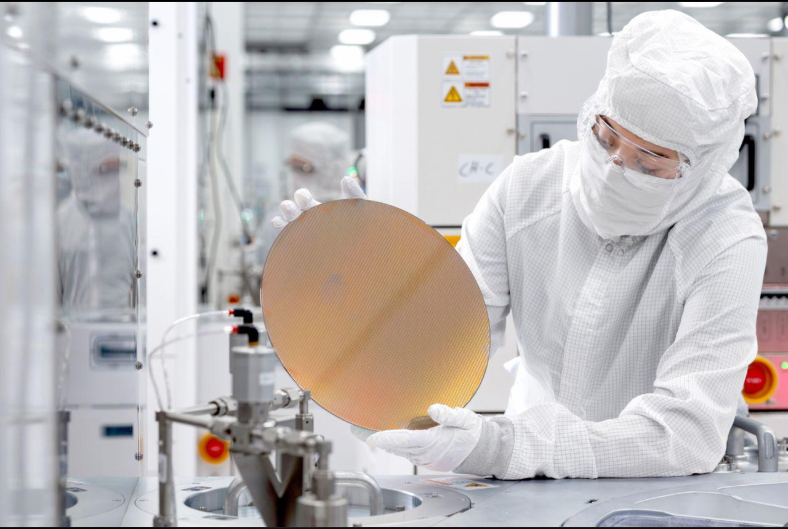
The project’s use of an 180nm, six-inch wafer semiconductor-processing platform is important because it places the development within a manufacturing-oriented environment. A wafer is a thin slice of semiconductor material on which multiple electronic devices can be fabricated. Processing devices across a wafer can help researchers develop repeatable methods that are more suitable for production than isolated laboratory experiments.
The 180-nanometre designation refers to a semiconductor process node. It does not, by itself, establish a detector’s performance, manufacturing yield or commercial readiness. The significance of the platform is that the work involves fabrication and device-processing stages rather than remaining solely at the conceptual research stage.
According to APP’s September report, the development pathway includes testing, packaging and intellectual-property work alongside fabrication. Each stage addresses a different challenge. A device must function reliably, be packaged for its intended environment and have a manufacturing process that can be repeated before commercial production becomes realistic.
This is a difficult transition for emerging technologies. A promising material or laboratory demonstration does not automatically become an affordable, reliable product. Manufacturing consistency, production costs, performance under real-world conditions and customer demand all influence whether a technology can succeed beyond research facilities.
Who Is the Pakistani Scientist Advancing UVC Research?
A Pakistani scientist in China, Dr Ali Imran serves as Director of Research and Development at the National Nanotech Innovation Center in Guangzhou, where the reported photodetector work has been undertaken.
The centre is part of China’s effort to move research in nanomaterials and nanodevices towards industrial applications. Its focus on technology development provides a setting in which researchers can work across scientific design, device fabrication and manufacturing-oriented processes.
For Pakistan, the project also draws attention to the contributions of researchers working within international scientific institutions. Overseas research experience can connect Pakistani scientists with advanced equipment, specialised teams and industrial development processes that may be difficult to access in less-equipped environments.
The wider opportunity is not simply to celebrate an individual achievement. It is to understand how such expertise might support research partnerships, technical training and knowledge exchange involving Pakistani universities, laboratories and businesses.
That outcome, however, requires deliberate collaboration. A scientist’s work abroad does not automatically translate into technology transfer or new industrial capacity at home. Partnerships need institutions, funding, suitable facilities and commercial incentives if research expertise is to generate wider benefits.
What Does This Mean for CPEC 2.0?
The photodetector project is not identified as a CPEC project. Its relevance is instead connected to the broader direction of Pakistan-China cooperation under CPEC 2.0, which increasingly includes technology, innovation, human-resource development and industrial collaboration alongside infrastructure and investment.
On 12 August 2026, the CPEC Secretariat reported that Pakistan and China had agreed to expand cooperation into knowledge, innovation, human resources and institutional development. The Secretariat’s 7 October progress review also highlighted research and innovation, including cooperation through joint research laboratories in applied sciences, disaster management and artificial intelligence.
These priorities create a policy context in which technology partnerships could become more important. Yet announcements about cooperation are only a starting point. Their value will depend on whether they lead to practical outcomes, including joint research, specialist training, intellectual-property development and stronger links between laboratories and industry.
For Pakistan, the challenge is to build pathways through which research can become productive economic activity. That means supporting scientists, strengthening university-industry relationships and helping businesses access the technical expertise needed to develop new products.
How Can Pakistani Scientists in China Support Industrial Innovation?
Pakistan’s technology ambitions will require more than scientific publications or isolated breakthroughs. They will depend on the ability to convert research into reliable products, intellectual property, skilled employment and commercially viable manufacturing.
Dr Ali Imran’s work in Guangzhou illustrates one part of that process: the attempt to move a specialised sensing technology through design, fabrication and manufacturing-oriented development. Whether the technology eventually achieves commercial success remains an open question, and the available reporting does not establish that it has entered mass production.
For CPEC 2.0, the broader lesson is that technology cooperation should be measured by what it enables people and institutions to do. Research partnerships can create value when they strengthen technical skills, support repeatable manufacturing processes and connect scientific work to genuine market needs.
Pakistan-China cooperation already has a substantial infrastructure and investment dimension. Expanding its contribution to knowledge and industrial capability will require sustained institutional support and practical implementation. The next milestone to watch is whether research pathways such as this one lead to validated devices, commercial partnerships or further collaboration with Pakistani institutions.
The long-term opportunity is not simply to develop new technology abroad. It is to build the skills, partnerships and industrial capacity that allow scientific knowledge to generate lasting economic value. The experience of a Pakistani scientist in China also highlights the importance of connecting research expertise with industrial partnerships and opportunities for knowledge exchange.